A visual guide to facial outlines
Face Shape Chart:
Compare 8 Shapes
Look at length, width and jaw outline—not just one feature. Use these simple diagrams to explore your closest shape matches.
01 / The chart
Eight outlines. More than one possible match.
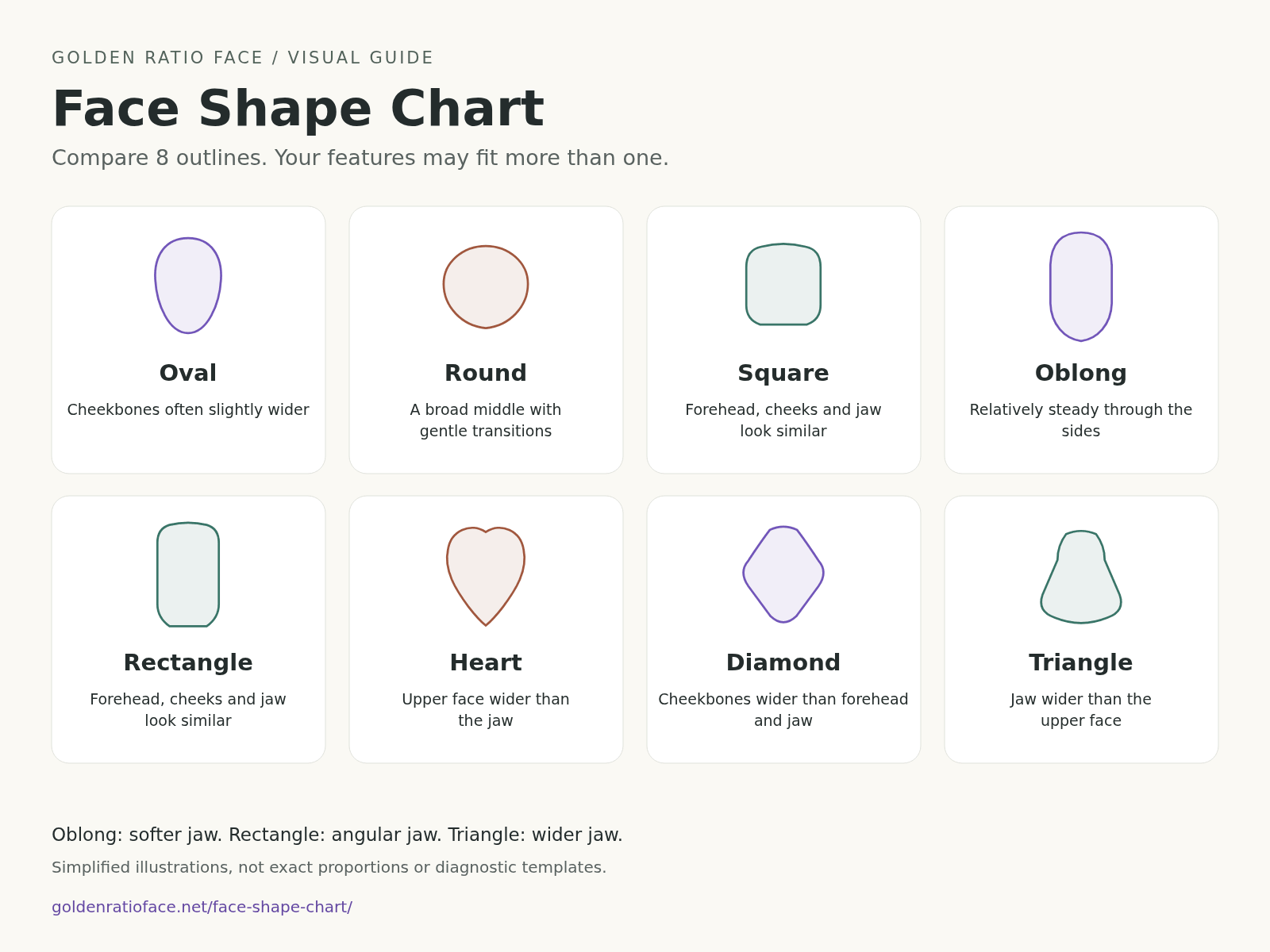
A face shape chart compares the overall outline of your face. This chart uses oval, round, square, oblong, rectangle, heart, diamond and triangle. Compare how long your face looks, which area is widest, and how the jaw narrows. Your features may fit more than one description.
Oval
A soft outline that gradually narrows toward the chin.
Oval guideRound
A shorter-looking outline with curved sides and chin.
Round guideSquare
A relatively compact outline with straighter sides.
Square guideOblong
A long outline with less angular jaw corners than rectangle in this chart.
Oblong guideRectangle
A longer outline with straighter sides and an angular lower face.
Rectangle guideHeart
A wider upper outline that tapers toward the lower face.
Heart guideDiamond
The middle of the face stands out, with narrower upper and lower sections.
Diamond guideTriangle
The lower face appears wider than the forehead.
Triangle guideSimplified illustrations—not exact proportions or diagnostic templates.
| Shape | Length | Relative widths | Jaw outline |
|---|---|---|---|
| Oval | Moderately longer than wide | Cheekbones often slightly wider | Rounded, with a gentle taper |
| Round | Relatively similar length and width | A broad middle with gentle transitions | Rounded, without prominent corners |
| Square | Relatively similar length and width | Forehead, cheeks and jaw look similar | Clearly defined jaw corners |
| Oblong | Noticeably longer than wide | Relatively steady through the sides | Softer, rounded lower outline |
| Rectangle | Noticeably longer than wide | Forehead, cheeks and jaw look similar | Clearly defined jaw corners |
| Heart | Can vary | Upper face wider than the jaw | Narrows toward a smaller chin |
| Diamond | Often longer than wide | Cheekbones wider than forehead and jaw | Tapers below the cheekbones |
| Triangle | Can vary | Jaw wider than the upper face | A broad lower outline |
Why eight? This site separates a long, softer-jawed oblong outline from a long, more angular rectangle. Some guides combine them. Here, triangle means a wider jaw; a forehead-wide inverted triangle belongs to a different pattern. The labels are styling categories, not a universal anatomical classification.
02 / A simple starting point
How to use a face shape chart
Get a clear view of your outline
Use a mirror or a front-facing photo. Keep your head level, your expression relaxed and your hair away from the sides of your face where possible. A beard or covered hairline can make the outline harder to judge.
Look at length, then relative widths
Does your face look relatively compact, moderately long or noticeably long? Then compare the forehead, cheekbones and jaw. Look for an overall pattern rather than trying to make every line match a drawing.
Compare the jaw and your closest two shapes
Notice whether the lower outline is rounded, angular or strongly tapered. If two descriptions fit, keep both as useful starting points. You do not need to force a single label.
For a clearer reference photo, use our face shape photo guide.
03 / See the difference
Compare two face shapes
Choose two outlines to see their main differences. This compares the chart’s descriptions; it does not analyze or classify your face.
Oval and oblong
Both can have a softer jaw. Oblong looks more elongated and has relatively steadier side widths; oval has a more gradual taper.
Oval vs oblong
Both can have a softer jaw. In this chart, oblong looks more elongated and has relatively steadier side widths; oval has a more gradual taper. A single length-to-width number does not settle every case. Explore oval vs oblong.
Oblong vs rectangle
Both describe longer outlines. We use oblong for a softer lower outline and rectangle for clearer jaw corners. Other guides may use “oblong” and “rectangular” as synonyms, so compare the description as well as the name.
Round vs square
Both can look relatively compact. A round outline has softer transitions around the jaw; a square outline has clearer corners. Cheek fullness on its own does not distinguish the two.
Heart vs diamond
Both may taper toward the chin. Compare the upper face with the cheekbones: heart has a wider upper outline relative to its jaw; diamond is most noticeably wide at the cheeks, with narrower areas above and below.
Triangle vs inverted triangle
Here, triangle means a jaw wider than the upper face. Inverted triangle means the opposite: a wider upper face tapering toward the chin. It overlaps with what many guides call heart. A widow’s peak is not needed for that overall outline.
04 / Measurements in context
Do face shape measurements help?
Measurements can help you compare proportions, especially when two outlines look similar. Common reference areas are face length, forehead width, cheekbone width and jaw width. Follow one method throughout: a straight width and a tape wrapped around a curve measure different distances.
A length-to-width ratio is a clue, not a complete classification. It does not describe every jaw curve or tell you where your face is widest. This chart deliberately avoids presenting exact ratio cutoffs as biological rules.
The measurement-based face shape calculator is an optional route. Use its placement instructions, and treat its result as a comparison rather than a certainty.
Why can a photo result change?
- Angle and distance: a tilted head or close camera view can change visible proportions.
- Expression and visibility: smiling, hair and facial hair can affect the outline the tool sees.
- Measurement choices: tools may use different landmarks or estimate a hidden hairline differently.
- Different definitions: two services may group the same features under different names.
Our detector uses estimated photo landmarks and custom comparison rules. Its match scores are not accuracy percentages. See the detector’s method explanation for the current implementation.
05 / Make the chart useful
Use your shape as a starting point for style
A label should help you explore options, not limit them. Hair texture, frame fit, comfort and your preferences also matter. Decide whether you want to highlight a feature, add contrast or simply try something you like.
06 / Common questions
Face shape chart questions
What are the eight face shapes?
This guide uses oval, round, square, oblong, rectangle, heart, diamond and triangle. It separates oblong and rectangle by the softer or more angular jaw outline. Eight is this site’s chosen grouping, not a universally required number.
Is there a different face shape chart for men and women?
You can use the same outline descriptions regardless of gender. This does not mean everyone has the same anatomy. Styling choices depend on the individual’s features, hair, preferences and practical needs.
Can I have two face shapes?
Your visible features can fit more than one category. For example, you might have an elongated outline with a jaw that looks between rounded and angular. Compare both relevant guides instead of treating the label as a pass-or-fail test.
Why do some charts show six or seven shapes?
Guides simplify and name the patterns differently. Some combine oblong and rectangle, leave out a category or use inverted triangle alongside heart. Compare what a label describes before assuming the charts disagree about your features.
Are oblong and rectangle the same face shape?
Sometimes those words are used interchangeably. In our chart, both are longer outlines; oblong has a softer jaw and rectangle has more defined corners. This distinction explains our labels rather than establishing a universal naming rule.
What is the rarest or most attractive face shape?
This chart cannot establish how common a shape is across populations or rank attractiveness. Its categories and illustrations are intended for comparison and styling. No shape is a score of your beauty or worth.
Is a face shape detector more accurate than a chart?
A detector can estimate photo landmarks and apply its rules consistently, while a chart lets you inspect the descriptions yourself. Neither provides a definitive anatomical classification. Reliability depends on the photo, the measurements and the method; this guide does not claim a validated accuracy percentage for either approach.
Can I download this face shape chart?
Yes. Use the download button below the eight illustrated cards to save a PNG for personal reference. It contains the chart’s simplified outlines and labels, not your photo or an individualized result.
Method, sources and corrections
These diagrams are original, simplified illustrations of this site’s eight-shape terminology. They are not scans, exact measurement templates or a medical assessment. The descriptions distinguish relative length, widths and jaw outline without claiming a universal formula.
- Warby Parker: glasses and face shape — an eyewear example showing that category names vary and that fit and personal preference matter. Its individual ratio or prevalence claims are not adopted here.
- Google MediaPipe: face landmark detection for the web — documentation for landmark estimation, not validation of our custom shape categories.
- Golden Ratio Face detector — current tool behavior, method disclosure and limitations.
14 thoughts on “Face Shape Chart: Compare 8 Shapes with Clear Diagrams”