Glasses for Your Face Shape: Style Chart & Fit Guide
Choose a look you like, understand frame sizes, and avoid buying a pair that feels wrong. Start with fit, then use the eight-shape chart for ideas.
What glasses suit your face shape?
Use face shape to choose styles to try, not to decide your frame size. Compare the look you prefer, then check how the frame rests on your nose and sides, how it behaves when you move, and whether it works with your lenses.
The goal is a pair you enjoy wearing without constant adjustment. A photo filter can help you imagine a style; it cannot confirm a comfortable bridge or the correct prescription-lens fitting. If your current pair already feels good, bring it along as a useful reference.
A simple order for choosing glasses
- Start with use. Everyday prescription wear, reading, outdoor wear and a fashion accessory can have different requirements. Tell the optician what you need.
- Find a comfortable starting frame. Eliminate obvious pressure or slipping before comparing every colour.
- Try two visual directions. Compare curved and angular rims, or subtle and bold rims, in a similar fit.
- Check the lenses. Ask the provider to confirm the prescription, measurements and lens design for that frame.
- Check the practical details. Ask about adjustment support, total cost and current return terms before ordering.
You do not need to identify one perfect face-shape category first. If you are between two, use both rows in the chart and let the actual frame comparison help you decide.
Glasses ideas for all eight face shapes
| Face outline | Description | Two directions to compare |
|---|---|---|
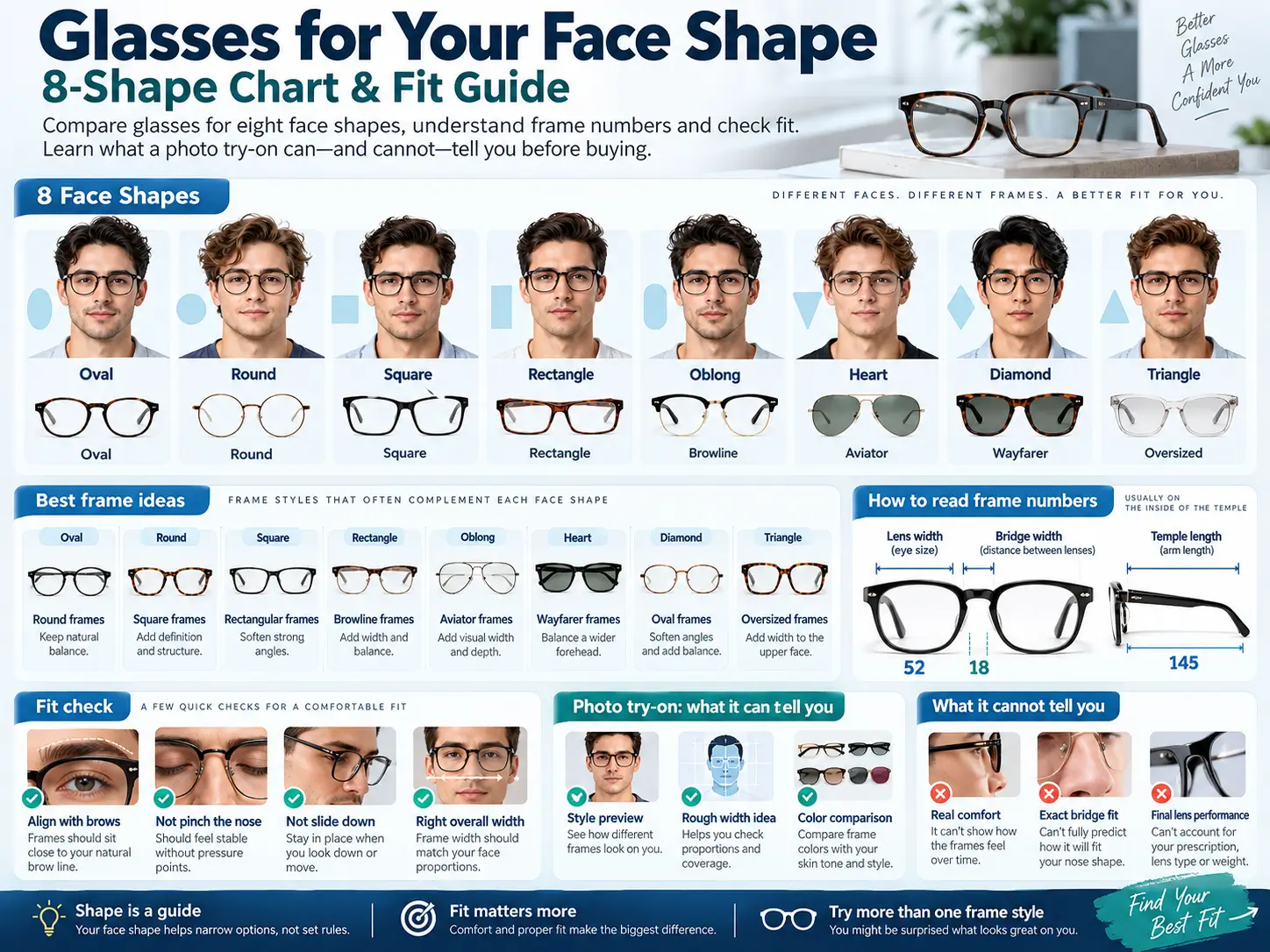
| Oval | Soft taper; moderately longer than wide | Compare a rounded rectangle with a curved frame. Choose scale and rim weight by preference. |
| Round | Relatively compact, curved outline | Angular rims create contrast; round rims repeat curves. Neither is compulsory. |
| Square | Compact outline with clearer jaw corners | Try curved edges for contrast or squared rims for a more geometric look. |
| Oblong | Noticeably long, softer outline | Compare deeper and shallower lens shapes in a comfortable width. |
| Rectangle | Long outline with noticeable jaw corners | Compare a curved frame with a softer rectangle; assess both depth and rim weight. |
| Heart | Broader upper face, narrower lower face | Try a light rim and a stronger upper rim to see which emphasis you prefer. |
| Diamond | Cheekbones stand out beyond a narrower upper/lower outline | Compare a curved lens outline and a browline; check actual cheek clearance. |
| Triangle | Lower face wider relative to the upper face | Compare a more prominent top rim with a lighter even rim; decide how bold you want the look. |
If you want an outline estimate, use the automatic face shape detector or the illustrated shape chart. Neither measures your frame size, pupillary distance or bridge fit.
Read the numbers inside your frames
Many frames show three numbers such as 51 □ 19 – 145. They usually describe lens width, bridge width and temple length, in millimetres. Specsavers’ frame-size guide explains these dimensions.
| Marking | Meaning | What it cannot tell you |
|---|---|---|
| 51 | Horizontal width of one lens | The total outside width of the frame. |
| 19 | Bridge measurement between the lenses | The full contour of the support that rests on your nose. |
| 145 | Length of the temple arm | Where that arm will bend around your particular ear. |
These numbers narrow the search; they do not prove fit. Two frames with similar measurements can have different rims, bridge contours and front curves. Do not assume that twice the lens width plus the bridge equals the exact outside frame width.
Check the complete product diagram where available. Warby Parker’s measurement guide describes additional dimensions. In India, Lenskart’s frame guide is another reference for frame parts and sizing terms; use the exact product’s data rather than transferring a retailer’s Small/Medium/Large label between brands.
Check comfort before committing
The frame should rest steadily without needing an uncomfortable squeeze to hold it in place. Check the nose, the sides of the head and behind the ears. Smile and talk: note whether the cheeks move the frame. Look down normally and see whether it repeatedly slips.
If one area feels wrong, describe that area to the optician rather than only saying “too big.” Warby Parker’s fitting guide covers these contact points. A small adjustment may help, but a different design may be necessary.
Recurring cheek contact or low positioning may be worth comparing with low bridge fit designs. The frame’s bridge shape matters; nose-bridge height cannot be converted into one guaranteed millimetre size.
Frame shape is not an optical measurement
Pupillary distance, or PD, is the distance between pupil centres. Your lens provider uses appropriate measurements for lens positioning. A face-shape category and a selfie ratio cannot supply them.
Ask the optician or lens provider to confirm the measurements needed for your order, especially for progressive lenses. Do not move pupils to the geometric middle of a frame in a photo editor or estimate a prescription from a virtual try-on.
A large frame is not automatically unsuitable, and a small frame is not automatically suitable. The chosen lens design, prescription and fitting matter. If the finished glasses cause persistent discomfort or your vision seems wrong, have the provider check them; changing a face-shape label will not resolve that.
Change one style detail at a time
Outline
Compare curved with angular rims. This is about the line you see around the eyes, not a rule that one shape cancels another.
Visual weight
Compare fine metal or rimless styling with thicker acetate. A darker, thicker rim can become a focal point even in a modest size.
Colour
Compare a colour close to your usual clothes with a deliberate contrast. A frame can be expressive without being physically too large.
Depth
Compare taller and shallower lens outlines. Keep fit and lens requirements in the decision; there is no universal face-height fraction to follow.
A useful online-shopping check
- Record the exact model and size of a comfortable pair, plus what you would change about it.
- Ask the seller for missing dimensions or side photographs instead of guessing from a front image.
- Use virtual try-on to compare appearance, while treating pressure, balance and bridge contact as unverified.
- Check whether prescription lenses change the return conditions, and whether local adjustment is available.
- Compare the full price for the selected lenses and frame; a starting frame price may not be your order total.
Availability and policies vary by country and seller. This guide does not promise free measurements, free adjustments or a fixed return period.
Glasses and face-shape questions
Do glasses have to be opposite to my face shape?
No. Contrast and repetition create different looks. Neither is required; fit and your own preference come first.
Do all frames with the same numbers fit the same?
No. Rim thickness, bridge contour, pad placement and frame curve can differ even when the printed dimensions are similar.
Can a face shape detector tell my glasses size?
No. This site’s face-shape tools estimate an outline from a photo; they do not measure prescription-lens fitting or physical frame comfort.
Are oversized frames always wider than 145 mm?
No universal number defines oversized for every wearer. The effect depends on the frame design and the person wearing it.
How do I know if I need low bridge fit?
Compare how frames rest and move on your face. See the low bridge fit guide for questions to take to an optician, not a diagnosis from a photo.
Sources and scope
References: Warby Parker on fit, frame measurements, Specsavers sizing, and Lenskart’s frame guide. Retailer guidance informs the fit explanations; the style chart is our editorial comparison, not an endorsement, prescription or personalized fitting.
7 thoughts on “Glasses for Your Face Shape: Style Chart & Fit Guide”