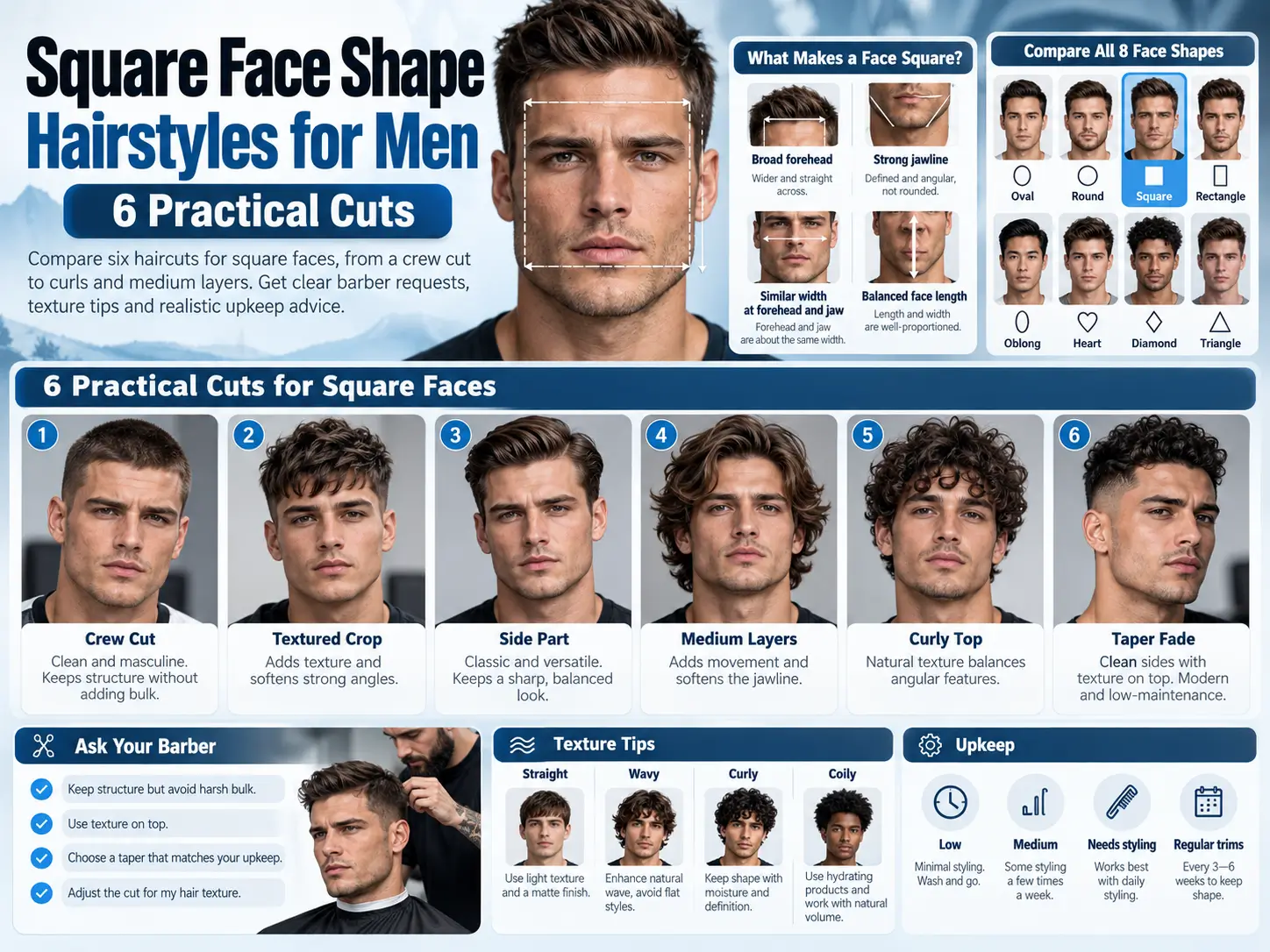
Square Face Shape Hairstyles for Men: 6 Cuts & Barber Tips
Show the angles or add movement. Compare six practical cuts, choose the details that suit your hair, and take a clear request to your barber.
Which haircuts are worth trying?
For a square face, start with a crew cut, textured crop, side sweep, curly taper, short quiff or medium layers. Choose whether you want a crisp outline or more movement, then adapt the cut to your texture, hairline and routine.
No face shape needs fixing. A square outline does not make you better suited to a buzz cut than everyone else, and a straight fringe is not automatically a mistake. The important question is whether you like the effect and can maintain it.
Choose the effect before the haircut name
| Your preference | Try discussing | Tradeoff |
|---|---|---|
| Show the jaw and hairline | A crew cut, buzz cut or brushed-back top | Less hair hides the outline; very sharp edges can need more touch-ups. |
| Add movement around the face | Waves, curls, a side sweep or broken fringe | The result depends on natural texture and how the fringe dries. |
| Keep mornings simple | A short cut that follows natural growth | Less styling does not mean no trims or no care. |
Six cuts and the words to ask for
1. Crew cut with a blended taper
A short top keeps the face visible without requiring a shaved side. A little extra length at the front lets you brush it up or across.
Ask your barber: “A crew cut with a blended taper. Leave the front a little longer, and follow my natural hairline.”
Check first: Discuss how short the sides should be. A skin finish is optional, and a forced sharp line-up may need frequent upkeep.
2. Textured crop with a broken fringe
A forward top and uneven fringe edge introduce smaller lines around the forehead. It can be neat without a stiff, straight fringe.
Ask your barber: “A textured crop, with a broken fringe and low taper. Keep enough top coverage that it does not separate into thin gaps.”
Check first: Check how the fringe sits dry. Fine hair may need less texturizing; thick hair needs controlled bulk rather than automatic heavy thinning.
3. Side part or side sweep
A diagonal direction adds movement while leaving the jaw visible. It works as a tidy office cut or a looser weekend style.
Ask your barber: “Keep a natural side part, enough front length to sweep, and a soft blend into the sides. No shaved part unless we agree first.”
Check first: Let the part follow the growth pattern. A stubborn cowlick may resist the exact direction shown in a reference photo.
4. Curly top with a low taper
Curls create a different outline from a very straight top. A low taper tidies the edges while preserving some side coverage.
Ask your barber: “Keep the curl shape through the top and upper sides. Taper the neckline and sideburns, and check the finished fringe when dry.”
Check first: Show your usual curl routine. Wet length is not the final dry length; how much the curls spring up varies.
5. Short quiff with controlled height
A modest raised front gives a lifted look. You can keep the silhouette broad or narrower by changing the upper-side coverage.
Ask your barber: “A short quiff, with enough front length for a little lift. Keep the upper sides blended rather than taking the fade very high.”
Check first: This needs more directional styling than a crew cut. If your face also looks long, compare a lower version before committing.
6. Medium layers or soft curtains
Longer hair gives more movement around the face. A curtain opening shows the middle of the forehead; a side sweep changes that effect.
Ask your barber: “Medium layers with movement, and a soft opening at the front. Keep the ends where they work with my texture, not at a fixed face-shape line.”
Check first: Ask how it looks without heat styling. A photo of a styled cut does not show the work needed on a normal morning.
Adjust for your real hair
Fine or lower-density hair
Ask the barber to preserve coverage where you need it. Taking out lots of weight to create “texture” can leave a see-through finish. Start with a small amount of styling product; add more only if needed. A matte finish is a preference, not a requirement for square faces.
Thick or straight hair
Explain whether you want a rounded or deliberately squared hair silhouette. The width above the ears matters as much as the length on top. Ask how bulk will be controlled while keeping the shape connected.
Wavy, curly or coily hair
Use a reference with a similar texture where possible. Discuss dry length, shrinkage and the amount of side volume you want. A taper, rounded shape or geometric top can all be intentional. Nationality does not determine the right cut: your actual hair does.
Beard, glasses and a changing hairline
A beard is optional. Short stubble leaves much of the jaw visible; a rounded beard edge changes the outline; a boxed beard repeats the angular look. Choose the finish you like instead of assuming a square face must soften or exaggerate the jaw.
Wear your glasses to the appointment. Ask the barber to check the sideburn transition around the frame arms. Our glasses fit and style guide separates frame appearance from comfort.
If your hairline has changed, show where you want coverage and where you are comfortable exposing it. A forward crop and a short buzz are both legitimate choices. Face shape cannot tell you why hair is thinning, and a haircut cannot diagnose or treat hair loss.
A simple barber brief
Bring one photo of the front and one showing the sides. Then say:
“I want a [crisp / relaxed] outline. I can spend [my real time] styling it. Keep [this much] forehead coverage and [this much] hair above the ears. Show me how short the shortest section will be before cutting.”
Agree on the top, fringe, side coverage, shortest side length and neckline separately. “Low fade” alone does not describe the whole haircut. Ask whether the cut can grow into a softer version you still like.
Make the routine match the promise
Before leaving, ask for a short demonstration using the amount of product you would use at home. Try the movement yourself. If the style only works after a long blow-dry and you want a quick morning, adjust the plan before the cut is finished.
Return when the fringe, side bulk or outline stops behaving the way you want. A square face does not need a universal two-week schedule. Very sharp fades and line-ups lose their fresh contrast sooner than softer blends, but tolerance and growth differ.
When using heat, keep it limited and use low or medium settings with heat protection. The American Academy of Dermatology’s hair-care guide explains gentler styling habits.
Not sure whether you are square or rectangle?
The square face guide and photo tool compares length, widths and jaw together. If your outline looks noticeably long as well as angular, read the rectangle haircut guide; extra top height may create a different effect than you expected.
Use the men’s hairstyle hub to compare options across shapes. You do not need a perfect label before asking for a comfortable haircut.
Common haircut questions
Does a buzz cut suit a square face?
It can. It exposes more of the face and needs little daily shaping, but it also exposes the hairline and scalp more. Choose length with the barber instead of using a face label to pick a clipper guard.
Should square-faced men avoid a straight fringe?
No. A straight fringe creates a clear horizontal edge. Keep it if you like that look; choose a broken or side-swept fringe if you want more movement.
Is a fade required?
No. A scissor blend or a taper can keep more coverage at the sides. Fade height and how short it becomes are separate decisions.
What is the easiest hairstyle to maintain?
Usually a short cut that follows your natural growth and needs little reshaping. The exact choice depends on texture, density and how often you want a trim.
Can the same advice work for Indian and American men?
The useful factors are hair texture, growth, density, dress needs and routine—not nationality. Use a familiar local haircut name, then explain the actual details.
Sources and editorial approach
These shortlists and barber briefs are our editorial suggestions. GQ’s interview with barber Matty Conrad provides a practitioner perspective on face-shape styling. Wahl’s crop-fade education shows a professional example of that cut. Neither validates a universal “best” haircut for square faces.