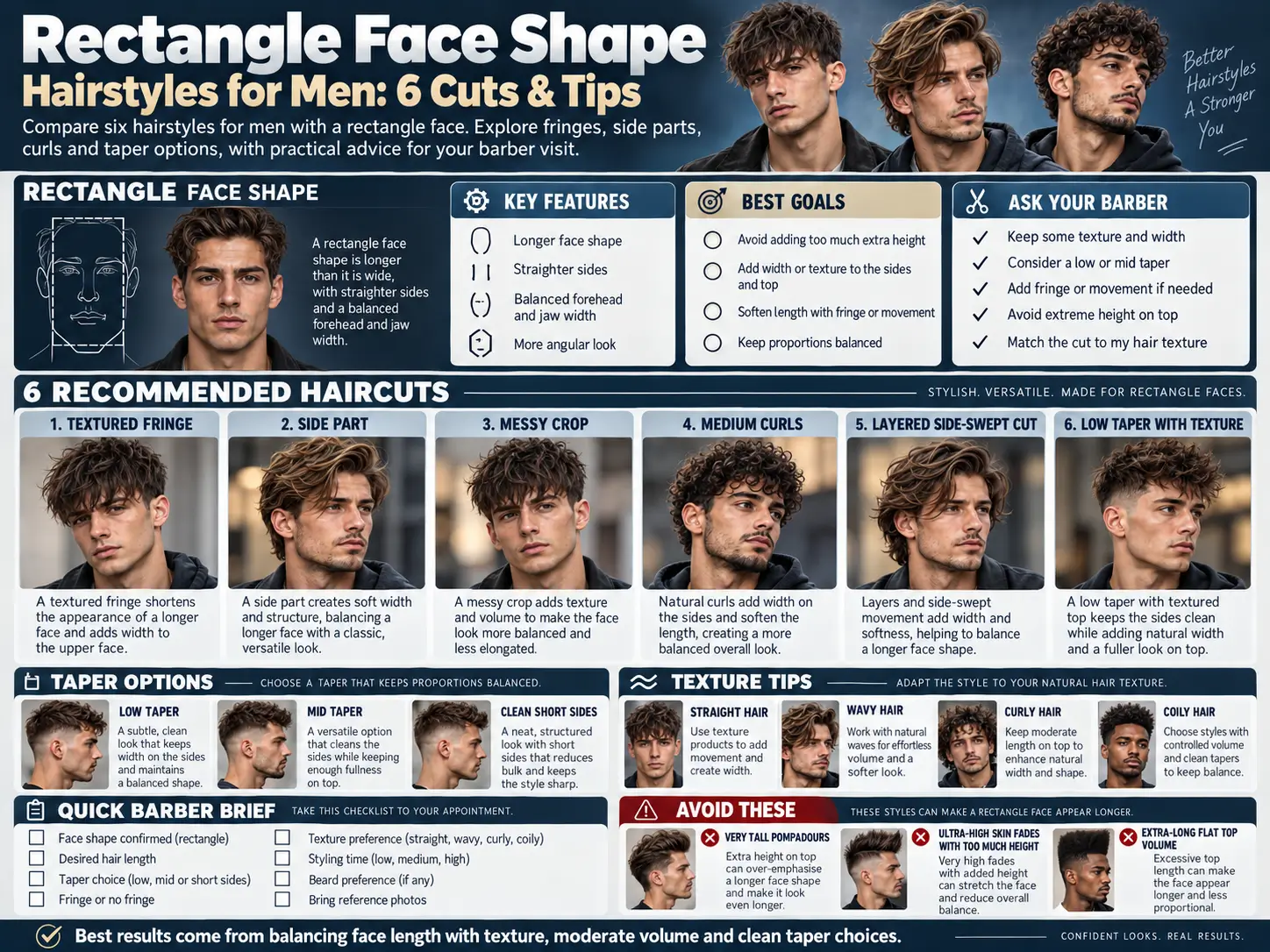
Men’s haircut guide · Rectangle
Rectangle Face Shape Hairstyles for Men
Keep a long, angular outline or soften it—it is your choice. Compare six cuts, forehead coverage and side lengths before your next barber visit.
What haircut suits a rectangular face?
A French crop, side-swept fringe, moderate side part or medium layered cut can be useful starting points. If you want less apparent length, keep top height controlled and discuss some side coverage. A fringe can cover part of the forehead; it does not change the face itself.
You can also choose a buzz cut, tall quiff or high fade because you like the look. Face shape helps describe possible effects, not decide which hairstyles you are allowed to wear. Match the finished outline to your hair texture and daily routine.
Rectangle vs square vs oblong
In this guide, rectangle means an elongated outline with a more angular jaw. Forehead, cheekbone and jaw widths may look relatively similar, but they do not need to match exactly. Square is a more compact angular outline; length is an important distinction.
We use oblong for a longer outline with softer contours. Other styling systems combine oblong and rectangle, so advice may overlap. These are broad styling categories, not medical diagnoses or universal ratio thresholds.
Six haircuts to discuss with your barber
Choose by the coverage and finish you prefer. A lower top, fuller sides and a fringe are separate adjustments—you do not need all three. Illustrations show simplified outlines, not exact haircut instructions or photo predictions.
Choose top height, side coverage and fringe separately
| Your preference | Discuss | Check before cutting |
|---|---|---|
| Less apparent height | A lower top or relaxed sideways styling | How it looks without a tall blow-dried finish |
| More side fullness | Retained side length or a softer taper | Exactly where the shortest area ends |
| Some forehead coverage | A forward or side-swept fringe | Its dry length and whether it blocks your view |
A low taper is not a complete haircut specification. Tell the barber what remains above it. A skin fade describes how close the shortest area is; a high fade describes placement. Both can be intentional choices, even if you do not want to follow the usual “add width” suggestion.
Your angular jaw is not a problem to solve
If you like its definition, choose a finish that shows it. If you prefer softer framing, try looser texture or a different beard outline. Neither approach is more correct. There is no rule that every rectangular face needs rounded edges.
Adapt the cut to your hair and routine
Fine hair, curls and a changing hairline
Fine strands do not automatically require clay or prohibit pomade. Product amount, hold and finish matter. Ask for a demonstration using your actual cut. With dense hair, avoid requesting aggressive thinning without discussing the fullness you want to keep.
Waves and curls vary in how they expand. A rounded, lower shape may suit your goal better than a tall one, but it is a preference. If your hairline is receding, decide whether you want coverage or exposure. A fringe only works as intended if your growth pattern and density can support it.
Beard length and appointments
A long chin section can add visible length below the face. If you want a shorter-looking overall outline, discuss a more compact beard instead. Straight edges may show the jaw; softer edges frame it differently. Clean-shaven is equally valid.
Choose appointment timing from how the cut behaves. You may need an edge cleanup, a fringe trim or a full reshape; these are not interchangeable. Ask what will happen as your side length grows rather than assuming the top always needs trimming first. See the beard guide for more on the separate facial-hair decision.
Your barber brief
“I like this side-swept crop. I want moderate top height, some side coverage and a fringe that stays out of my eyes. Please show me where the taper will stop and how this will sit when air-dried. I prefer a natural finish rather than a very tall styled top.”
Bring front and side reference photos with a texture similar to yours. Before cutting, agree on the fringe’s dry length, top shape, side coverage and neckline. Ask what styling is needed at home and what will change as the cut grows out.
For a reusable request based on your preferences, use the men’s haircut brief builder. It creates a conversation starter, not an AI prediction.
Common questions
What is the best short haircut for a rectangle face?
A French crop, short side-swept cut or crew cut can be starting points. Decide whether you want forehead coverage, then agree on top height and side contrast. There is no single best haircut for all rectangular faces.
Is rectangle the same as oblong?
The terms overlap in many guides. Here, both describe elongated outlines, with rectangle used for a more angular jaw and oblong for softer contours. You can borrow useful styling ideas from either without forcing a precise label.
Can I wear a high fade with a rectangle face?
Yes. It removes more side coverage and can create stronger contrast with the top. If you prefer more fullness at the sides, ask for a lower transition or scissor taper. Make the choice from the silhouette you want.
Are curtains or long hair suitable?
They can be. Curtains provide framing depending on where they fall, while longer hair may sit flat or create width at the sides. Discuss the front-piece length and layers rather than assuming all long hair has the same effect.
Should I grow a beard for this face shape?
Only if you want one. A beard can change apparent length and jaw width, but it is not necessary. Discuss chin length separately from fullness at the sides so the beard and haircut create the overall outline you prefer.
What is the difference between square and rectangle haircuts?
The styling options can overlap. Rectangle describes more visible face length, so someone wanting less apparent length may choose a lower top or fringe. A square-faced person may prefer extra lift, or may not; neither label creates a fixed haircut rule.
Sources and editorial approach
This article separates face length, jaw outline and haircut choices so the reader can describe a preferred result. CADMEN provides consultation background; the GQ fade interview helps distinguish fade variants. Our shortlist is editorial guidance, not a professional assessment or an attractiveness score. See the men’s hairstyle hub for other shapes, or the rectangle face shape overview for the category itself.
1 thought on “Rectangle Face Shape Hairstyles for Men: 6 Cuts & Tips”