Quick answer:
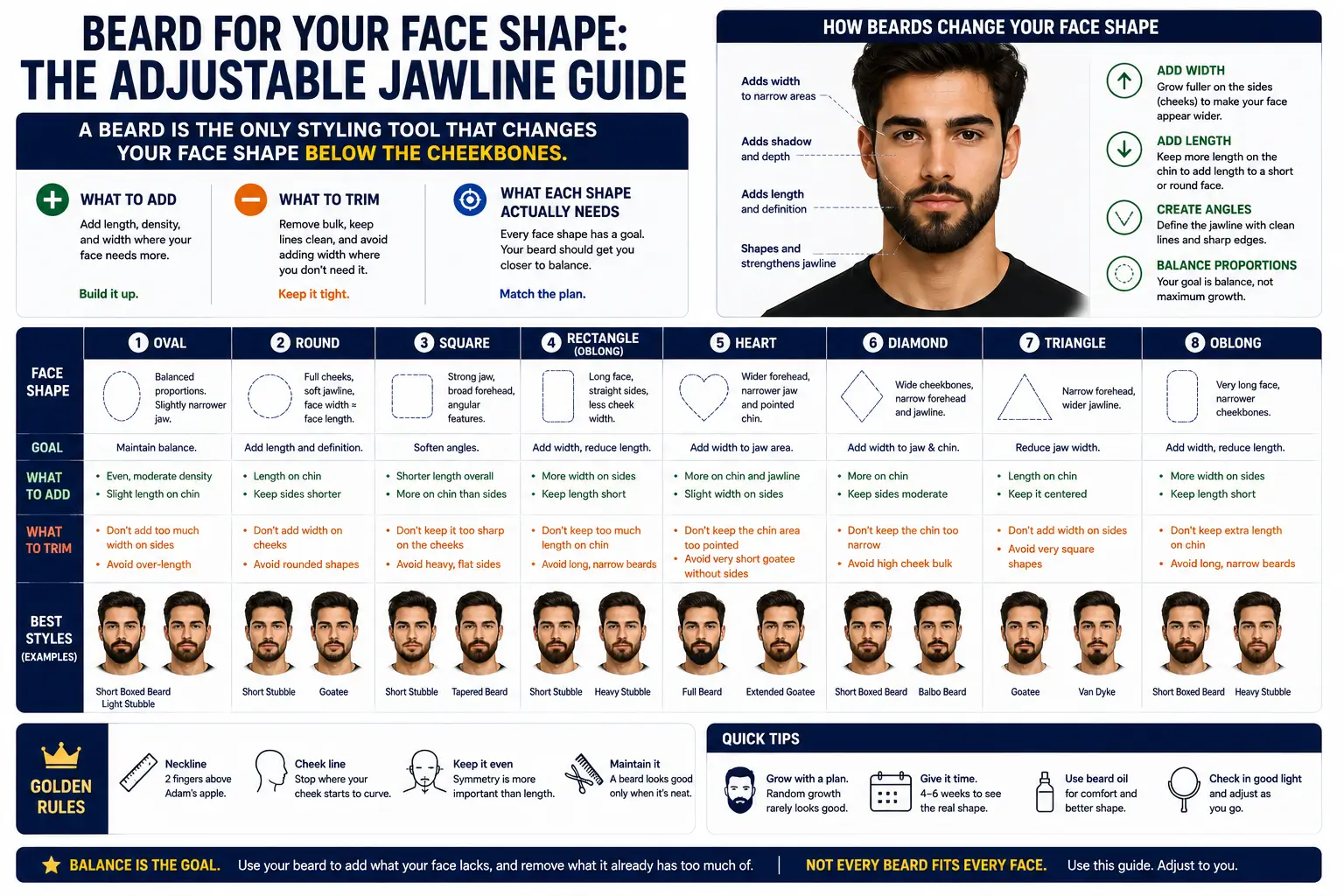
A beard is the most powerful face shaping tool most men have, because it is the only one that changes the bottom half of your face. Hair changes the top of the frame. A beard changes the jaw. The rule is short: grow width at the sides to widen a narrow or long face, grow length at the chin to lengthen a short one, and use edge sharpness to add or soften angles. Everything below is those three levers applied to each shape.
The three levers
Every beard decision is one of three moves. Learn the levers, and you can work out any style yourself.
| Lever | What it changes | Use when |
|---|---|---|
| Width at the sides | Makes the face wider at jaw level | Your face is long, or narrow at the jaw |
| Length at the chin | Makes the face longer | Your face is short and wide |
| Edge sharpness | Adds or softens angles | You want more structure, or less |
Almost every beard style is a combination of those three. A full beard with fuller sides is width. A goatee is chin length. A sharply lined boxed beard is edge sharpness plus width.
What each face shape needs
Find your shape, or use the face shape detector if you are not sure.
| Shape | The goal | Grow | Trim |
|---|---|---|---|
| Oblong | Add width, avoid length | Fuller sides, short boxed beard | Long goatees, chin length |
| Rectangle | Add width, soften corners | Fuller sides, rounded outline | Long chin growth, sharp boxed edges |
| Round | Add length and angles | Length at the chin, defined goatee | Full rounded beards, heavy cheek growth |
| Square | Your choice: soften or showcase | Rounded outline to soften, sharp lines to showcase | Nothing mandatory, this shape has options |
| Triangle | Keep the jaw contained | Short stubble, tight sides, fuller moustache | Full wide beards, mutton chops |
| Heart | Add width at the narrow jaw | Full beard, fuller at the jaw corners | Pointed goatees, thin chinstraps |
| Diamond | Square off a narrow jaw | Full beard wider at the jaw, boxed beard | Pointed goatee, chinstrap |
| Oval | Nothing needs correcting | Whatever you like, in proportion | Very long beards, which push toward oblong |
Notice the pattern. Long faces get width, short faces get length, narrow jaws get bulk, wide jaws get restraint. The shape names are just shorthand for those four situations.
Three practical things guides skip
- Measure your face shape with the beard flattened, or from an older photo. A beard covers the jawline, which is one of the three measurements that decides your shape. If you measure through a beard, you will get a reading of your beard, not your face. If you have a full beard, the manual entry route on the detector is more reliable, because you can feel the jaw corner with a finger even when a camera cannot see it.
- A receding hairline changes the answer. It lengthens the visible face, which pushes you toward the long shapes, and long shapes want width at the sides. If your hairline has moved, measure to where it originally sat, or your beard plan will be built on the wrong shape.
- Grow-out changes the effect. A beard shaped for width at week two has more length by week six, and length works in the opposite direction. If a style stopped working, it may not be the wrong style, just overdue. Trimming the length while keeping the sides full preserves the effect.
What a beard cannot do
Honest limits, because this topic attracts a lot of overclaiming.
- A beard changes the apparent shape, not the bone structure. That is the entire point of it, and it is genuinely effective, but no beard narrows a jaw. Width can be added. It cannot be subtracted.
- Growth pattern is genetic, and uneven is normal. Patchy cheeks or a thin connection between moustache and beard are extremely common, and they limit which styles are realistic for you more than face shape does. Work with what grows.
- Nothing you apply changes where hair grows. Products can condition, soften, and hold. Claims beyond that are worth reading carefully. If beard growth itself is a concern, that is a question for a doctor rather than a styling guide.
FAQs
What beard suits my face shape?
Long faces suit fuller sides and short beards, because width balances length. Short round faces suit length at the chin and defined edges. Narrow jaws, meaning heart and diamond shapes, suit a full beard grown wider at the jaw. Wide jaws, meaning triangle shapes, suit short contained stubble.
Does a beard change your face shape?
It changes the apparent shape, not the bone structure, and that is exactly why it works. A beard is the only styling tool that alters the bottom half of your face, so it can widen a narrow jaw or lengthen a short face. It cannot make a jaw narrower.
What is the best beard for a long face?
Fuller at the sides and short at the chin. Width at jaw level balances the length. Avoid long pointed goatees and anything that adds length below the chin, because both extend the face further.
Should I shave to measure my face shape?
You do not need to shave. Measure from a photo taken before you grew the beard, or use the manual measurement route and feel your jaw corner with a finger. Measuring through a full beard gives you the shape of the beard rather than the shape of your face.
Can a beard hide a weak jawline?
It can add visible width and structure at jaw level, which is the effect people usually mean. A full beard grown fuller at the jaw corners is the most effective version. It is adding definition rather than hiding anything, and the underlying structure is unchanged.
1 thought on “Beard for Your Face Shape”