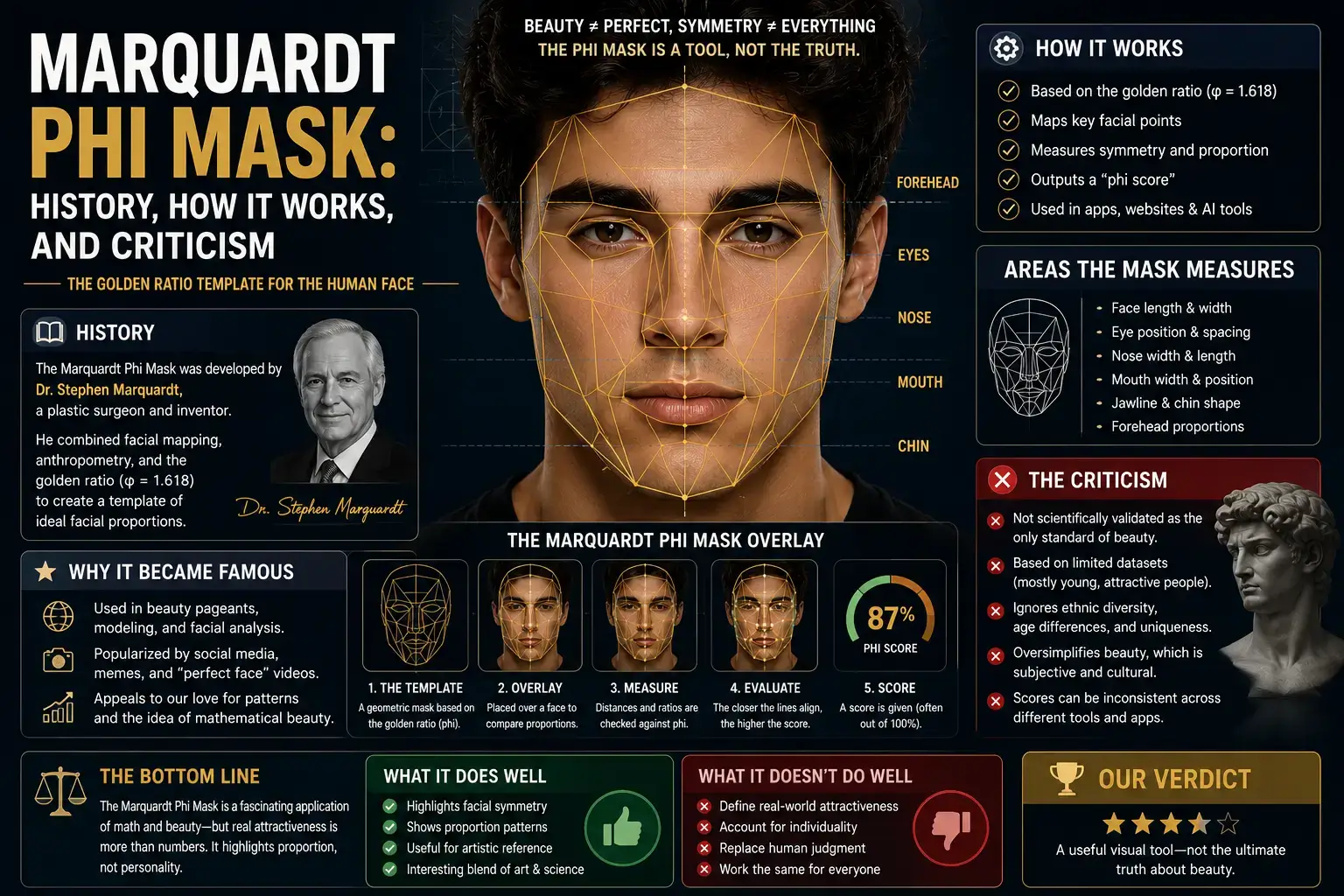
The Marquardt phi mask is the most famous attempt to turn the golden ratio into a complete face template. Created by American oral and maxillofacial surgeon Dr. Stephen Marquardt around 2002, the mask overlays a geometric grid built entirely from phi (1.618) onto a face photo. This guide covers where the mask came from, how it works, and the honest criticism it has received, so you can judge it fairly before trying a golden ratio face test yourself.
Who Created the Phi Mask?
Dr. Stephen Marquardt spent years reconstructing faces after injuries and defects. He needed a repeatable way to define what a “normal, harmonious” face looks like, because surgeons cannot rebuild toward a vague idea.
His answer was geometry. He built a mask from golden ratio shapes, mainly pentagons and decagons whose proportions all relate through 1.618. The claim: attractive faces across cultures fit this mask closely.
How the Phi Mask Works
The mask is a transparent overlay placed on a straight, front-facing photo. The process is simple.
- Scale the mask so its outer frame matches the face outline.
- Compare the landmarks. The mask has fixed positions for the eyes, brows, nose, lips, and chin.
- Read the fit. The closer the real features sit to the mask lines, the closer the face is to the phi ideal.
There are separate male and female versions, plus smiling and repose variants, because average male and female proportions differ. The underlying math all traces back to the golden ratio itself, which has a long documented history on the Wikipedia golden ratio page.
Why the Mask Became Famous
The phi mask spread fast for three reasons. It was visual, so anyone could hold it over a photo and “see” beauty math. It was used in media stories ranking celebrity faces, similar to the scores we cover in our celebrities with golden ratio faces article. And it gave cosmetic surgery a scientific-sounding planning tool during a boom period for the industry.
The Honest Criticism
Researchers have pushed back on the mask, and the criticism deserves equal airtime.
| Criticism | What It Means |
|---|---|
| Sample bias | The mask was built mostly from faces of models and actresses from limited populations, then presented as universal. |
| Poor fit across ethnic groups | Studies testing the mask on attractive faces from different populations found many did not fit it well. |
| Circular logic | If you build a mask from faces you already call beautiful, faces like them will always fit best. |
| One template problem | A single ideal cannot represent the wide range of proportions people genuinely find attractive. |
Our full breakdown of the science debate is in Is the Golden Ratio Face Real?. The short version: the mask is a fascinating measurement tradition, not a proven law.
FAQs About the Marquardt Phi Mask
What is the Marquardt phi mask made of?
It is a geometric grid built from golden ratio pentagons and decagons, where every proportion relates through 1.618. It is applied as a transparent overlay on face photos.
Is the phi mask still used today?
Some surgeons and researchers still reference it, but most modern analysis uses individual ratio measurements and landmark software instead of one fixed template.
Can I test my face against the phi mask?
Overlay versions exist online, but a ratio-based test gives clearer numbers. Our free calculator measures the same core phi proportions the mask is built on and scores each one separately.
Did the mask prove the golden ratio defines beauty?
No. It popularized the idea, but follow-up studies found many attractive faces that fit the mask poorly, especially across different populations.