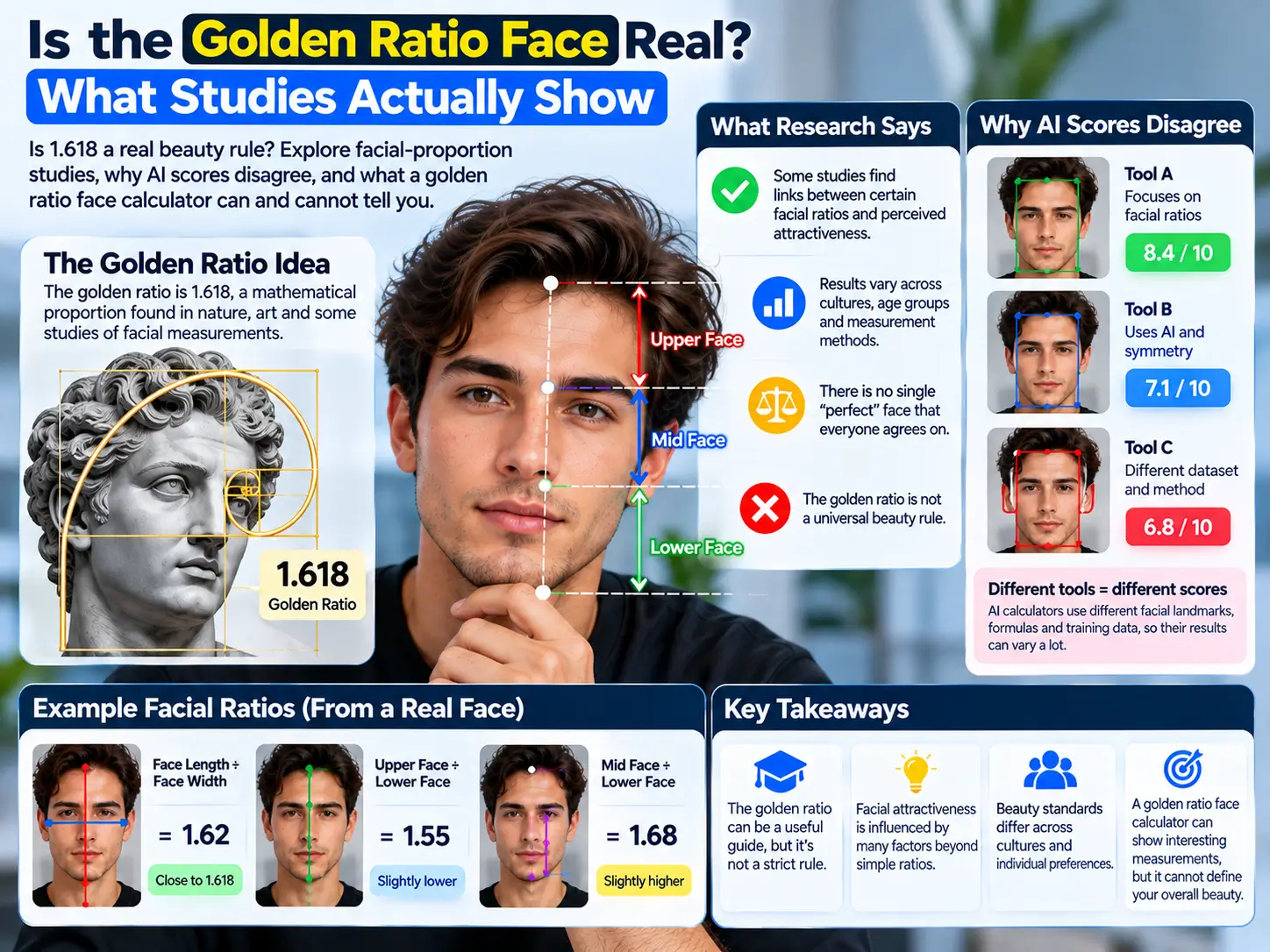
Is the golden ratio face real? What the evidence supports
The number is real. The claim that it defines a perfect face needs much more evidence. Here is how to tell the two apart.
Is the golden ratio face real?
The useful distinction is between a number, a measurement and a conclusion. Phi is a precisely defined number. A facial ratio depends on the distances you choose and how you measure them. A claim about attractiveness needs separate evidence; it does not follow automatically from either of the first two steps.
This guide explains what studies have tested, why internet face scores disagree, and what our own calculator does. It does not rank celebrities or assign a universal appearance standard.
What 1.618 actually describes
The golden ratio, written as phi (φ), is (1 + √5) ÷ 2, approximately 1.6180339. A common geometric definition divides a line so that the whole divided by the longer part equals the longer part divided by the shorter part. Wolfram MathWorld explains the mathematics.
Applying that number to a face requires an additional choice: which two distances are being compared? Face length-to-width is different from mouth-to-nose width. Hairline-to-chin length is different from brow-to-chin length. Two tests can both mention “golden ratio” while measuring different things.
A close numerical match means that a particular ratio is close to phi under the stated method. It does not establish that the chosen ratio is the most useful description of appearance, or that other ratios must match it.
What the research does—and does not—show
A 3D facial-measurement study
Rossetti and colleagues (2013) analyzed 60 selected participants using 3D facial measurements and ten ratios. Seven ratios differed statistically from 1.618; three were similar. Their findings did not support a general relationship between the tested golden proportions and attractiveness. The selected sample and study-specific ratings limit generalization. Read the original study record.
A study of self-evaluated appearance
Alam and colleagues (2015) studied 286 Malaysian university students. They found no significant association between the tested golden-ratio relationship and facial self-evaluation scores. Self-evaluation is a specific outcome, not the same as ratings by independent observers, and university students are not a representative sample of the world. Read the PLOS ONE study.
A systematic review
Londono and colleagues’ review, published online in 2022 and in a 2024 journal issue, evaluated natural facial proportions. Its abstract reports some comparisons without a significant difference from phi, but its conclusion reports no significant association with facial evaluation scores across the studied ethnicities. Finding a ratio near phi and demonstrating a beauty relationship are different findings. This summary is based on the published abstract; it is not an independent reanalysis of the included studies. Read the review abstract.
These studies use different measurements and outcomes. They do not validate this website’s scoring formula. They also do not justify saying that proportions never influence perception. The narrower conclusion is that the evidence here does not establish 1.618 as a universal beauty standard.
Why two face calculators give different scores
A ratio and a score are different outputs. A ratio is a division, such as 19.5 ÷ 12.8 = 1.5234. A score applies another formula to that result. Developers decide which ratios to include, how much to weight them and how to turn differences into a number out of 100.
| Difference | Effect on the result |
|---|---|
| Landmark definitions | A brow-to-chin distance does not equal a hairline-to-chin distance |
| Photo conditions | Pose, expression and perspective can change apparent distances |
| Measurement method | 2D photos and direct or 3D measurements represent different geometry |
| Scoring formula | Identical ratios can receive different scores when weights or penalties differ |
| Missing measurements | A tool may omit, estimate or silently substitute an unavailable point |
A result shown to several decimal places can still be based on uncertain endpoints. Repeating a result is not proof of accuracy. A calculator would need an appropriate validation study to claim a measured error rate or a relationship with a separately defined outcome.
What our calculator can honestly do
The GoldenRatioFace calculator compares three selected ratios with the rounded reference 1.618: face length-to-width, mouth-to-nose width and lip-line-to-chin divided by nose-base-to-lip-line. It shows the ratios and the custom formula. The combined number is a mathematical comparison, not a beauty percentage.
Automatic photo mode uses estimated landmarks and a disclosed upper-boundary approximation. That point is not a detected true hairline. You can correct it if your visible hairline can be identified. Manual mode uses the measurements you supply; it does not make unclear inputs reliable.
We have not validated the score against an independent population dataset, professional measurements or attractiveness ratings. It should not be used to assess health, recommend a procedure or compare demographic groups. See the measurement guide for the exact endpoints and worked arithmetic.
How to judge a “scientific beauty score” claim
- Find the measurements. Can you identify exactly where each distance starts and ends?
- Find the formula. Are the weights and penalties public, or is “AI” being used as the whole explanation?
- Look for actual validation. A paper about facial proportions does not automatically validate a particular app or its score.
- Check the sample and outcome. A small selected group, self-ratings and edited-image judgments answer different questions.
- Separate a demonstration from evidence. A spiral, mask or celebrity overlay can illustrate geometry; it does not independently prove a universal beauty rule.
A claim that someone has “the most perfect face” needs a defined method and defensible comparison dataset. Without those, a ranking is not a scientific population result. Use styling tools for practical questions you want to answer, rather than treating an unexplained number as a verdict about you.
Questions about the golden ratio and faces
Is the golden ratio face a myth?
Phi is a real mathematical constant. The broader claim that one ratio universally determines a perfect or attractive face is not established by the evidence discussed here.
Does a higher golden ratio score mean more attractive?
Not under our calculator. It means the selected ratios are closer to the chosen reference under our custom formula. We have not validated it as an attractiveness scale.
Can a face ratio of 1.68 be attractive?
A ratio of 1.68 does not settle attractiveness either way. It is a numerical description under a particular measurement definition, and it is not the same number as phi.
Are celebrity golden ratio rankings scientific?
A named formula can produce a reproducible ranking of selected images. That alone does not make it a validated ranking of human attractiveness. Image choice, landmarks, sample selection and scoring all matter.
Does using AI make a face score accurate?
AI can estimate landmarks, but its output still needs checking. Detection accuracy, distance accuracy and evidence for a beauty claim are separate questions.
What should I use the calculator for?
Use it to explore the three published proportion comparisons and understand how input choices affect the math. It is not a clinical assessment or a measure of personal worth.