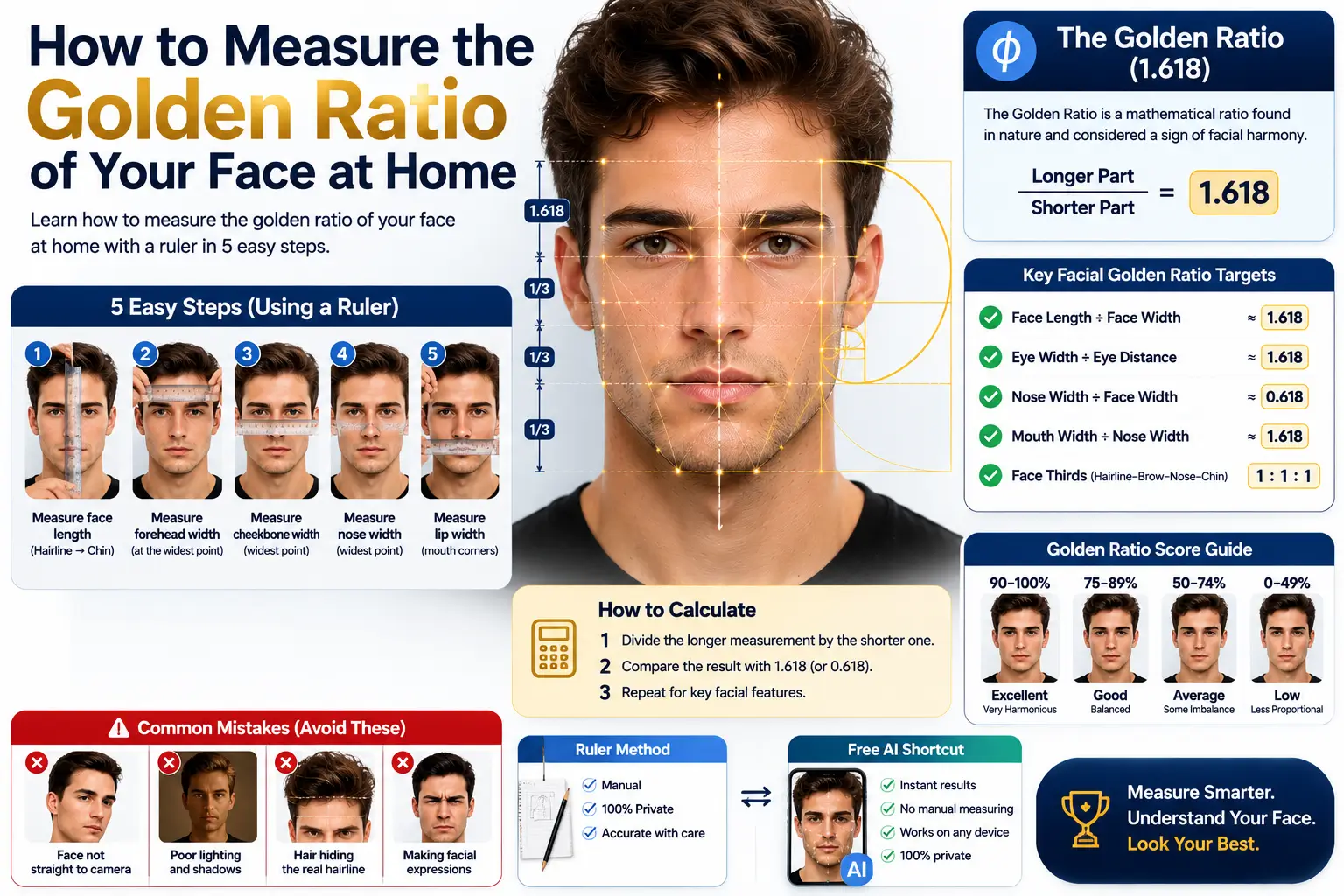
Want to know how to measure the golden ratio of your face without any special tools? You only need a ruler, a calculator, and five minutes. This guide shows you the exact points to measure, the ratios to calculate, and how to compare each result to phi (1.618). If you want the fast option instead, our free golden ratio face calculator does everything automatically from a photo.
What You Need Before You Start
Grab these three things first. Good preparation matters more than the math.
- A soft measuring tape or ruler. A soft tape works better because it sits flat against your face.
- A calculator. Your phone calculator is fine.
- A mirror or a helper. Measuring your own face in a mirror is tricky. A friend gets straighter lines.
One more tip: pull your hair completely off your face and keep a relaxed, neutral expression. A smile or raised eyebrows shifts your features and changes the numbers.
Step 1: Measure Your Face Length
Place the tape at the center of your hairline, where your hair actually starts growing. Run it straight down the middle of your face to the lowest point of your chin. Write this number down.
Important: start at the hairline, not the top of your head. Measuring from the top of your skull is the number one mistake people make, and it pushes every ratio way past 1.618.
Step 2: Measure Your Face Width
Find the widest point of your face. For almost everyone, this is across the cheekbones, just below the outer corners of your eyes. Measure straight across from one side to the other and write it down.
Step 3: Calculate Your Main Ratio
Now divide face length by face width. This is the most famous golden ratio face measurement.
Formula: Face Length divided by Face Width = Your Main Ratio
Example: a face that is 19.4 cm long and 12 cm wide gives 19.4 divided by 12, which equals 1.617. That is almost a perfect match to phi. It does not matter if you measure in centimeters or inches, because a ratio compares two numbers in the same unit.
Step 4: Measure the Smaller Feature Ratios
The full golden ratio face test uses more than one ratio. Here are the three extra measurements worth taking, with their targets.
| Ratio | What to Measure | Target |
|---|---|---|
| Mouth to nose width | Lip corner to lip corner, divided by nostril width | 1.618 |
| Lips-chin to nose-lips | Lips to chin distance, divided by nose to lips distance | 1.618 |
| Facial thirds | Hairline to brows, brows to nose base, nose base to chin | All three roughly equal |
For the facial thirds check, you are not dividing anything. You just compare the three vertical sections. The closer they are to equal, the more balanced your face is under the classical proportion rules.
Step 5: Read Your Results
Use this simple guide to understand what your numbers mean.
| Your Main Ratio | What It Means |
|---|---|
| 1.55 to 1.68 | Very close to phi. Your face length and width sit near the classical ideal. |
| 1.40 to 1.55 | A shorter or wider face window. Extremely common and completely normal. |
| Above 1.68 | A longer face window, typical for oblong and rectangular face shapes. |
Remember what these numbers are: geometry, not a beauty grade. Research shows people find many different proportions attractive, and the idea that 1.618 defines beauty is genuinely debated among scientists. You can read the full math background on the Wikipedia golden ratio page.
Common Measurement Mistakes to Avoid
Manual measuring is honest work, but it has weak spots. Watch out for these four traps.
- Starting from the top of the head. Always start at the hairline. This single mistake ruins every ratio.
- Using a front-camera selfie for reference. Wide-angle selfie lenses stretch the middle of your face. If you measure from a photo, have someone take it from 3 to 5 feet away with the back camera.
- Measuring with a tilted head. Even a small tilt changes your face length reading. Look straight ahead at eye level.
- Trusting one attempt. Hands shake and tape slips. Measure everything twice and average the results.
The Faster Option: Let AI Measure for You
Here is the honest truth about rulers: they are fine for a rough answer, but they struggle with precision. Landmarks like the exact corner of an eye are millimeters wide, and millimeters matter when you calculate to three decimal places.
That is exactly why we built our free golden ratio face test with AI photo analysis. It finds 468 landmark points on your face, measures every distance the same way every time, and scores your ratios in seconds. It even works with your live camera, and nothing you upload ever leaves your device.
FAQs About Measuring the Golden Ratio Face
Can I measure my golden ratio face with just a ruler?
Yes. Face length divided by face width needs only a ruler and a calculator. For the smaller feature ratios, a soft measuring tape is easier because it bends with your face.
Does it matter if I measure in inches or centimeters?
No. A ratio divides one number by another in the same unit, so the unit cancels out. Just never mix units in one calculation.
Where exactly does my hairline start?
Use the point where hair naturally grows at the center of your forehead, not where it is styled or combed. If your hairline has receded, estimate where it originally sat for the classical measurement.
What is a normal golden ratio face result?
Most people land somewhere between 1.4 and 1.7 on the main ratio. Very few faces hit 1.618 exactly, and that is completely normal.
Is manual measuring accurate?
It gives a good general picture but not lab precision. Shaky hands, unclear landmarks, and head tilt all add small errors. An AI photo analysis gives the same result from the same photo every time.