Quick answer:
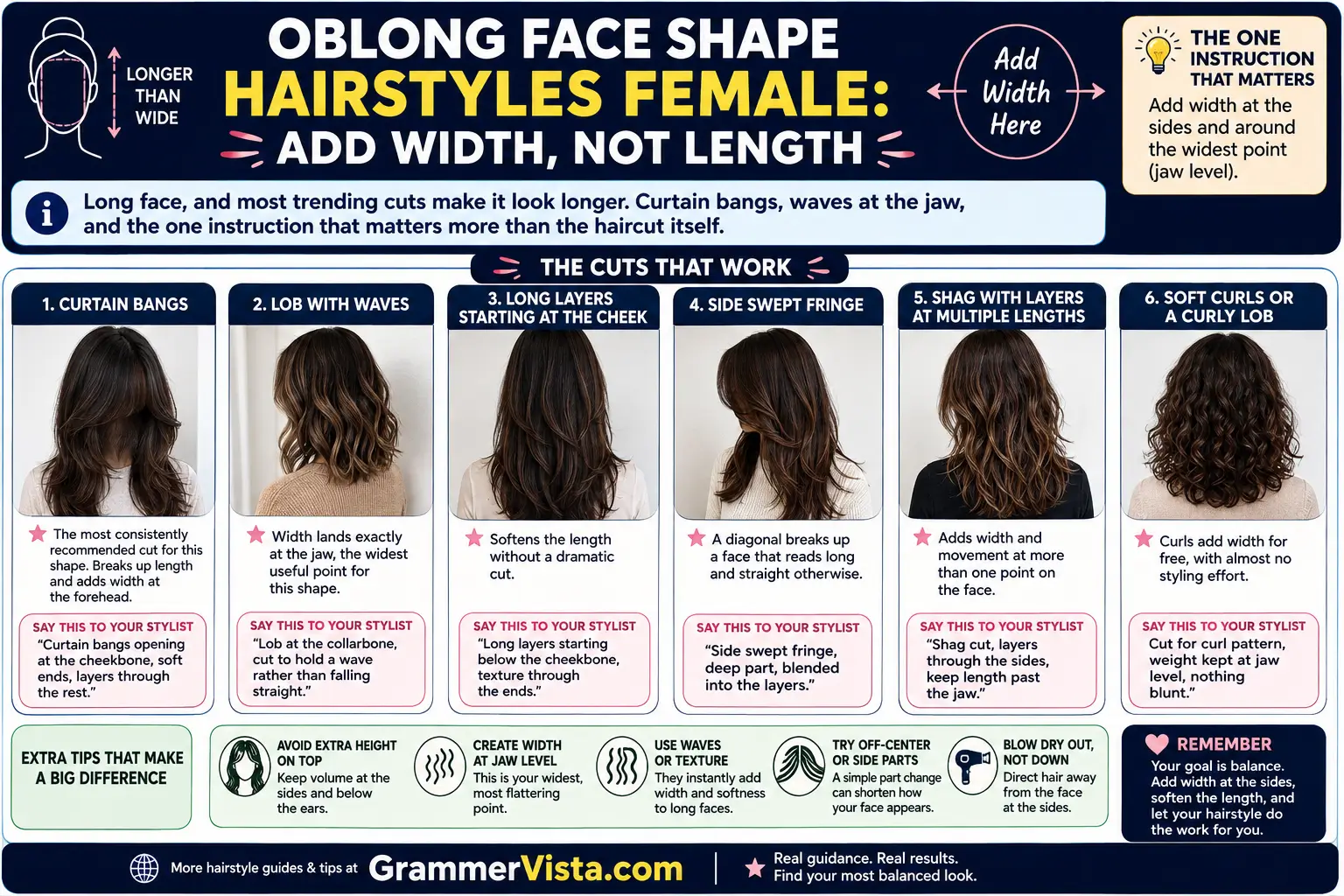
An oblong face is clearly longer than it is wide, with the forehead, cheekbones and jaw measuring close to the same width. The cuts that work add width at the sides and break up the length: curtain bangs, waves or curls at jaw level, and layers that stop well short of one-length straight hair.
What works against you is almost everything currently trending for long hair: a sleek middle-part ponytail, hair pulled back tight, or length with no layers at all, because all three stretch the face further rather than balancing it.
Confirm the shape first
Pull your hair fully back. Is your face clearly longer than it is wide, with your forehead, cheekbones and jaw reading close to even? That is oblong. If your jaw specifically turns a corner rather than curving, you are closer to rectangle instead, which shares almost all of this advice with one extra consideration for the jaw. The face shape detector confirms both in about ten seconds.
The cuts that work
| Cut | Why it works | Say this to your stylist |
|---|---|---|
| Curtain bangs | The most consistently recommended cut for this shape, breaks up length and adds width at the forehead | “Curtain bangs opening at the cheekbone, soft ends, layers through the rest” |
| Lob with waves | Width lands exactly at the jaw, the widest useful point for this shape | “Lob at the collarbone, cut to hold a wave rather than falling straight” |
| Long layers starting at the cheek | Softens the length without a dramatic cut | “Long layers starting below the cheekbone, texture through the ends” |
| Side swept fringe | A diagonal breaks up a face that reads long and straight otherwise | “Side swept fringe, deep part, blended into the layers” |
| Shag with layers at multiple lengths | Adds width and movement at more than one point on the face | “Shag cut, layers through the sides, keep length past the jaw” |
| Soft curls or a curly lob | Curls add width for free, with almost no styling effort | “Cut for curl pattern, weight kept at jaw level, nothing blunt” |
What actually goes wrong, more than the cuts themselves
- A sleek middle part. It draws one straight vertical line down an already long face and adds nothing at the sides. A side part creates asymmetry that breaks up the length, and it costs nothing at your next appointment.
- Hair pulled back tight. A high ponytail or a slicked bun removes every bit of width the sides could be adding and exposes the full length of the face at once. If you want length pulled back, leave face framing pieces loose rather than pulling everything flush.
- Long, straight, one-length hair with no layers. Without layers or texture, the length pulls the eye straight down the centre of the face and reads even longer than it measures. Waves, curls, or layers all solve this without giving up length if you want to keep it.
Match it to your hair texture
- Fine and straight. Curtain bangs or a lob with long layers is the strongest option, since fine hair needs the cut itself to create width. A volumising mousse at the roots and drying outward at the sides helps hold what the cut sets up.
- Thick and straight. Thick hair can carry real length without going flat, so a textured lob or long layers with some internal thinning both work. A completely blunt cut is the one thing to avoid at this texture, since thick hair cut straight reads heavier and longer than it needs to.
- Wavy. One of the easiest textures for this shape. Waves add width at jaw level with almost no styling required, and a lob or shoulder length cut works close to as-is.
- Curly. Curls add real width for free, which is exactly what this shape benefits from. A curly lob or shoulder length curls both work, and protective styles like braids or twists add the same width without hesitation.
- Coily and afro textured. A shaped medium length style or twists with fullness at the sides supply the width this shape needs. A very tall, narrow shape at the crown works against the goal, since height adds length rather than width.
How your cut ages
| Weeks | What happens | What to do |
|---|---|---|
| 1 to 3 | Bangs and layers sitting as cut | Nothing |
| 4 to 6 | Bangs growing past the brow, layers softening | Trim the bangs only |
| 7 to 10 | Length and straightness both increasing | Full cut, or add waves to compensate |
The bangs are doing most of the work on this shape, and they grow out fastest. A bang trim every four to five weeks keeps the width working well before a full cut is due.
FAQs
What is the best hairstyle for an oblong face shape woman?
Curtain bangs paired with long layers or a wavy lob is the most consistently recommended combination. The bangs add width at the forehead while waves or layers add width at the jaw, together countering the length that defines this shape.
Should I avoid a middle part with an oblong face?
A sleek, dead centre part is worth avoiding, since it draws a straight vertical line down an already long face. A side part costs nothing and adds the asymmetry that helps.
Is a middle part ever fine for this shape?
Yes, paired with waves or curls, since the texture supplies the width a straight middle part alone would not. It is the combination of centre part and flat straight hair specifically that works against this shape.
Can an oblong face shape have long straight hair?
Yes, if it has layers or texture. Long, one length, completely straight hair is the version that works against this shape, since it pulls the eye down the centre with nothing to break the length.
What is the difference between oblong hairstyles for men and women?
The underlying goal is identical, add width at the sides, avoid extra length. The specific cuts differ by convention: curtain bangs and lobs for women, low tapers and French crops for men. The full men’s oblong hairstyle guide covers the male-specific cuts.
Reference on the cuts discussed above: layered hair.
Grammar Vista improve your grammar.