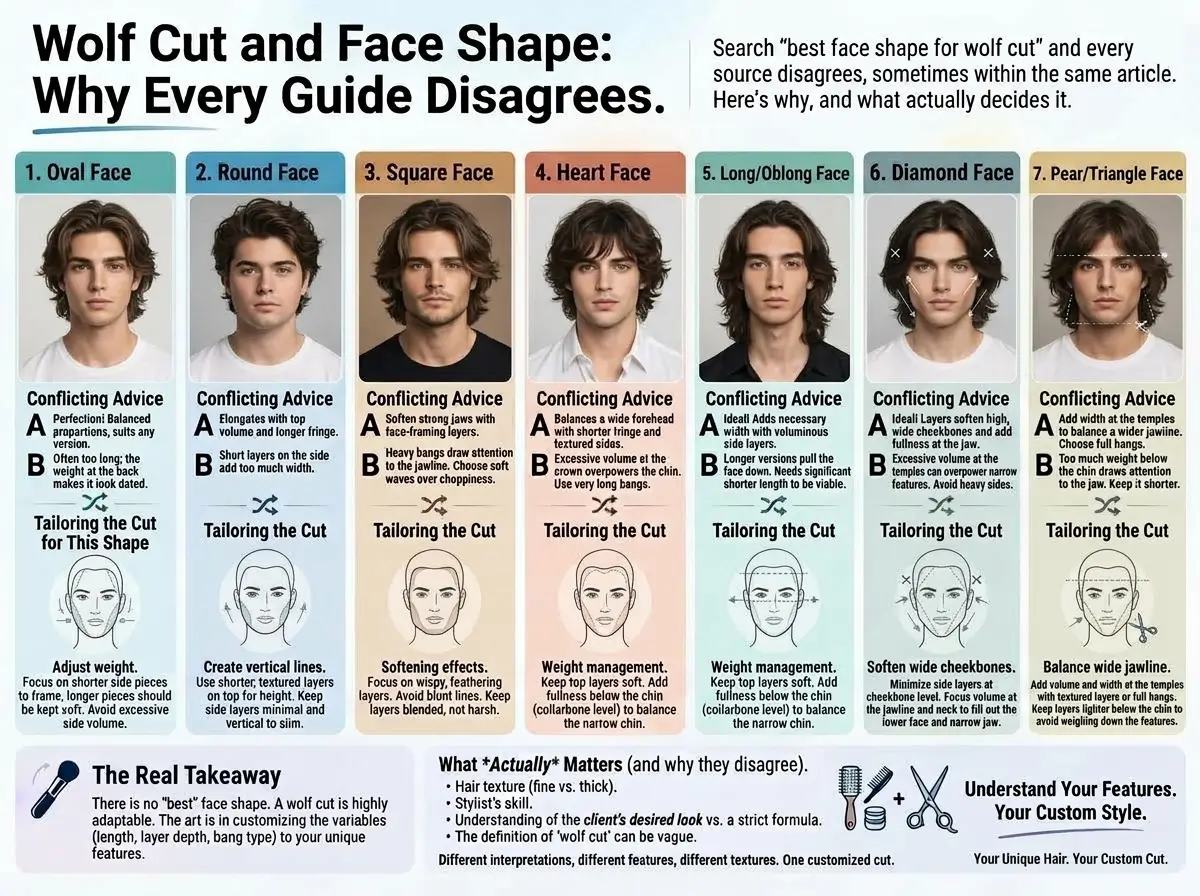
Search “best face shape for a wolf cut,” and you’ll collect a genuinely different answer from nearly every source, and not in the small, expected way two honest opinions sometimes differ. One widely shared guide recommended oval, diamond, and heart-shaped faces in one section, then recommended oval, oblong, and heart-shaped faces in a different section of the very same article. That’s not disagreement between sources; that’s a single source disagreeing with itself.
Quick answer:
There’s no real consensus on which face shape suits a wolf cut best; credible sources recommend round, square, oval, diamond, heart, and oblong faces in different, often contradictory combinations.
What actually determines whether the cut works on your specific face is where a stylist places crown volume, where face-framing layers begin, and how heavy the fringe is, not which face shape category you fall into.
What we found checking multiple sources directly
Laid out plainly, since the contradiction itself is the most useful thing to know before you sit in a stylist’s chair asking for this cut by name alone:
| Source claimed best for | Shapes named |
|---|---|
| Source 1 | Round specifically, citing the crown-height slimming effect |
| Source 2 | Oval, round, and diamond |
| Source 3 (section one) | Oval, diamond, or heart |
| Source 3 (section two, same article) | Oval, oblong, or heart |
| Source 4 | Square and heart-shaped, citing jawline and cheekbone balance |
| Source 5 | Nearly every shape, with the right customization |
Five sources, six different answers, one of which contradicts itself internally. That’s a genuine pattern worth naming rather than smoothing over with a confident-sounding pick of our own that would just add a seventh opinion to a pile that already doesn’t agree.
What’s actually happening here
The wolf cut isn’t one fixed haircut with a single silhouette, the way a classic bob is. It’s a loose category, heavy layering combining shag-like texture with mullet-like structure, that gets executed very differently depending on the barber, the client’s hair type, and the specific choices made about volume placement.
Two haircuts that both get called “a wolf cut” can look meaningfully different from each other, which is a large part of why guides disagree so much about which face shape it flatters: they’re often not even describing the same haircut under the same name.
The three variables that matter more than face shape
- Crown volume. More height and lift at the crown reads as added vertical length, which matters most for faces that don’t have much natural length to begin with. Less crown height keeps the cut closer to the head, which suits faces that already read long.
- Where face-framing layers start. Layers beginning around cheekbone height do something different from layers beginning at the jaw. The higher starting point tends to add width near the cheekbones; the lower one adds width right at the jawline instead.
- Fringe weight and length. A heavy curtain fringe falling past the eyebrows visually shortens and narrows the forehead. A shorter, lighter fringe barely touches forehead width at all. This single choice does more to change how the cut reads on a wide-forehead face than the face shape label itself does.
These three decisions interact with each other and with your actual proportions in ways that a single “best for round faces” headline can’t capture, which is exactly why the guides keep contradicting each other. They’re each locking onto one plausible combination of these variables and presenting it as the universal answer.
What to actually bring to your stylist
Rather than asking for “a wolf cut” by name and hoping the result suits you, describe the effect you want: more length, a softer jawline, less forehead width, whatever your actual proportions call for. That gives a stylist something specific to work with regardless of which face shape you fall into.
Knowing your real proportions first, rather than guessing from a mirror, makes that conversation considerably more precise.
The face shape detector gives you the actual numbers behind forehead, cheekbone, and jaw width in under a minute, which is a more useful starting point than any single “best for X shape” claim floating around online.
FAQs
What face shape is best for a wolf cut?
There’s no reliable consensus; sources contradict each other, sometimes within the same article. The cut’s effect depends more on crown volume, where face-framing layers start, and fringe weight than on face shape category alone.
Can a wolf cut work on any face shape?
With the right customization to crown height, layer placement, and fringe, most sources agree it can be adapted to most shapes. It’s the uncustomized, generic version that tends to suit some proportions better than others.
Why do so many guides disagree about this specific haircut?
Partly because “wolf cut” describes a loose category rather than one fixed silhouette, different barbers execute it differently, so guides are sometimes describing genuinely different haircuts under the same name rather than disagreeing about the same one.
What should I actually tell my stylist if I want a wolf cut?
Describe the effect you want, more length, a softer jaw, less forehead width, rather than just naming the trend. Knowing your actual face shape measurements first makes that conversation more specific and more likely to get a result that works for you.
Does hair type affect how well a wolf cut works, separately from face shape?
Yes. Medium to thick hair holds the layering and volume this cut relies on most easily. Very fine hair or very tightly coiled hair sometimes needs an adjusted approach to achieve a similar effect.