Face Shape Explained: What the Labels Really Mean
Oval, round, heart and the other shape names describe broad patterns in your outline. They are useful styling shortcuts—not exact boxes that every face must fit.
What is a face shape?
Face shape is a simple description of the outline of your face. Styling guides usually compare how long it looks, which area is widest, and how the jaw narrows or curves.
A shape label summarizes those clues. It does not describe every feature, reveal your personality, or tell you how attractive you are.
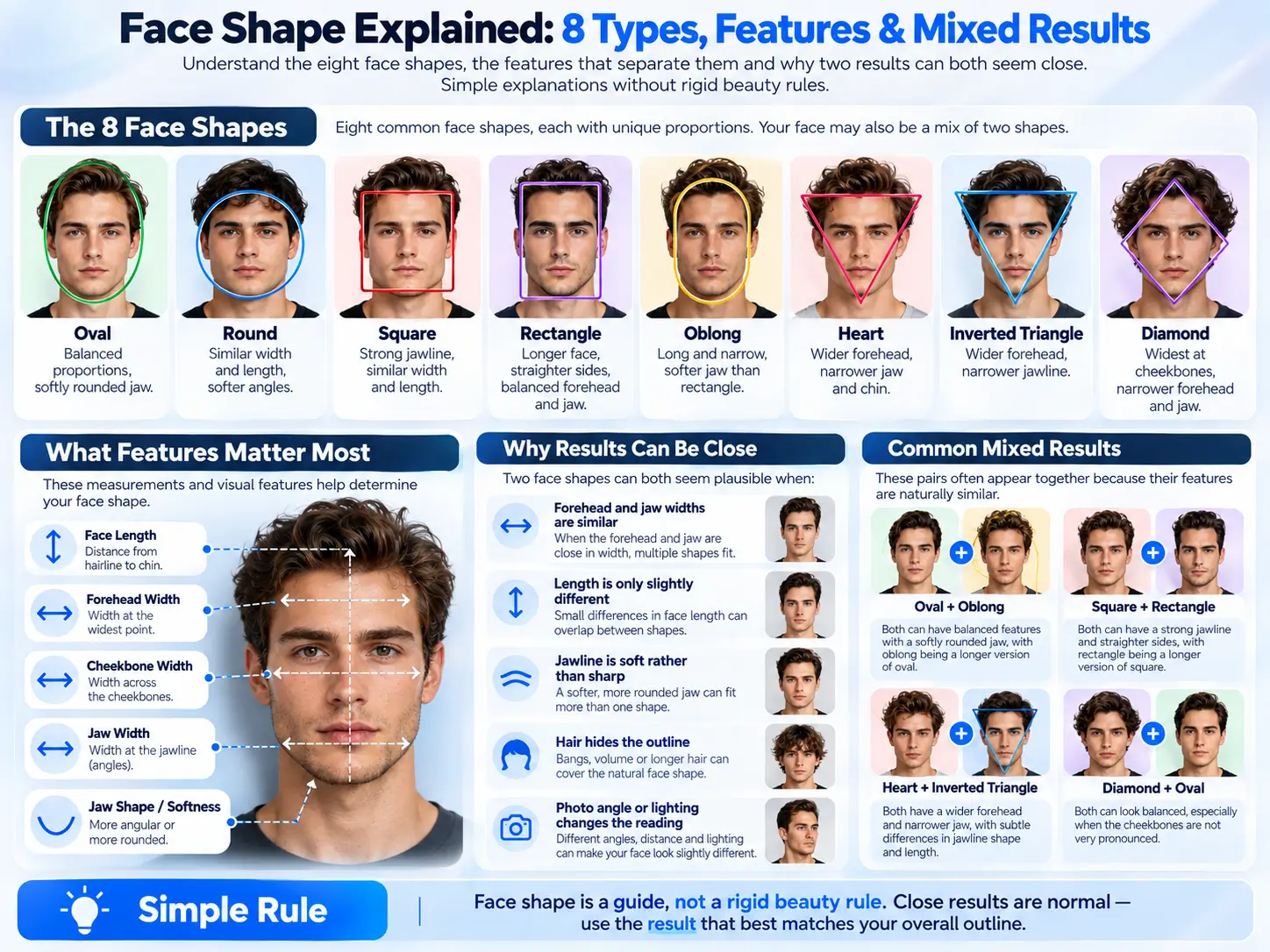
On GoldenRatioFace, we use eight profiles: oval, round, square, oblong, rectangle, heart, diamond and triangle. Other guides may combine some of them or use different names. Eight is our organizing system, not a universal anatomical rule.
For an illustrated comparison, use the face shape chart. This page explains what the clues and labels mean, including why a mixed result can make sense.
The three clues to understand
1. Length compared with width
A face can look relatively compact, moderately long or clearly elongated. For our comparison, the reference width is across the cheekbone area. Length needs a defined top and bottom: a visible hairline-to-chin measurement is not the same as a nose-root-to-chin measurement.
Photo mode estimates an upper boundary because it does not reliably detect the true hairline. That means a ratio from the photo tool may differ from a ratio you measured yourself. A number without its measurement method can be misleading.
2. Where the outline is widest
Compare the forehead, cheekbone area and jaw. A broad jaw points toward a different profile from a broad upper face. Small differences can be hard to see, so “similar widths” is sometimes a better description than forcing one area to win.
Cheekbone width is different from cheekbone height. High cheekbones sit higher on the face; they do not automatically mean a diamond shape. See how cheekbones relate to face shape.
3. How the lower outline narrows
The jaw can look softly curved, more angular at the corners, or strongly tapered toward the chin. The whole lower outline matters. A pointed chin by itself does not settle the category, and a beard can hide the outline being compared.
These are useful styling clues, not the only facts about a face. Two people can share a label while having different features, hairlines, proportions and preferences.
What the eight labels describe
| Shape | Main pattern | Useful distinction |
|---|---|---|
| Oval | Moderately elongated, with a gradual taper and a softer lower outline. | Length alone is not enough; compare the side taper. |
| Round | A relatively compact outline with softer curves. | “Round” does not mean the face is a perfect circle. |
| Square | A relatively compact outline with a broad, more angular jaw. | Jaw corners help separate it from round. |
| Oblong | A clearly elongated outline with relatively steady side widths and a softer jaw. | We separate it from rectangle by the lower outline. |
| Rectangle | A clearly elongated outline with more angular jaw corners. | Some other guides call this oblong. |
| Heart | A broader upper face that narrows toward the jaw and chin. | A widow’s peak is not required in our system. |
| Diamond | Cheekbones stand out in width, with a narrower forehead and jaw. | Look at width across the cheeks, not just their height. |
| Triangle | The jaw is broader than the upper face. | This is the opposite width direction from inverted triangle. |
Our triangle guide uses “triangle” for a wider jaw. “Inverted triangle” usually describes a wider upper face and overlaps with heart in styling discussions. It is not a ninth output from this tool.
The oval versus oblong guide explores a common close pair. If another site combines rectangle and oblong, different labels may describe a similar overall outline.
Why you can get two close results
Think of the labels as nearby descriptions rather than eight sealed boxes. A face might have the length of an oblong profile but a taper that also resembles oval. The combined clues can place it close to both.
The input can change
Head angle, expression, lighting, hair and camera distance can change the visible outline. Compare similar photos before deciding the tool is inconsistent.
The method can change
Tools can use different landmarks, reference ranges or category names. Even the same photo can receive a different label under different rules.
The tool can also make a mistake. A clear photo does not guarantee that every landmark or jaw estimate is right. Inspect the measured lines when a result does not match what you see.
In our tools, scores compare inputs with custom profiles. A score of 80 out of 100 does not mean “80% proven correct.” A small gap between the best two scores is a reason to compare both, not to report a certain diagnosis.
Use the result for a real decision
- Start with your goal. Are you choosing a haircut, trying glasses, or just learning the names? You may not need an exact label to make that decision.
- Pick one or two likely profiles. Use a clear photo or a careful visual comparison. Keep a close second match instead of discarding it.
- Translate the pattern into a preference. You might want more height in a haircut, less width at the sides, or simply a style you enjoy. These are choices, not corrections your face requires.
- Check the practical fit. Hair texture, growth direction and upkeep affect a haircut. Frame width, bridge comfort and arm length affect glasses. A shape label cannot replace those checks.
Try the automatic face shape detector for a photo-based starting point, then use the men’s hairstyle guide or glasses guide for practical comparisons.
If you only want the meaning of a term, you can stop at the description. You do not need to scan repeatedly until a tool gives a preferred label.
Common questions about face shape
How many face shapes are there?
There is no single count used by all styling guides. GoldenRatioFace uses eight profiles. Systems that combine rectangle with oblong or heart with inverted triangle can produce a different count.
Is oval the best face shape?
No shape is a requirement for looking good. A label can help organize style ideas, but it does not rank people or set a beauty standard.
Does a wide forehead always mean heart-shaped?
No. Compare the forehead with the cheekbones and jaw, and look at the taper toward the chin. One isolated feature is not enough to settle a label.
Can I have a mixed face shape?
Yes, your visible outline may share traits with more than one styling profile. Using two close descriptions can be more useful than forcing one.
Are face shape and head shape the same?
No. A front-facing outline does not describe the back or top of the skull. Hair can also change the apparent head outline without changing the visible face beneath it.
Is this the same as facial symmetry or the golden ratio?
No. Shape describes the overall outline. Symmetry compares sides, and a golden-ratio tool compares selected distances with a mathematical ratio. None is a complete measure of a person’s appearance.
How this guide was checked
Definitions here follow GoldenRatioFace’s published tool method and shape chart. They are explained as styling conventions rather than clinical classifications.
For an example of different naming, Omni Calculator’s guide groups oblong with rectangular. Google’s Face Landmarker documentation describes the landmark technology, not evidence that our eight categories are scientifically validated. Reviewed October 6, 2026.