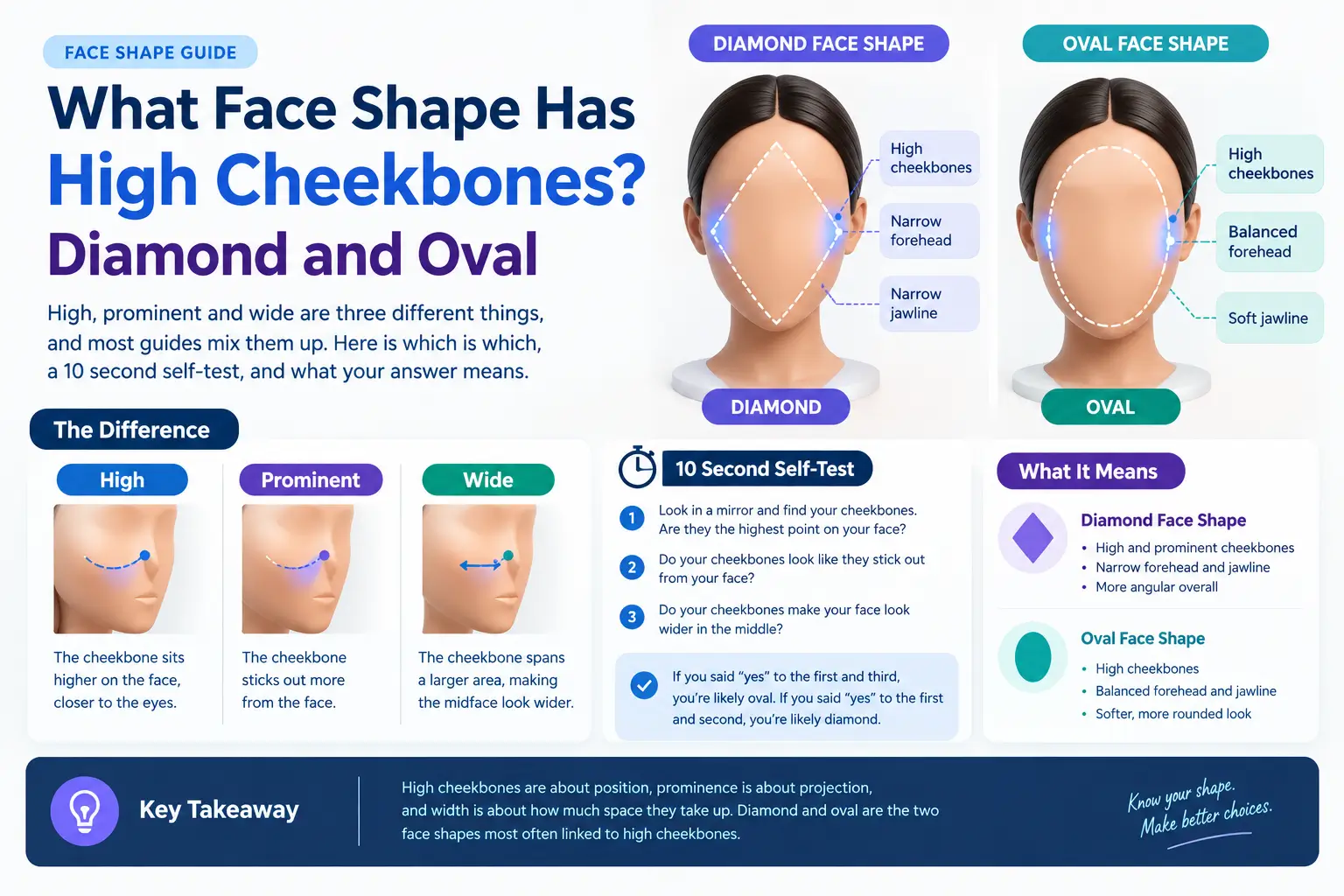
Quick answer:
Diamond and oval face shapes are the two defined by cheekbones being the widest point on the face. On a diamond face the cheekbones are dramatically wider than both the forehead and jaw. On an oval face they are wider too, just by a smaller margin.
Heart shaped faces often have prominent, full looking cheekbones, but the forehead is still technically the widest measurement on that shape, not the cheekbones. Round and square faces do not feature cheekbones as the widest point at all. But before any of that applies to you, it helps to know which of three different things you are actually asking about.
High, prominent and wide are not the same thing
This is the part almost every source on this topic gets tangled up in, and it explains why different pages give contradictory answers.
| Term | What it actually measures | Example |
|---|---|---|
| High | Vertical position. Where the cheekbone sits relative to your eyes and nose | A cheekbone sitting close to the bottom of your eyes is high. One sitting closer to the bottom of your nose is low |
| Prominent | Projection. How much the bone stands out from the surface of your face | Can happen at any height, high or low, and often changes with how much fat sits over the bone |
| Wide | Proportion. How far your cheekbones extend compared with your forehead and jaw | This is the one that actually decides your face shape, since face shape is about width relationships, not height or projection |
The one that determines your face shape is width, not height. A cheekbone can be high and narrow, or low and wide, or any other combination. Face shape categories are built entirely on how your three widths, forehead, cheekbones and jaw, compare with each other, so “height” alone does not tell you much about shape, even though it is what most people mean when they first ask the question.
A ten second test for height, if that is what you meant
Place your thumb at the top of your ear and your index finger at the side of your nose, level with where your nostril sits. Picture a straight line between the two. If your cheekbones sit above that line, they are high. If they sit at or below it, they are low. This is a real, physical check rather than a guess, and it works regardless of your actual face shape.
One thing worth knowing: Cheekbone height and prominence are bone structure, and height specifically does not change with weight. Prominence can look softer when there is more fat over the bone, and sharper when there is less, but the underlying position does not move.
If you are trying to judge your own cheekbones and your face has changed with weight recently, that affects how prominent they look, not how high they actually are.
Which face shapes actually have wide cheekbones
This is the part that determines your shape, using the same measurements as every other tool on this site.
| Shape | Cheekbone width | What this means |
|---|---|---|
| Diamond | The widest point on the face, clearly | Cheekbones measure wider than both forehead and jaw by a real margin, not a close call |
| Oval | The widest point, but only just | Cheekbones lead, with the forehead close behind and the jaw narrower again |
| Heart | Often prominent looking, but not the widest measurement | The forehead is technically wider on a true heart shape, even when the cheekbones look full |
| Triangle | Not the widest point | The jaw is widest on this shape, with the forehead narrowest |
| Round | Close to even with forehead and jaw | No single width dominates, which is part of what defines this shape |
| Square | Close to even with forehead and jaw | Same as round, evenness rather than a dominant cheekbone width is the defining feature |
| Oblong | Close to even, but the face reads long | Width relationships are even, the length is what defines this shape instead |
| Rectangle | Close to even, but the face reads long | Same as oblong, with an angular jaw as the added distinction |
So if your actual question is “are my cheekbones the widest part of my face,” the honest answer is that it points toward diamond or oval, and diamond specifically if the gap is large rather than close. If your cheekbones look prominent but your forehead still measures wider, heart is the more accurate answer despite how the cheekbones look.
How to check which one you actually are
Two methods, from fastest to most precise.
- Fingers at the temples, then the jaw. Hold two fingers at your temples and note the gap, keeping it steady as you move them to your cheekbones, then to your jaw below your ears. Whichever position gives the widest gap is your widest measurement.
- The face shape detector, which measures all three widths from a photo and tells you exactly how much wider your cheekbones are than your other two measurements, rather than leaving it to a visual guess.
FAQs
What face shape has the highest cheekbones?
Diamond face shapes have the most clearly defined wide cheekbones, wider than both the forehead and jaw by a real margin. Oval faces also have cheekbones as the widest point, just by a smaller amount. Height, meaning vertical position, is a separate property from width and can vary within any face shape.
Do oval faces have high cheekbones?
Oval faces have cheekbones as their widest measurement, though only slightly wider than the forehead. Whether they are also high, meaning sitting close to the eyes rather than the nose, is a separate question that depends on individual bone structure rather than face shape alone.
Is having high cheekbones the same as having wide cheekbones?
No, and mixing these up is the most common source of confusion on this topic. High refers to vertical position, wide refers to how your cheekbones compare in width with your forehead and jaw. A cheekbone can be high and narrow or low and wide. Face shape is decided by width, not height.
Do heart shaped faces have high cheekbones?
Heart shaped faces often look like they have prominent, full cheekbones, but the forehead is still the widest measurement on a true heart shape, not the cheekbones. If your cheekbones measure as your widest point instead, diamond or oval is the more accurate shape.
Why do different sites give different answers about which shape has high cheekbones?
Because most sources use “high,” “prominent,” and “wide” interchangeably when they are three different physical properties. A page focused on vertical height will point to different shapes than a page focused on width, even though both are technically answering a version of the same question.
Can I tell if I have high cheekbones without a photo?
Yes. Place your thumb at the top of your ear and your index finger at the side of your nose, and picture a straight line between them. If your cheekbones sit above that line, they are high. This tells you about height specifically, not about your overall face shape, which depends on width instead.
Reference on the anatomy discussed throughout: zygomatic bone.