Understand the feature, beyond the label
High Cheekbones:
Meaning, Position & Appearance
Higher, wider and more defined are different descriptions. Learn what each means—and why a single selfie can be misleading.
01 / A clear definition
What are high cheekbones?
High cheekbones usually describes a cheek contour that appears relatively close to the lower eye area. It is an everyday description of position. It does not automatically mean the cheeks are wide, sharply defined or part of a particular face shape.
The cheekbones are the paired zygomatic bones, which contribute to the cheeks and eye sockets. The zygomatic arch extends toward the ear and includes parts of both the zygomatic and temporal bones. The bone and the whole arch are related structures, not interchangeable names. See the NCI cheekbone definition and Elsevier’s anatomy reference.
What you see on the outside also includes skin and soft tissue. A visible cheek highlight or hollow does not reveal the underlying bone’s exact position by itself.
02 / Position, illustrated
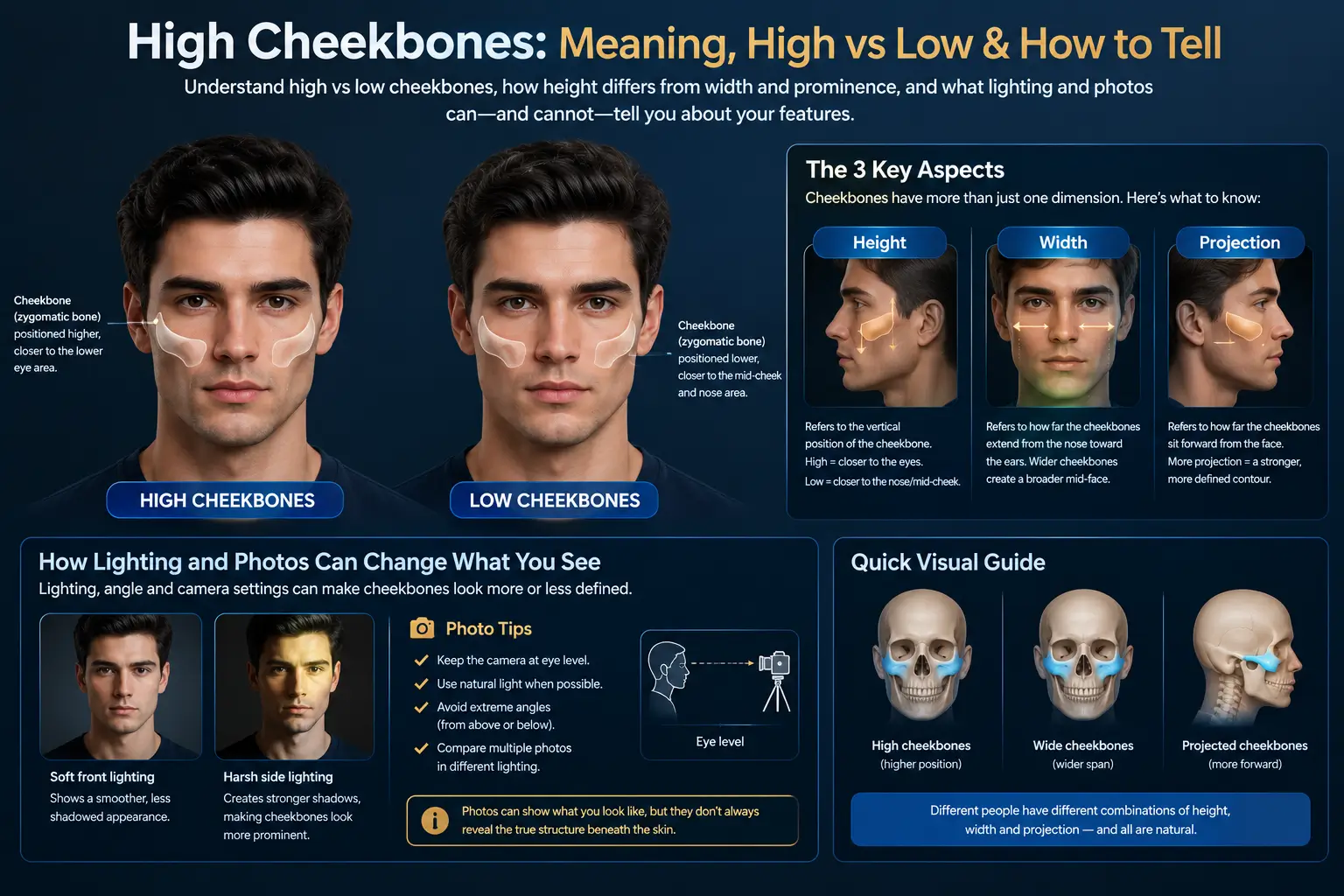
High cheekbones vs low cheekbones
These simplified drawings show the idea of a higher or lower-looking cheek contour. They do not establish a measurement threshold or reproduce the anatomy of a particular person.
The highlighted area appears closer to the lower eye region.
The highlighted area appears farther down the midface.
The colored areas are explanatory highlights, not a map of the entire bone. “High” and “low” are not grades, and this guide does not use an eye-to-nose line to assign a medical label.
People also use “high” when they actually mean noticeable or sculpted. Before comparing two photos, ask whether you are talking about position, width or definition. That small distinction explains many apparently conflicting answers.
03 / Three separate questions
High, wide and prominent are not the same
Height
Where does the cheek contour appear? Higher and lower describe its vertical position relative to surrounding features.
Width
How far apart are the sides of the face? Compare cheekbone width with the forehead and jaw when exploring face shape.
Prominence
How strongly does the contour stand out? Projection and the tissues over it contribute to appearance; shadows can exaggerate definition.
Explore the descriptions
Use the buttons to change an explanatory highlight. This illustration does not measure your face.
Position: the highlights show the upper cheek area. Their placement is illustrative, not a high/low cutoff.
For example, broad cheekbones can contribute to a wide-looking midface without proving that the cheek contour sits high. A softer-looking cheek area also does not prove that the underlying cheekbones are low. Avoid using one word as a shortcut for all three features.
04 / A useful visual check
How can I tell if I have high cheekbones?
You can make a rough visual observation, but a home check does not give a precise anatomical classification. The aim is to describe what you see consistently—not to pass a test.
- Use even light. Face a window or another soft light source. Strong side lighting can make one cheek look much more defined.
- Keep your head level and face relaxed. Use an unfiltered front view. A smile or tilted head changes the visible contours.
- Look below and outside the eyes. Notice the cheek contour rather than only the brightest highlight or darkest hollow.
- Compare like with like. If you take another photo, keep the angle, distance and expression similar. A different camera view is not evidence that the bone moved.
- Leave uncertain cases uncertain. If the contour is not clear, “not sure” is a more useful answer than a forced high/low label.
About the finger-line test: drawing an imaginary line from the ear to the nostril is not treated here as a validated diagnostic method. Its placement varies, and it should not be presented as more accurate than another observation without supporting evidence.
Why cheekbones look different between photos
| Factor | What to keep in mind |
|---|---|
| Lighting | Highlights and shadows can make the same contour look softer or sharper. |
| Camera angle | Front, side and tilted views emphasize different surfaces. Compare similar views. |
| Expression | Smiling changes the appearance of the cheeks. Use a relaxed expression for comparison. |
| Soft tissue | Cheek fullness is not the same thing as bone position. Do not infer bone height from fullness alone. |
| Makeup and image editing | Contouring or a filter can change visible edges without establishing the underlying anatomy. |
Keep cosmetic appearance and anatomy separate. A more sculpted-looking photograph is not proof of a structural change, and a face-shape app’s label is not a clinical finding.
Do high cheekbones mean a diamond face shape?
No. Cheekbone height alone does not identify face shape. In this site’s styling categories, diamond describes cheeks that look wider than the forehead and jaw. That is a width relationship, not a test of vertical height.
To compare overall shape, also consider face length, the upper and lower widths, and the jaw outline. Read the focused guide to cheekbones and face shape, or use the eight-shape comparison chart.
If your goal is choosing frames, prioritize comfort and fit alongside the appearance you prefer. Our glasses guide is a starting point, not a rule that a particular cheekbone type must follow.
05 / Common questions
Questions about high cheekbones
Are high cheekbones the same as prominent cheekbones?
No. High usually describes position; prominent describes how strongly a contour stands out. A photo’s shadows can make prominence look greater without establishing cheekbone height.
Can men and women both have high cheekbones?
Yes. The description is used for people of different genders. It is not a test of gender, masculinity, femininity or attractiveness.
Can a round face have high-looking cheekbones?
A round-looking overall outline does not determine the vertical position of every feature. Use face-shape terms for the overall proportions and describe the cheek contour separately.
Are low cheekbones unattractive?
This guide does not rank faces or assign beauty scores. “High” and “low” describe an appearance; they are not judgments about a person or a reason to change their features.
Does losing weight give you high cheekbones?
A change in cheek fullness can change visible definition, but definition is not the same as vertical bone position. Weight loss should not be presented as a reliable way to obtain a particular cheekbone label.
Can contouring or a filter make cheekbones look higher?
They can alter the apparent placement of highlights and shadows. That changes the visual impression, not what the underlying bone is. Compare unfiltered images if you want to understand your usual appearance.
Can your AI tool detect high cheekbones?
Our current face shape detector estimates photo landmarks and compares overall shape profiles. It does not offer a validated high-versus-low cheekbone result. We do not substitute a width ratio or face-shape label for a cheekbone-height measurement.
Can I identify ancestry from cheekbones?
This guide cannot establish ancestry or ethnicity from cheekbone appearance. It does not use facial features to label someone’s background.
Sources and editorial notes
This guide explains appearance terminology and the limits of informal comparisons. Original diagrams simplify the concepts; they do not show measured examples or before-and-after results.
- National Cancer Institute: cheekbone — basic anatomical definition.
- Elsevier Complete Anatomy: zygomatic bone — relationship between the bone and arch.
- Elements of Morphology: Standard Terminology for the Head and Face — clinical terminology distinguishes cheekbone prominence and cheek soft-tissue fullness; it does not validate our illustrations as a diagnostic test.
1 thought on “High Cheekbones: Meaning, High vs Low & How to Tell”