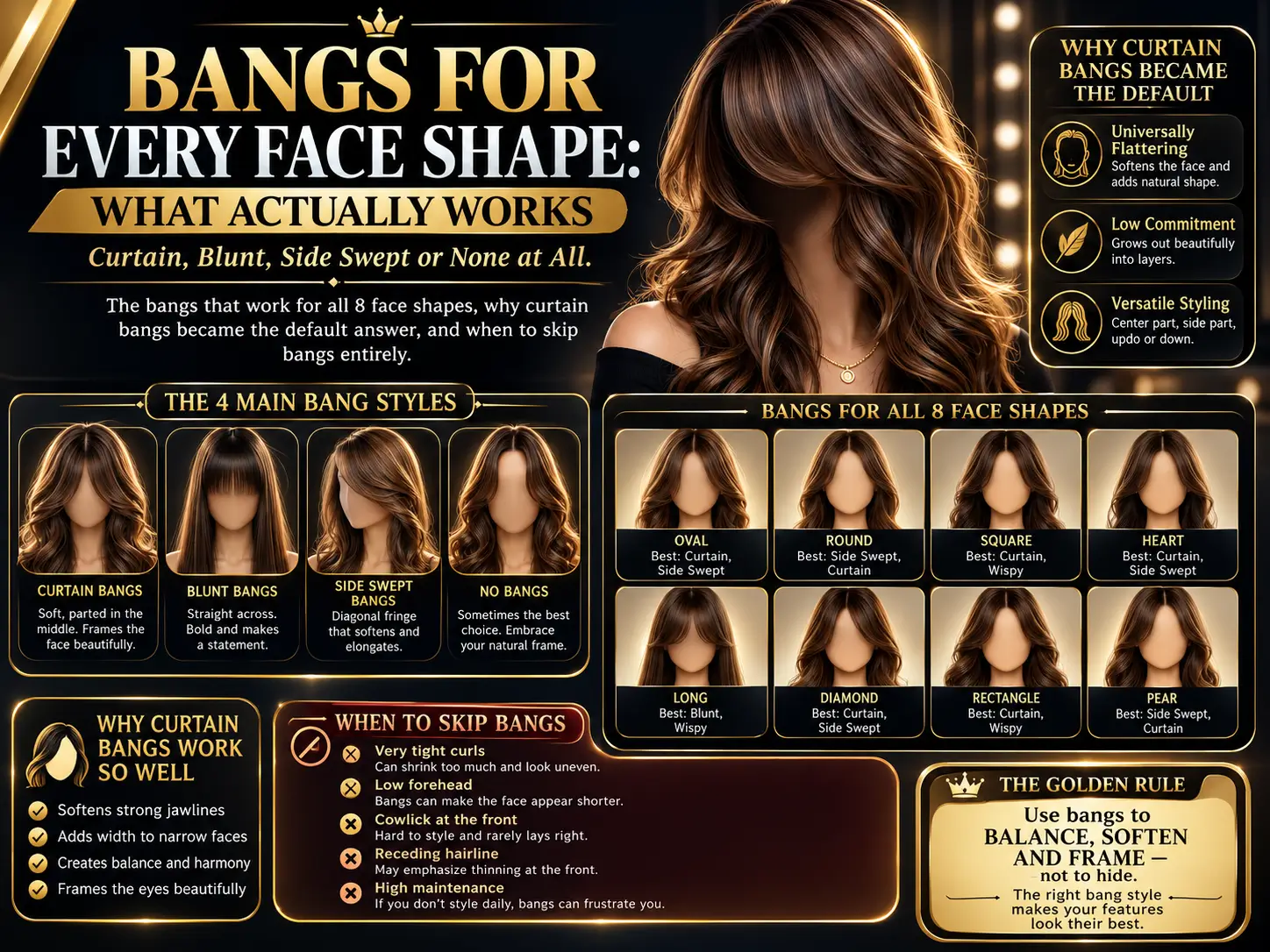
Quick answer:
Bangs change how long your face reads and where the eye lands first, which makes them one of the highest impact changes available without cutting any real length off your hair. Curtain bangs are the closest thing to a universal answer, because they part in the centre and sweep both ways, which softens angles, adds width at the forehead, and never sits as a single hard line. But “universal” is not “correct for everyone.”
The table below breaks down what actually works shape by shape, and the sections after it cover the two things most bangs guides skip: your hair texture, and your forehead height.
Why curtain bangs show up on every list
Search this topic and curtain bangs appear as the recommended choice for round faces, square faces, oblong faces, diamond faces and heart faces, which is unusual, since almost nothing else in face shape styling works for that many shapes at once.
The reason is structural, not trendy. A curtain bang is not one straight line; it is two diagonal pieces meeting at a centre part. That shape does three things simultaneously: it adds visual width at the temples, which helps narrow foreheads (triangle, oblong); it breaks up a straight hairline, which helps square and rectangle jaws by not repeating their angle; and it never sits as a hard horizontal, which is the one thing every face shape genuinely needs to avoid. That third property is why it beats a blunt fringe almost everywhere.
Bangs by face shape
| Shape | What works | What to approach carefully |
|---|---|---|
| Round | Side swept or curtain bangs, both add an angle a round face lacks | A full blunt fringe sitting straight across, which adds width exactly where the face already reads widest |
| Square | Curtain bangs, wispy or textured fringes, anything with soft broken ends | A blunt fringe spanning the full forehead, which adds a second hard horizontal to match the jaw |
| Oval | Almost anything, curtain, side swept, or a soft blunt fringe all work | A very heavy, completely flat blunt fringe, which is the one style that works against this shape specifically |
| Oblong | Curtain bangs or a full fringe sitting just above the brow, both shorten the visible length of the face | Side swept bangs alone with nothing at the centre, which does less to interrupt the length |
| Rectangle | Curtain bangs, for the same length-shortening reason as oblong | A blunt fringe landing exactly at the jaw corner in profile, doubling the angle |
| Heart | Side swept or curtain bangs, both break up forehead width without adding to it | A heavy blunt fringe, which adds more visual weight to the part of the face that is already widest |
| Diamond | Curtain bangs, since the forehead is the narrow point here and curtain bangs add width there specifically | A fringe cut level with the cheekbones, which draws a line across the widest part of the face |
| Triangle | Wispy bangs or a textured fringe that adds volume at the forehead, which is this shape’s narrowest point | A heavy fringe with no volume, which sits flat rather than widening anything |
The two variables most bangs guides skip
Your hair texture decides whether bangs will actually behave. A curtain bang on fine, straight hair needs regular blow drying with a round brush to hold its curve, or it will drop flat within a day and stop doing the job it was cut for. On thick or wavy hair, curtain bangs mostly style themselves. On curly or coily hair, bangs shrink upward as they dry, so they need to be cut noticeably longer than the finished length you actually want, and a curl-specific cut (cut dry, curl by curl) holds up far better than a uniform wet cut that shrinks unevenly.
Your forehead height changes which specific bang works. A short forehead usually looks best with wispy, higher, lighter bangs, since heavy full bangs on a short forehead can look cramped. A tall forehead has more room for a fuller curtain or even a blunt fringe, since there is more surface area for the style to sit on without looking crowded. This is somewhat independent of face shape itself, worth checking in a mirror before committing regardless of what your shape table cell says.
When to skip bangs entirely
Three genuine reasons, not just preference:
- A cowlick directly at the hairline. Bangs cut against a strong cowlick fight it daily, and no amount of product fixes this permanently. A side part with the length swept away from the cowlick is more reliable.
- You wear glasses. Fuller bangs and thick frames both add weight to the upper half of the face, and stacking them can look heavier than either alone. Wispy, shorter bangs pair better with glasses than a full curtain does.
- Low maintenance is the actual priority. Bangs need trimming every three to four weeks to keep the shape working, faster than the rest of a haircut. If that upkeep genuinely will not happen, face framing layers without a true fringe give a lighter version of the same effect with far less maintenance.
FAQs
What face shape suits curtain bangs best?
Curtain bangs work across more face shapes than any other bang style, because the centre part and diagonal sweep add width at the temples, soften angular jaws, and never sit as a hard line. They are a strong default for round, square, oblong, diamond and heart shapes specifically.
What is the best face shape for bangs generally?
No shape should avoid bangs altogether, only styles of bangs that work better or worse for each one. Oval faces have the most freedom. Oblong and rectangle faces benefit most, since a fringe genuinely shortens how long the face reads. Round faces need to be more careful about a fully blunt style specifically.
Do bangs suit a round face shape?
Yes, side swept or curtain bangs both work well, since they add an angle a round face otherwise lacks. A full, straight, blunt fringe is the one style to be cautious with, since it adds width right where a round face already reads widest.
What type of bangs work for a square face shape?
Curtain bangs or a wispy, textured fringe, both of which introduce a soft broken line rather than repeating the straight angles already present in a square jaw. A heavy blunt fringe spanning the full forehead is the style to avoid, since it adds a second hard horizontal.
How often do bangs need to be trimmed?
Every three to four weeks for most people, faster than the rest of a haircut, since even a small amount of growth changes how bangs sit and can push them into the eyes. This is worth factoring in before choosing a full fringe over a lighter, longer face framing style.
Can curly hair have curtain bangs?
Yes, but they need to be cut differently. Curl shrinks bangs upward as it dries, so curtain bangs on curly hair are cut longer than the intended finished length, ideally dry and curl by curl rather than uniformly wet, to account for how much the curl pattern will pull the length up.
Reference on the style discussed throughout: bangs.
3 thoughts on “Bangs for Every Face Shape”