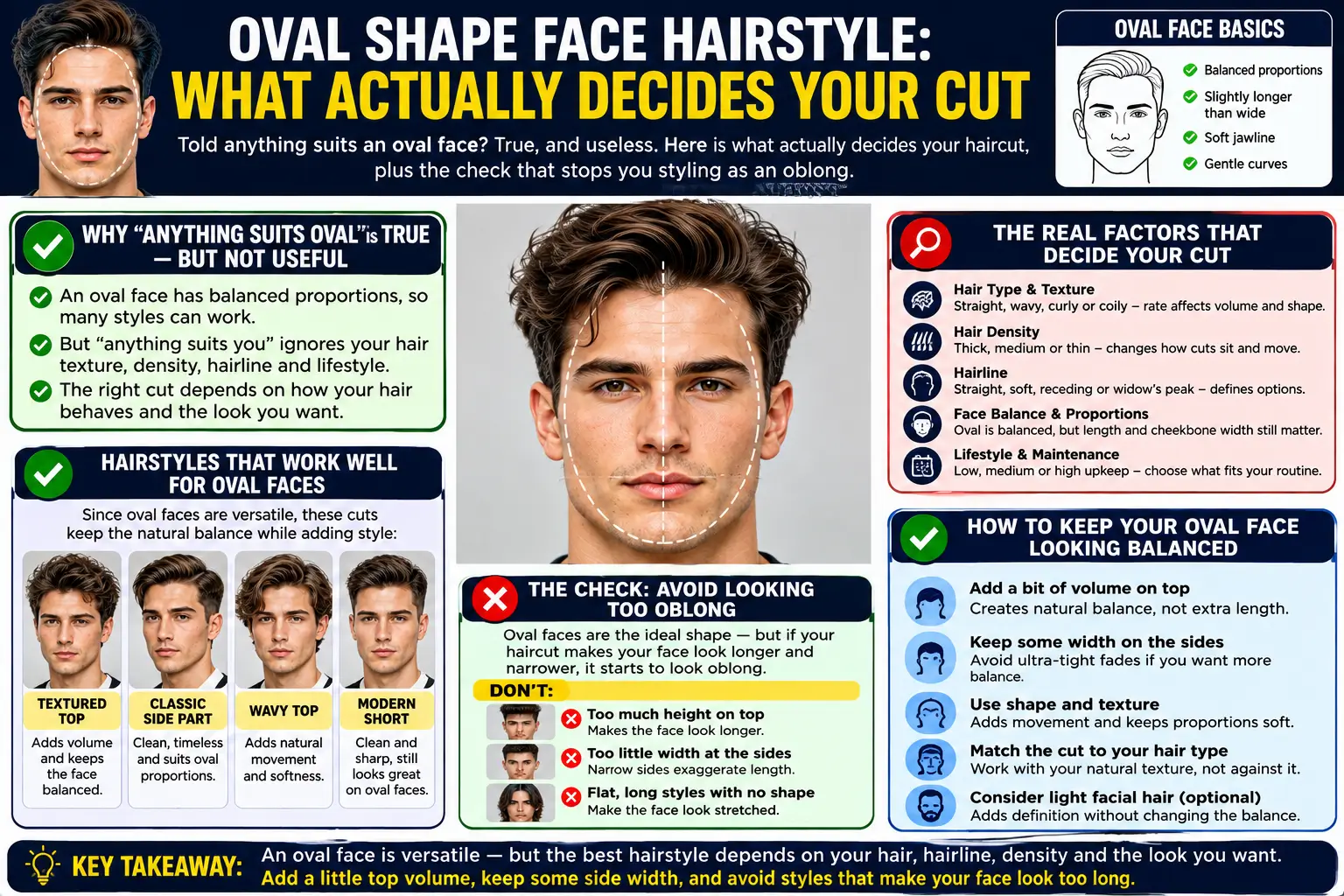
Quick answer:
An oval face has no imbalance for a haircut to correct, which is why every guide says anything suits you. That is accurate and it is not advice. With no corrective goal, three other things decide your cut: your hair texture, your hair density, and how much styling you will realistically do. Face shape rules out only two things here, and they are listed below.
First though, check you are actually oval, because this is the most common misclassification in the whole category and it changes the answer.
The check that matters more than any cut
Several widely published guides describe an oval face as being about one and a half times longer than wide.
But 1.5 is where oblong begins on most measurement systems, including ours. So a guide describing an oval is often describing a face a calculator would call oblong.
That is not a naming quibble. The advice diverges on one specific point:
| Oval | Oblong | |
|---|---|---|
| Volume at the crown | No restriction | Works against you |
| Long straight length | Fine with layers | Adds to the length |
| Width at the sides | Optional | Actively wanted |
If you are actually oblong and styling as an oval, the crown volume you were told was fine is lengthening a face that was already long.
Divide face length by cheekbone width. 1.30 to 1.50 is oval. Above 1.50 is oblong. Between 1.45 and 1.55 you are genuinely on the seam, so read the oblong page too. The face shape calculator prints your number.
What actually decides your cut
1. Hair texture. The real constraint, and the one guides skip.
- Fine and straight: a blunt lob or a one length bob, which create the illusion of density. Avoid heavy layering, which removes what little weight you have.
- Thick and straight: long layers, or a lob with internal thinning. Blunt cuts on thick hair read heavy and triangular.
- Wavy: medium length with light layering. Almost anything works, so choose by lifestyle.
- Curly: a curly lob or long layered curls. Layers cut for curl rather than pulled straight.
- Coily: a shaped afro, twists, locs or a tapered cut. All work, so choose by maintenance appetite.
2. Hair density. Fine hair and thick hair want opposite things at the same length, and this matters more than face shape here. Fine hair wants weight kept in. Thick hair wants weight removed.
3. Your actual routine. A blowout lob needs twenty minutes and a round brush. A blunt bob air dries. Stylists report this as the most common reason a technically flattering cut disappoints: the client will never do what it needs.
Cuts, and what each one gives you
Not ranked, because none is more correct for this shape. Pick by effect.
| Cut | What it gives you | Maintenance |
|---|---|---|
| Blunt lob | Sleek, modern, makes fine hair look denser | Low to medium |
| Long layers | Movement and softness, best on thick or wavy hair | Low |
| Classic bob | Sharp, timeless, showcases the jaw and neck | Medium, needs regular trims |
| Pixie cut | Puts the focus entirely on your features | Low daily, high trim frequency |
| Curtain bangs with long hair | Face framing without commitment to a full fringe | Low |
| Shoulder length with face framing layers | The safe middle, flatters almost everyone | Low |
| Slicked back | Clean and sharp, works because the proportions carry it | Low |
| Wolf cut or shag | Texture and attitude, good on wavy hair | Low |
The pixie point deserves saying explicitly. On an oval face a pixie works better than on almost any other shape, because there is no imbalance for hair to correct. The face carries itself. On a round face short hair removes needed structure, on an oblong it exposes length. On an oval it simply reads as a choice.
The two things that genuinely do not work
Short list on purpose. Padding it to look thorough would be dishonest.
- Blunt full width bangs. They shorten the face and flatten the natural balance that defines the shape. Curtain, side swept and wispy fringes are all fine.
- Very long, one length hair with no layers. It pulls the eye straight down and turns balanced proportions into long ones.
Everything else is preference. That is not a cop out, it is the actual finding.
Face framing, if you want a rule to follow
With no correction to make, face framing becomes about which feature you want to lead.
| Where the shortest framing piece falls | What it draws attention to |
|---|---|
| Cheekbone level | Cheekbones and eyes |
| Jaw level | Jawline and neck |
| Collarbone | Nothing specific, softens overall |
That is a decision about emphasis rather than balance, which is the whole difference between this shape and the other seven.
How your cut ages
An oval face is the most forgiving of grow out, because the proportions stay balanced as length changes. That is a genuine practical advantage.
| Weeks | What happens |
|---|---|
| 1 to 4 | As cut |
| 5 to 8 | Softer, less defined, still balanced |
| 9 plus | Shape lost, but the face still reads fine |
Practical: Six to eight weeks for a bob or pixie where the shape is the point, ten to twelve for long layers where it is not. You have more room than any other shape.
FAQs
What hairstyle suits an oval face?
Nearly all of them, which is why the more useful question is what decides your cut instead. Choose by hair texture, density and how much styling you will actually do. The only cuts that work against an oval face are blunt full width bangs and very long one length hair with no layers.
Is an oval face the best face shape?
It is called ideal in styling guides because it needs the least correction, which is a statement about styling convenience rather than appearance. That convention comes from classical art, not from research. Every shape has cuts that suit it.
Can an oval face wear a bob?
Yes, and it is one of the strongest options. Blunt bobs and lobs both work, and a blunt cut is especially useful on fine hair because it creates the illusion of density.
Should an oval face avoid bangs?
Only heavy blunt full width bangs, which shorten the face and remove the gentle length that defines the shape. Curtain bangs, side swept fringes and wispy see through bangs all work well.
Can an oval face wear a pixie cut?
Yes, and it suits this shape better than most. With no imbalance to correct, short hair reads as a deliberate choice rather than something that removes needed structure.
How do I know if my face is oval and not oblong?
Divide your face length by your cheekbone width. Between 1.30 and 1.50 is oval, above 1.50 is oblong. It matters because oblong faces should avoid crown volume and add width at the sides, while oval faces have no such restriction.
More on cutting terminology: layered hair.