Quick answer:
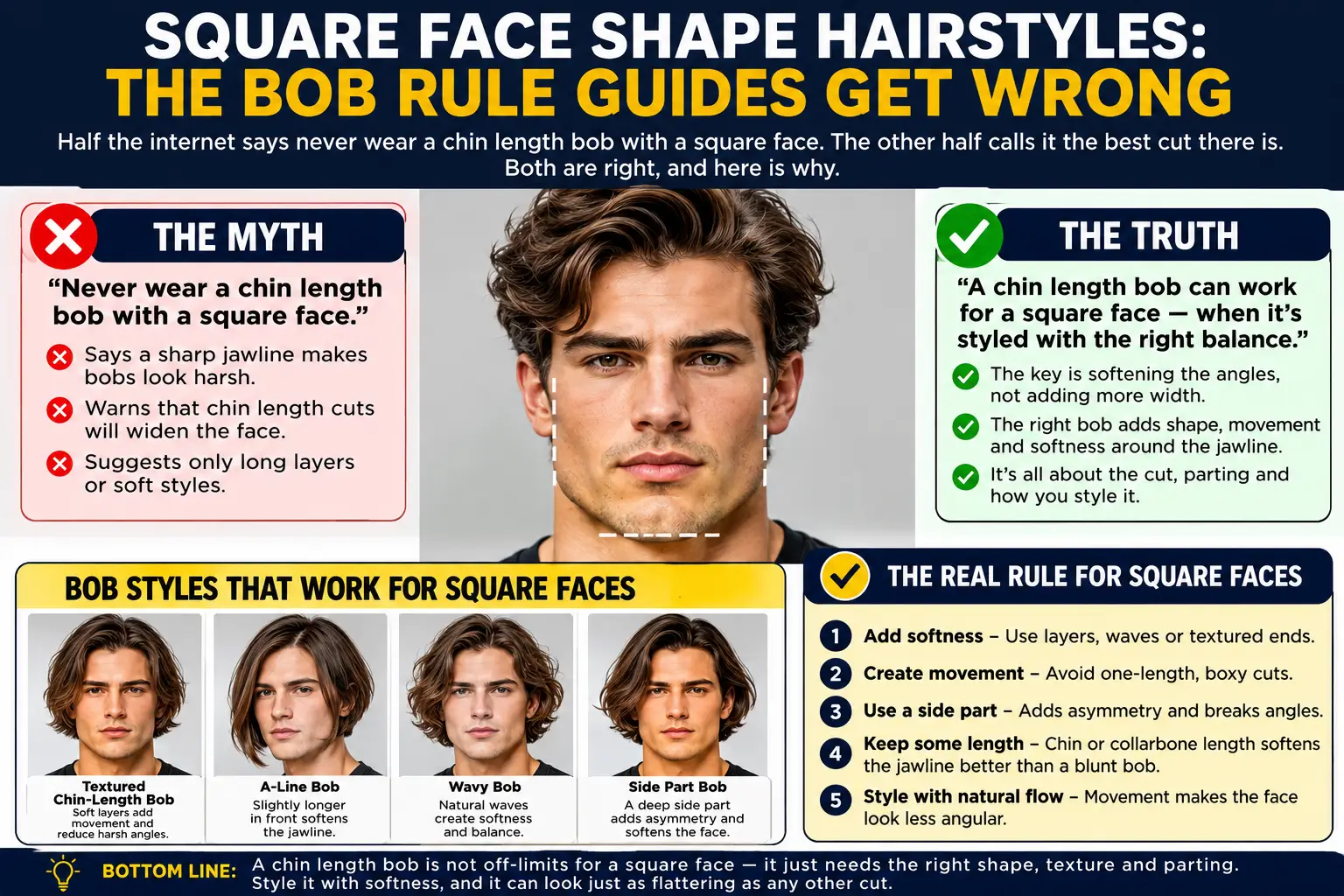
A square face is compact with even widths and a jaw that turns a visible corner. The cuts that work introduce curves, diagonals and movement against that angular structure: soft layers, curtain bangs, side swept fringes, waves, and bobs whose ends curve inward. The one genuine risk is a blunt horizontal line landing level with your jaw, because it draws a second straight line parallel to your jawline. Note the wording carefully, because it is not about length. It is about whether the ends turn in or sit flat.
Not sure you are square? Run a finger along your jawline from below your ear toward your chin. A distinct turn means square. A smooth curve means round. Both shapes are compact, so proportions cannot separate them. The face shape detector reads the jaw contour for you.
The chin length bob argument, settled
This is the most contradictory advice in the whole category, and it is worth resolving before anything else.
- One side says avoid it. Published guides warn that chin length bobs “accentuate the square jawline” and advise keeping length below the jaw to avoid bulk in that area.
- The other side says it is the best cut available. A major beauty brand calls the French bob, a chin length cut, among the most flattering haircuts for square faces. Multiple stylist led articles agree.
Both are describing real outcomes. The variable neither one names is what the ends do.
| The same length, two executions | What it does to a square jaw |
|---|---|
| Blunt ends sitting flat at jaw level | Draws a straight horizontal line right along the jawline, doubling it |
| Ends curving inward below the chin | Draws a curve against the angle, which softens it |
The French bob works precisely because it is described as having ends that curl slightly inward toward the face. Stylists achieve it with a round brush, turning the ends under just below the chin.
So the honest rule is not “avoid chin length bobs”. It is: if your bob ends at jaw level, the ends must turn in. Straight and flat at that length is the version that widens you.
If you would rather not manage that, the safe alternative is simple: take the length below the jaw, to collarbone or lower, where the horizontal line lands somewhere that does not matter.
The cuts that work
| Cut | Why it works | Say this to your stylist |
|---|---|---|
| Textured lob | Length below the jaw, layers add movement against the angles | “Collarbone lob, long layers starting below the cheekbone, soft ends not blunt” |
| French bob | Chin length but the ends curve in, which softens rather than squares | “French bob, chin length, ends turning under toward my face, short curtain bangs” |
| Long layers with curtain bangs | The most reliable combination for this shape | “Long layers, curtain bangs opening at the cheekbone, keep the ends soft” |
| Side swept pixie | Asymmetry plus a diagonal, and it showcases the bone structure | “Pixie with long side swept bangs, texture through the top, keep it soft not blocky” |
| Wolf cut or shag | Layers at many heights, maximum movement | “Shag with layers through the sides, plenty of texture, nothing blunt” |
| Stacked bob with a side part | Volume at the crown plus asymmetry | “Stacked bob, deep side part, angle the front slightly longer” |
| Tousled waves | Curves everywhere, the least effortful softening there is | “Long layers cut for wave, nothing that will sit flat” |
| Curly bob | Curls are the strongest natural softener for an angular jaw | “Curly bob, layered for shape, keep the weight off the jaw line” |
The bangs rule, and it is consistent
Every source agrees on this one, which is unusual in this topic.
Bangs work on a square face as long as they do not span the full width of your forehead. A full width blunt fringe adds a horizontal line at the top to match the one at your jaw, and the face reads boxier.
What works instead:
- Side swept bangs, because they create a diagonal across the forehead
- Curtain bangs, because they open outward and curve
- Wispy or see through fringe, because there is no hard line to read
If you love a blunt fringe anyway, the workaround from stylists is to keep everything else soft, pairing straight bangs with a medium length cut styled in loose waves so the fringe is the only hard element rather than one of two.
Match it to your hair texture
- Fine and straight. Your challenge is that fine hair sits flat, and flat plus angular reads severe. Ask for a cut that builds body: a lob with long layers, or a stacked bob with volume at the crown. Blow dry with a mousse or styling foam at the roots and shape loose bends rather than a poker straight finish. Part slightly off centre, because a dead centre part on fine straight hair with a square jaw is the most severe combination available.
- Thick and straight. You have the opposite problem, which is bulk. Thick hair cut bluntly at jaw level is the worst case for this shape. Ask for internal layering and thinned ends, and take the length below the jaw. Longer rounded layers work particularly well on thick hair.
- Wavy. Naturally suited. The wave supplies the curve for free. A textured lob or shag is close to ideal. Do not straighten it flat, which removes the exact quality that is helping.
- Curly. One of the best textures for a square face. Curls soften an angular jaw with no styling effort at all. A layered curly bob or long layered curls both work. Keep the widest part of the curl above or below the jaw rather than at it.
- Coily and afro textured. Rounded shapes work beautifully here, softening the corners. A shaped afro, a curly bob, or twists with volume at the crown all add curve. The thing to avoid is a hard geometric outline at jaw level, which repeats the angle.
About the “more feminine” framing
Worth naming, because you will meet it constantly.
A lot of square face advice is written as damage control. Soften. Round out. Look less harsh. One guide explicitly recommends avoiding very short cuts because they can look “boxy or masculine” and advises length and softness for a “more feminine and harmonious” result.
That is one aesthetic opinion presented as a rule. A defined jawline is a structural feature, not a flaw, and it appears across every gender. Plenty of stylists take the opposite view and recommend cropped pixies precisely to showcase the bone structure.
So the softening advice on this page is offered as one direction, not the correct one. If you want to lean into the angles instead, a sharp pixie, a blunt lob below the jaw, or a sleek bob all do that deliberately, and they are legitimate choices rather than mistakes.
How your cut ages
| Weeks | What happens | What to do |
|---|---|---|
| 1 to 3 | Layers and ends sitting as cut | Nothing |
| 4 to 6 | Ends losing their curve, layers dropping | Round brush the ends more deliberately |
| 7 to 10 | Ends now sitting flat, and if the length is at the jaw the horizontal line returns | Trim, especially if you wear a chin length bob |
The maintenance point specific to this shape: a chin length bob depends on the ends turning under. As it grows the ends drop and straighten, so the exact thing that made it work disappears first. If you wear that length, a six to eight week trim is not optional, it is what keeps the cut doing its job.
FAQs
What hairstyles suit a square face shape?
Cuts with curves and movement against the angular jaw: textured lobs, long layers with curtain bangs, French bobs with ends curving inward, shags, and tousled waves. The one thing to avoid is a blunt horizontal line landing level with your jaw.
Can a square face wear a bob?
Yes, and it can be one of the best cuts for this shape, but the execution matters more than the length. A bob whose ends curve inward below the chin softens the jaw. A blunt bob sitting flat at jaw level draws a straight line along the jawline and makes the face read squarer.
What bangs are best for a square face?
Side swept, curtain, or wispy see through bangs. All three either create a diagonal or open outward. Avoid a blunt fringe that spans the full width of your forehead, because it adds a second horizontal line to match your jaw.
Should square faces avoid short hair?
No. Some guides warn against very short cuts, but plenty of stylists recommend cropped pixies specifically to showcase strong bone structure. A side swept pixie with texture is a genuinely good option. It is an aesthetic choice rather than a rule.
What is the difference between a square and a round face for hairstyles?
The jaw, and it changes everything. Both shapes are compact, but a round face needs height and angles added, while a square face already has angles and the question is whether you want to soften or showcase them. Compare on the square face shape page.
Is a middle part bad for a square face?
Not bad, but it is the most severe option, because it splits the face into two symmetrical halves and adds no diagonal. It works best with waves or curls that supply softness elsewhere. On fine straight hair, a slightly off centre part is more flattering.
Frame shapes follow the same principle as haircuts here, and the sizing rules are in the glasses guide. External reference: bob cut.