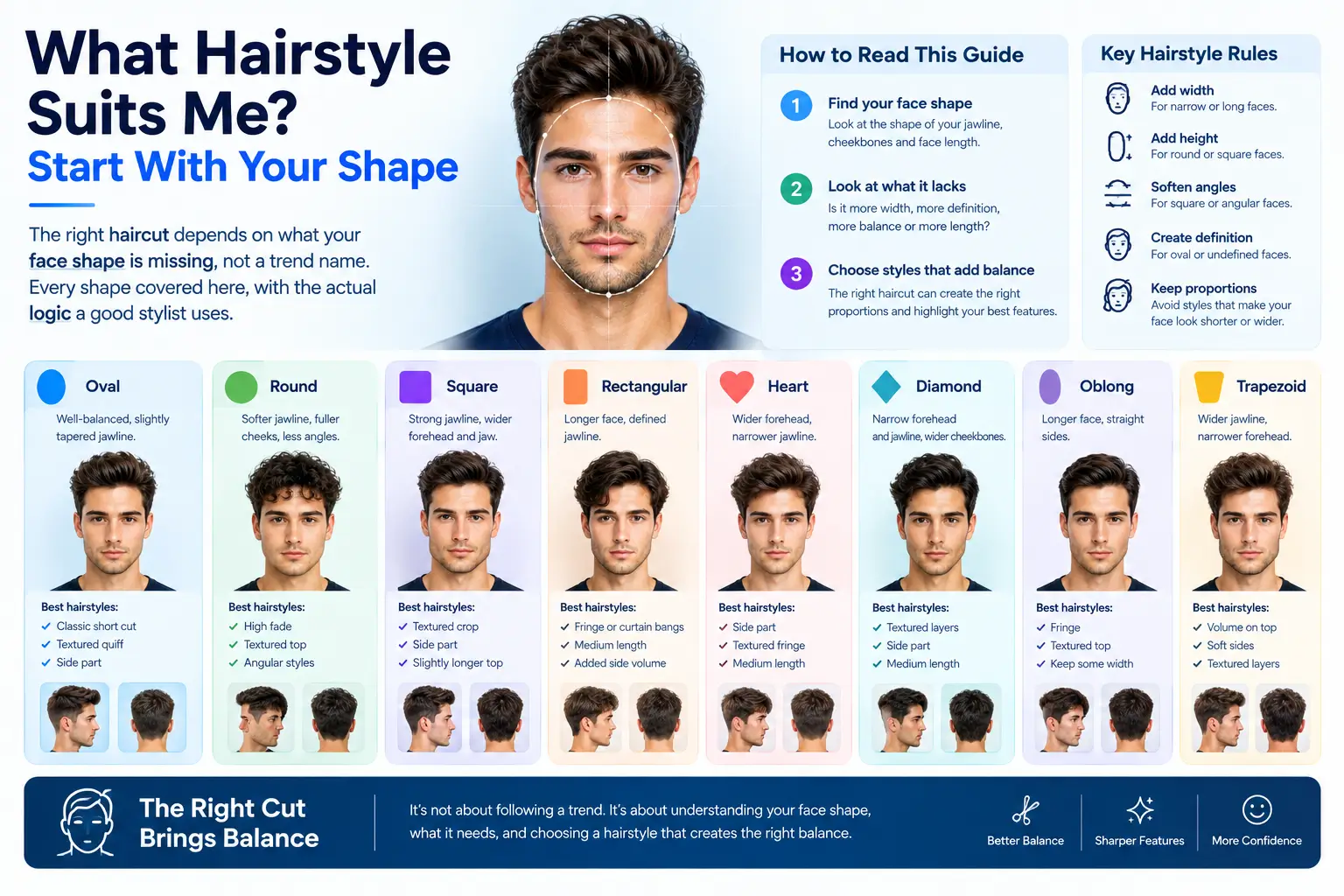
There’s no single haircut that suits everyone, but there is a consistent way to figure out what suits you specifically. It comes down to your face shape, and more precisely, what your face shape has plenty of already versus what it’s missing.
Quick answer:
A haircut that adds what your face doesn’t already have- height if your face is compact, softness if your jaw is angular, width if your face is narrow- tends to work better than picking a style because it’s trending.
Confirm your actual face shape first, then use the specific guide below, since round and oblong faces, for instance, need genuinely different things.
Why Trend Names Don’t Actually Answer This
“What haircut suits me” usually gets answered with a list of trendy style names. The problem is that a style name alone doesn’t say where volume goes, and that’s the part that actually determines whether a cut works for your face.
Two people can both get “a shag” and walk out with meaningfully different results, depending on where the stylist placed the layers and volume. That’s why this page points you toward your actual shape first, not a list of trends to scroll through.
Every Shape, With Its Own Guide
| Your shape | What it generally needs |
|---|---|
| Round | Height and angles, to add length |
| Oval | The most flexible shape; most cuts work with small adjustments |
| Square | Softer lines, to ease a strong jawline |
| Oblong | Width at the sides, length kept in check |
| Heart | Less added width near the temples |
| Diamond | Width at the forehead and jaw |
| Rectangle | Width at the sides, similar to oblong |
| Inverted triangle | Width lower down, to balance a wide forehead |
Looking for a men’s-specific breakdown instead? The face shape hairstyles for men hub covers the same shapes with men’s cuts specifically.
How Do I Actually Find Out My Face Shape First?
This is the step that makes everything above useful instead of a guess. Pulling your hair back and checking in a mirror gives a rough idea, but it’s genuinely easy to misjudge, particularly between similar pairs like round and oblong.
The face shape detector reads your actual proportions from a photo in under a minute. That’s a more reliable starting point than eyeballing it.
FAQs
How do I know what hairstyle actually suits me?
Confirm your face shape first, then match it to the guide for that shape above. The underlying logic is adding what your face doesn’t already have- height, width, or softness- rather than copying a trending style.
Is there one haircut that works on every face shape?
No single style is universal, though well-placed layers with face-framing pieces tend to be the most adaptable starting point across shapes.
Why did a haircut that looked great on someone else not work for me?
Most likely a different face shape, even if the styles looked similar in a photo. The same haircut name can be executed differently depending on where volume and layers are placed, and what balances one face shape can work against another.
Do I need to know my exact face shape, or is a rough guess enough?
For a haircut you’re committing to for months, an actual measurement is worth the extra minute over a guess. The face shape detector settles it more reliably than a mirror check.
What should I tell my stylist if I don’t know the name of the cut I want?
Describe the effect you want: more height, a softer jaw, less width at the temples, rather than a trend name. That gives a stylist something specific to work from, regardless of what the style is called.