Textured Crop Low Fade: What to Ask Your Barber
A short, textured top and a low side transition can give a neat, flexible haircut. The important details are the fringe, the shortest side length and how much coverage stays above the fade.
What is a textured crop with a low fade?
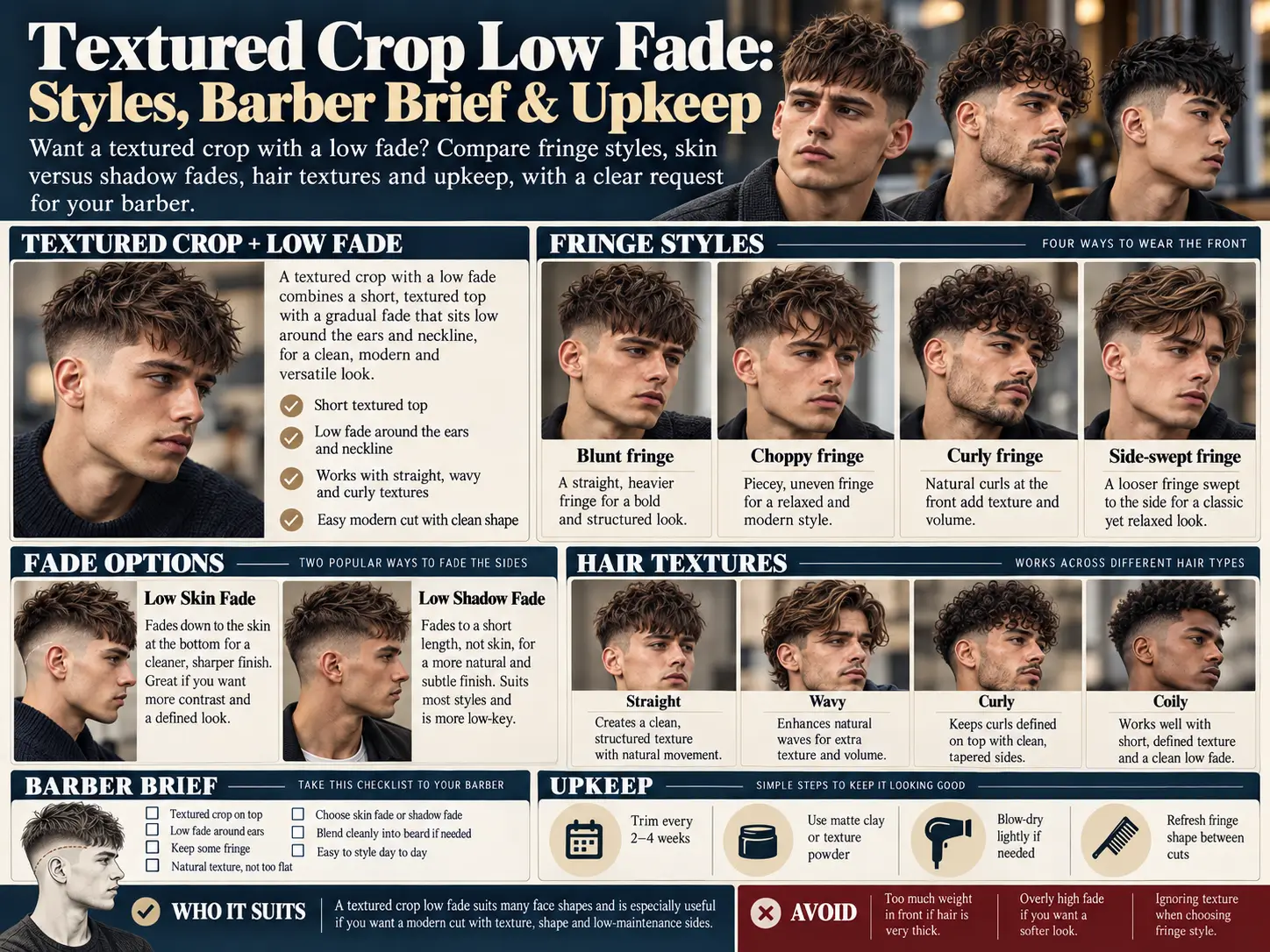
A textured crop low fade combines a short-to-medium top with visible separation or movement and a fade kept low around the sides and back. The fringe often moves forward, but it can be broken, blunt or angled. The top and the fade are separate choices.
A crop is not one exact length. “Low” describes where the transition sits; it does not automatically mean skin is exposed. Wahl’s professional crop-fade guide shows one version of the cut, rather than a rule every barber must copy.
This guide helps you explain what you want. For broader choices first, use our men’s haircut guide by face shape.
Agree these four details before cutting
- Fringe position: point to where it should sit when dry. Say whether you want a dense line, separated pieces or a diagonal edge.
- Top movement: explain whether you will wear it forward, loosely across or with a little lift. “Textured” does not have to mean spiky.
- Fade height: show where the short transition should end around the ears and the back. Ask how much temple coverage will remain.
- Shortest side length: choose visible skin or some short hair left at the bottom. This is separate from how high the fade goes.
Bring both a front and a side photo. A front-only reference can hide a high fade, a disconnected top or a back shape you did not intend to request.
Three useful versions to compare
Soft crop + low shadow fade
Some short hair remains at the bottom of the transition. Pair it with a softer fringe if you want a less exposed finish. Agree what “shadow” means with your barber; the name alone does not set the length.
Broken fringe + low skin fade
The lowest part reaches visible skin while the transition stays low. A separated fringe gives a different front line from a solid blunt edge. Decide whether you want that sharper contrast.
Wavy crop + retained side weight
Keep enough top length for your wave to show, and agree how the longer side area connects to the fade. Check the dry outline so the top does not expand in a way you did not expect.
These descriptions are conversation starters, not standardized salon menu names. Your barber may use different terms for the same finish.
Low fade, low taper or French crop?
| Term | What it usually describes | What to clarify |
|---|---|---|
| Textured crop | The top and fringe, with separation or movement. | Dry fringe length, direction and amount of texture. |
| French crop | A crop often associated with a more defined forward fringe; usage overlaps. | Show the exact front edge instead of relying on the label. |
| Low fade | A low-placed blend across the sides and back. | Where it starts and ends, plus the shortest length. |
| Low taper | A more localized transition near the sideburns and neckline in common barber usage. | How much side and temple coverage stays; terminology varies. |
| Skin fade | The shortest section reaches visible skin. | The height of the fade—skin does not mean high. |
A haircut can be a textured crop and a low skin fade at the same time. Those labels answer different questions. Ask the barber to point to the areas before starting.
Will it work with my hair?
Straight or fine hair
Discuss how much density to keep at the front. Texture can be created without aggressively removing coverage. Ask for the finish with a small amount of product so you can see what the cut itself does.
Thick hair
Explain where it sticks out and whether the front falls or stands up. The connection between the top and the side weight matters. Do not request heavy thinning by default; ask what method fits your hair.
Wavy, curly or coily hair
A crop can use natural movement. The visible length after drying may differ from the stretched or wet length, so agree the dry fringe position. You do not have to straighten your hair to imitate a reference with a different pattern.
Cowlicks and a high hairline
Show the natural growth direction. A short forward fringe may split or lift instead of lying flat. Ask the barber what can be achieved with a routine you are willing to do; no fringe promises to hide every hairline.
How face shape changes the request
On a round face, a little lift or a diagonal fringe can be an option if you want a taller-looking outline. A flat fringe is still a valid preference.
For an oval face, choose the fringe and top direction around your hair and routine. There is no need to ban all forehead coverage.
If your face looks long, decide whether you want more temple coverage and a lower top. A low fade can still remove hair you hoped to keep, so compare it with a small taper or scissor finish. See the oval and oblong haircut comparison.
A photo face-shape estimate can organize ideas, but it cannot determine the one correct crop for you.
A complete barber request
“I want a textured crop with a low fade. Keep the transition low around the ears and back, leave some short hair at the bottom rather than going to skin, and retain enough temple coverage. I want a soft broken fringe sitting here when dry, with a top I can wear forward using a small amount of product. Please show me the side connection before taking more off.”
If you want a skin finish or a blunt fringe, say that instead. Point to the dry fringe position in a reference. You do not need to invent a guard number; ask the barber to explain the length they propose.
Style it without making the routine complicated
- Start with the cut’s natural direction. Gently remove excess water rather than rubbing aggressively.
- If air-drying gives the shape you want, keep that routine. If using a dryer, direct the front where you want it to sit without chasing maximum heat.
- Spread a small amount of your preferred product between your hands. Work it through lightly, then separate a few pieces with your fingertips.
- Check the sides and fringe in ordinary light. Add more product only if the first amount was not enough.
Product names do not guarantee the same weight or finish across brands. Start small rather than assuming every crop needs a strong clay. For heat care, the American Academy of Dermatology recommends low or medium settings and heat protection.
Upkeep: two different kinds of maintenance
Daily styling is the time needed to arrange the top. Barber upkeep is how often you want the edges and transition refreshed. A crop may be quick in the morning while its crisp fade needs more regular attention.
Ask which part will lose its intended shape first and what an edge tidy includes. Book according to your growth and preferred finish, rather than a guaranteed number of weeks. If you want a softer grow-out, discuss leaving more coverage or choosing a taper.
Textured crop low fade questions
Does a low fade have to be a skin fade?
No. Low refers to placement. Skin refers to the shortest finish. Ask to keep short hair at the bottom if you do not want visible skin.
How long should the top be?
Long enough for the direction and texture you want, considering your growth pattern. Agree the dry fringe position and use a reference; one length does not work for every texture.
Is it the same as a French crop?
The terms overlap. French crop often suggests a more defined forward fringe, while textured crop emphasizes separation or movement. A photo and a clear fringe request are more reliable than the name alone.
Can I get this cut in India or the USA?
Yes, but terminology can vary by barber. Show front and side references and agree the transition, skin exposure and dry fringe length. Choose by your own hair rather than nationality.
Is this a zero-maintenance haircut?
No haircut keeps its first-day finish indefinitely. The top may be quick to style, but a sharp fade can need regular tidying.
Sources and scope
Wahl: How to Crop Fade is a professional education example supporting the basic cut description. American Academy of Dermatology: healthy hair tips supports the heat-care points. Our versions, comparison table and barber request are original editorial guidance, not a promise of identical results or a substitute for a barber assessing your hair.