Quick answer:
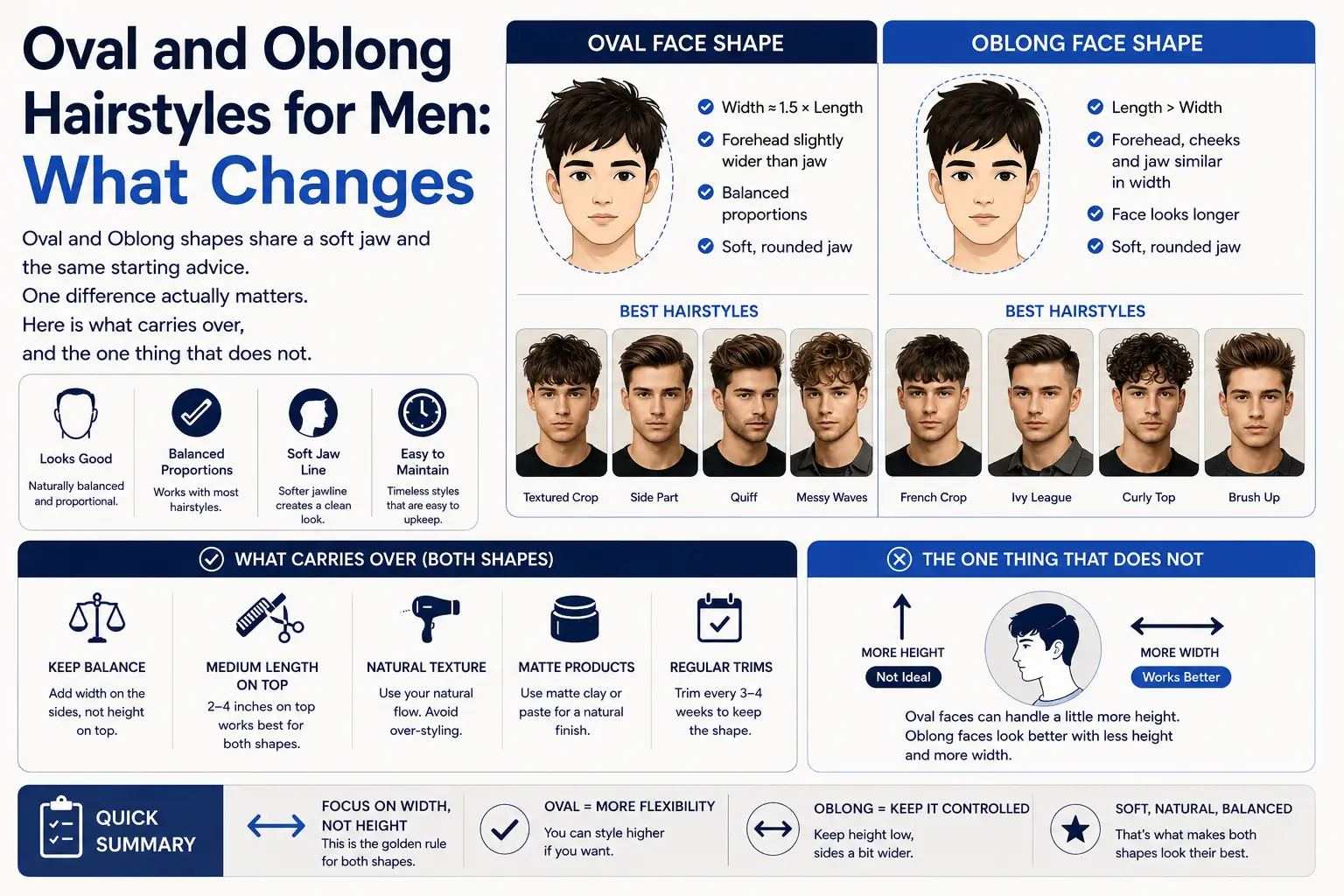
Yes, most of the advice is the same. Both shapes have a soft, curved jaw and cheekbones as the widest or near-widest point, so most cuts that work for one work for the other. The one real difference is length.
Oval has no imbalance to correct. Oblong does, and needs width added on purpose. Get that one adjustment right and the rest of the advice carries over directly.
Confirm which one you actually are first
Divide your face length by your cheekbone width. 1.30 to 1.50 is oval. 1.50 and above is oblong. Land between 1.45 and 1.55 and you are genuinely on the seam, so the advice below for both shapes applies to you either way.
This matters more here than almost anywhere else. Several popular guides describe an oval face as “about one and a half times as long as it is wide,” which is exactly where oblong starts on most systems, including this one. A guide written for “oval” using that description may actually be describing an oblong face. The face shape calculator gives you the exact number instead of a guess.
What carries over completely
| Principle | Why it applies to both |
|---|---|
| Soft jaw, no need to sharpen anything | Neither shape has an angular jaw to soften or showcase |
| Texture matters more than the cut name | Fine hair needs structure from the cut either way, thick and wavy hair carries almost any style |
| A centre part with no texture is the main thing to avoid | It flattens the face and, on oblong specifically, stretches it further |
| Beards work the same way | Full beards, stubble, goatees, all suit the soft jaw shared by both shapes |
The one thing that changes
Oval has nothing to correct. Oblong needs width, on purpose.
| Oval | Oblong | |
|---|---|---|
| Crown height | Free to add, no real downside | Best kept low, extra height reads as more length |
| Sides | Can be tapered close with no issue | Benefit from width, a low taper rather than a high fade |
| Fringe | Optional, a style choice | Genuinely useful, shortens the visible length |
| “Anything works” | Actually true | Not true. Height at the crown works against this shape specifically |
The practical result: An oval face can wear a high fade with a tall quiff and it works fine. The same cut on an oblong face adds length to a face that already has enough, which is the single most common mistake this shape runs into at the barber.
The cuts, by shape
Full breakdowns, hair texture specifics and grow-out timing are on each shape’s own guide. The short version for comparison:
- Works well on oval: textured crop, quiff, pompadour, side part, slick back, since none of them need to correct anything.
- Works well on oblong: French crop, curtain fringe, textured side quiff, classic side part, all of which add width at the sides rather than height on top.
- The one instruction worth repeating for oblong specifically: ask for a low taper, not a high fade. A high fade removes width right at the temple, which is already the narrowest useful point on a long face.
FAQs
Is oval and oblong the same face shape?
No, but close. Both have a soft jaw and similar width proportions, and the difference comes down to length: oval measures 1.30 to 1.50 times longer than wide, oblong is 1.50 and above. Most styling advice carries over between the two, with one exception.
Do oval and oblong faces need different haircuts?
Mostly not. The core advice is the same for both, since neither has an angular jaw to work around. The real difference is crown height: oval faces can add height freely, oblong faces should keep it low and add width at the sides instead.
Can a man with an oblong face wear the same haircut as an oval face?
Often yes, with one adjustment: skip extra height at the crown. A cut that works well on an oval face usually works on oblong too if the styling avoids adding more length, since that is the one thing this shape does not need.
What haircut works for both oval and oblong face shapes?
A textured crop with a low taper is the safest shared choice. It supplies structure for oval and adds width at the sides for oblong, without adding height that would only help one of the two shapes.
How do I know if I am oval or oblong?
Divide your face length by your cheekbone width. Below 1.50 is oval, at or above 1.50 is oblong. If you land close to 1.50, both this guide and each shape’s own hairstyle page apply to you.
Reference on the terminology discussed: head hair.