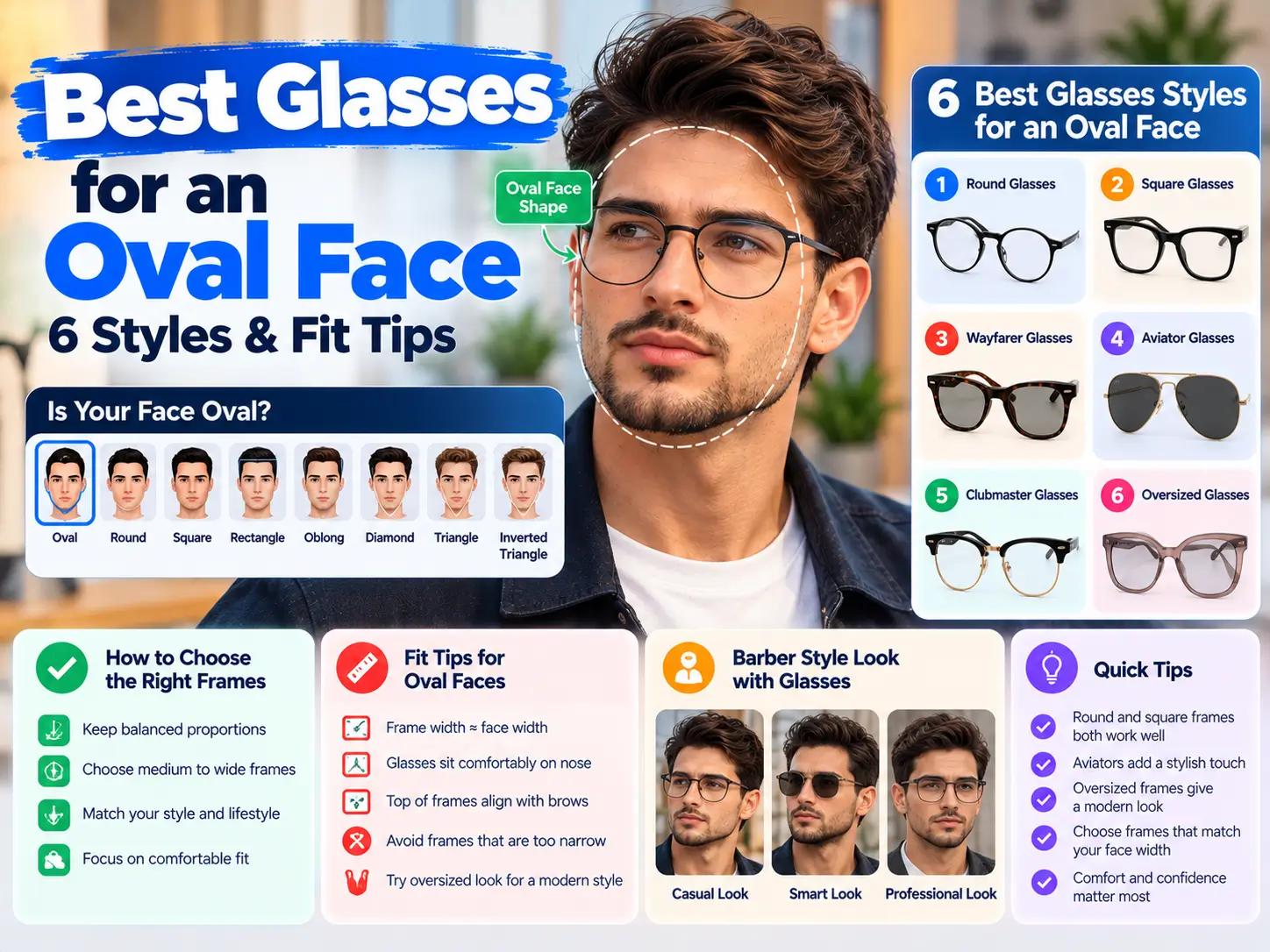
Best Glasses for an Oval Face: 6 Styles & Fit Tips
Find a frame you enjoy wearing. Compare shape, colour and visual weight, then check the fit details a face-shape label cannot tell you.
What glasses suit an oval face?
Rectangular, round, browline, cat-eye, aviator and rimless frames can all be worth trying on an oval face. Start with two contrasting styles you like, then choose the pair that fits comfortably and works with your lenses. There is no single best shape for every oval face.
An oval label describes the outline; it does not tell you your head width, nose-bridge fit or lens requirements. A stylish pair in the wrong fit is still the wrong pair. Our glasses fit and face-shape guide covers that second part in detail.
Six frame styles to compare
Rectangular or softly squared
Straight edges create a more defined frame outline against softer facial curves. Rounded corners make the effect less severe.
Try this: Compare a thin rim and a thicker rim in a similar size. This isolates visual weight instead of changing everything at once.
Round or oval
Curved frames repeat a softer outline. A small round lens and a larger round lens can look very different on the same person.
Try this: Check that you like the lens depth and eye position, not only the round shape in the product photo.
Browline
A more prominent upper rim draws attention toward the eyes and brows. Colour contrast changes how bold it feels.
Try this: Compare a dark top with a lighter or finer upper rim. Keep the overall size similar while deciding.
Cat-eye
An upswept outer edge creates a lifted-looking frame silhouette. It can be subtle or a deliberate statement.
Try this: Try both a gentle lift and a pronounced wing. The wings do not have to follow an imaginary face-width rule.
Aviator
The bridge and upper bar add horizontal detail; the lower lens shape can be rounded or more teardrop-like.
Try this: Look from the side as well as the front. A deep lens outline may sit differently from a shallow one.
Rimless or very thin metal
A less visible border keeps attention on your features. This changes visual weight without requiring a tiny lens.
Try this: Ask which lens shapes and sizes work with your prescription and the chosen mounting system.
These are original frame drawings for comparing design features, not photographs of products or a virtual fitting service.
Build a useful shortlist without trying everything
- Pick your everyday aim. Do you want the frame to stand out, blend in, or work across both office and casual clothes?
- Compare two shapes first. For example, try one soft rectangle and one round frame. Avoid changing shape, size, colour and rim thickness all at once.
- Keep the stronger candidate. Then compare it in two colours or rim weights.
- Check it while moving. Talk, smile and look down normally. Ask the optician to assess any slipping or pressure before deciding.
For example, if a large black rectangle feels too dominant, the next experiment need not be a completely different shape. Try a finer rim or a lower-contrast colour first. If the frame hurts, stop comparing colours and address fit.
The fit details an oval label cannot give you
A comfortable bridge, suitable side width and correctly positioned arms matter more than a “for oval faces” sticker. Warby Parker’s fit guide explains checking nose support, cheek clearance and temple comfort. A frame should not need constant pushing up or pinching to stay on.
Use the size on a comfortable existing pair as a starting reference, not a guaranteed replacement size. Specsavers explains the three frame measurements: lens width, bridge width and temple length in millimetres. The same numbers do not describe every detail of the frame.
If your frames repeatedly touch your cheeks or sit too low, explore low bridge fit glasses. Simply choosing a smaller bridge-width number is not a reliable answer.
Oval-face glasses for women and men
There is no separate geometric rule for men and women. For women with an oval face, cat-eye, rounded rectangles, fine metal and bold acetate frames are options—not requirements. Men can try those same shapes, along with browline or aviator designs if they prefer them.
Shop by the actual dimensions and effect you want. A “women’s” or “men’s” category can help you browse a retailer’s range, but it cannot confirm fit. A narrow face does not become wider because a frame is labelled unisex.
What if your oval face looks long?
First decide whether you want to emphasize that length or create a different visual balance. If you prefer less vertical emphasis, compare a frame with more visible lens depth to a very shallow rectangle. Look at the whole face in a mirror instead of enforcing a one-third-face-height limit.
The oval face guide explains why one numerical ratio cannot settle the label. You can also compare the long-face glasses guide, but do not buy an unnecessarily wide frame just because your face looks long.
Can an oval face wear oversized glasses?
Yes, if you enjoy the look and the frame fits. “Oversized” is relative to the wearer and the design; one fixed width does not define it for everybody. A bold, roomy lens shape can still have a suitable bridge and side fit.
Ask the optician whether the size works with your prescription and chosen lens design. Do not assume that a face-shape test or a flattering selfie proves optical suitability. If the pair is impractical, try a bolder rim in a more manageable size.
What to avoid when choosing
- Buying from a shape label alone: two people with oval outlines can need very different frames.
- Ignoring discomfort: a frame should not be accepted just because a style guide says it is flattering.
- Using “anything suits oval” as a guarantee: colour, scale, styling preferences and fit still change the result.
- Treating virtual try-on as a fitting: it helps compare appearance, but it cannot feel pressure or confirm how the bridge rests.
Before ordering online, check the exact model and size, lens options, adjustment support and current return terms for your location. These differ between retailers in the USA, India and elsewhere.
Oval-face eyewear questions
Are square or round glasses better for an oval face?
Neither is automatically better. Squared edges give a different outline from curved rims. Compare both in an appropriate fit and similar size.
Are cat-eye glasses good for an oval face?
They are an option if you like an upswept outer edge. Try the actual frame; the category name covers many sizes and degrees of lift.
What size should I buy?
There is no size assigned to oval faces. Use a comfortable pair as a reference and check the bridge, sides and lenses with an optician.
Should I avoid deep lenses?
Not as a blanket rule. Lens depth changes the look and needs to suit the frame fit and lens design. There is no universal one-third-of-your-face maximum.
Do these suggestions also work for sunglasses?
The style comparison can help, but sunglasses have separate lens-protection requirements. See the sunglasses guide and check the product’s protection details.
Sources and limits
Fit and measurement references: Warby Parker, Specsavers and Lenskart’s frame guide. The style comparisons and shortlist exercise are editorial suggestions, not an optician’s fitting, a prescription or a claim that these companies endorse this page.
2 thoughts on “Best Glasses for an Oval Face: 6 Styles & Fit Tips”