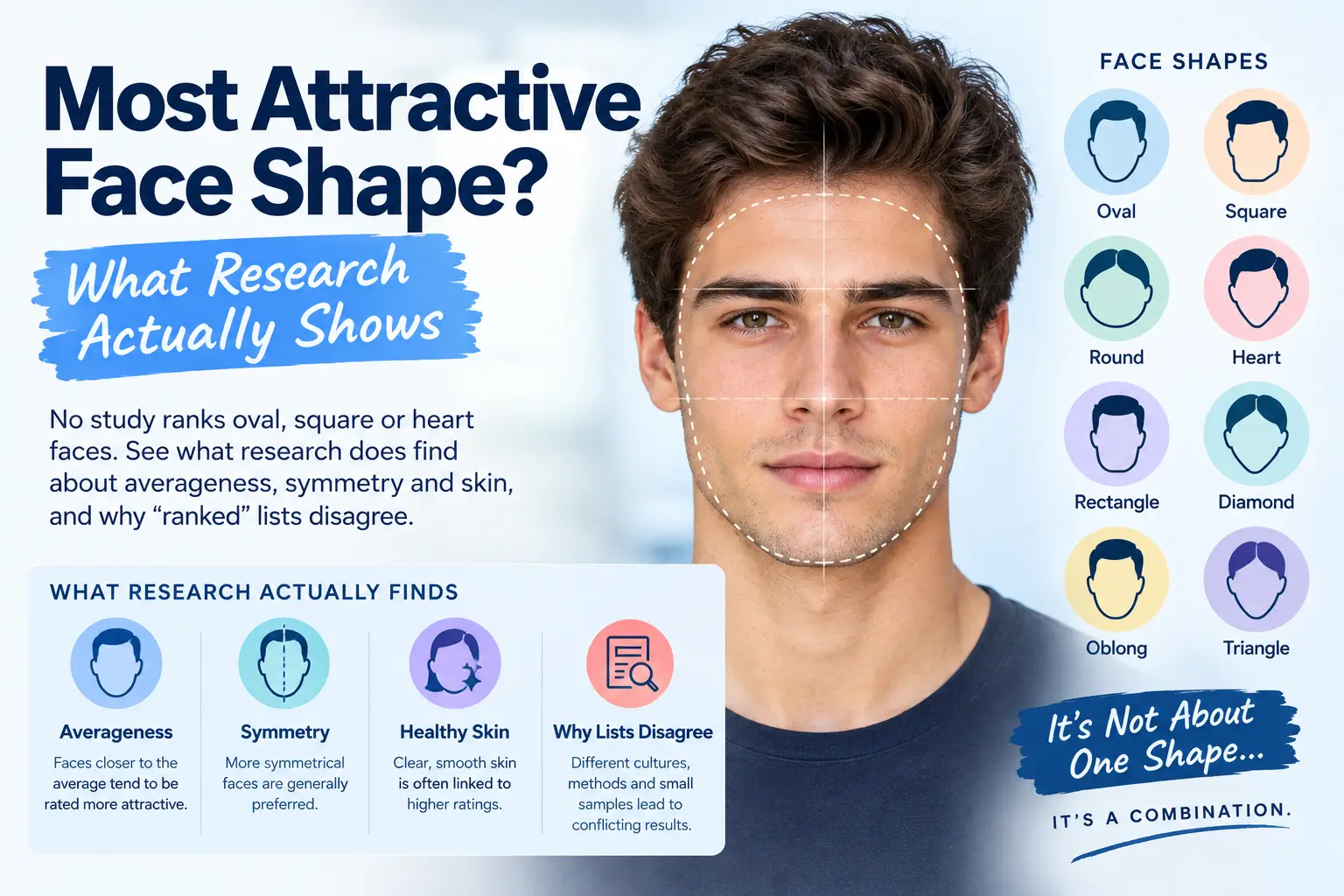
No study has ranked the everyday face shapes, such as oval, round, square or heart, by how attractive people find them. Oval gets called “ideal” because 1930s Hollywood makeup artists built their styling system around it, not because research crowned it. What attractiveness research does measure is different: how close a face is to average, sex-typical features, symmetry and skin. Here is what those studies found, why “ranked” lists disagree, and what actually changes how your face comes across.
Why oval gets called the “ideal” face shape
Oval is called ideal because the whole face-shape system was built around it. In the 1930s, Hollywood makeup artists Ern and Perc Westmore created the first systematic way to style hair and makeup by face shape. Their work grew out of earlier collaboration with Max Factor, which started from the premise that the ideal face shape was oval (Cosmetics and Skin).
Under that system, other shapes were described by how they differed from oval, and makeup and hair were used to make them look more oval. Style guides still follow that pattern today. So when a list says oval is the most attractive shape, it is often repeating the system’s starting point, not reporting a finding.
What research measures instead of face shape
One term causes a lot of confusion. In attractiveness research, “face shape” usually means the exact geometry of the whole face, measured with dozens of points. It does not mean the eight style labels used in beauty guides. Studies test qualities such as averageness, symmetry and sex-typical features.
Averageness
Averageness means how close a face is to the typical face of a group. It is one of the most consistent findings. In a 2025 study that measured several qualities at once, averageness predicted attractiveness ratings for both male and female faces (Lee and colleagues, 2025).
A 2010 study on feature spacing reached a similar conclusion. Faces looked most attractive when the eyes-to-mouth distance was about 36% of face length and the gap between the eyes was about 46% of face width. Those proportions match an average face (Pallett, Link and Lee, 2010).
Symmetry
The evidence on symmetry is mixed. A major 2006 review found symmetry was attractive in both male and female faces (Rhodes, 2006). But when the 2025 study measured symmetry alongside averageness and sex-typical features, symmetry did not predict ratings on its own (Lee and colleagues, 2025). Most real faces are slightly asymmetrical, and that is normal.
Masculine and feminine features
For female faces, more feminine features predicted higher attractiveness ratings in the 2025 study. For male faces, a more masculine shape did not (Lee and colleagues, 2025). An earlier study of male faces also found no link between measured masculinity and rated attractiveness, while skin colour did predict ratings (Scott and colleagues, 2010).
Culture matters too. A study across 12 populations found that preferences for strongly sex-typical faces showed up mainly in highly developed, urban settings, not everywhere (Scott and colleagues, 2014).
Skin and health cues
Features that change over time, such as skin colour and condition, can matter as much as bone structure. In the 2010 study above, skin colour predicted male attractiveness ratings when face shape did not (Scott and colleagues, 2010).
Do people agree on who is attractive?
Often, yes, but about specific faces, not shape categories. A large 2000 review of studies found that people tend to agree on who is attractive, both within and across cultures (Langlois and colleagues, 2000).
That agreement is about individual faces. Two people with oval faces can be rated very differently, and so can two people with square faces. A face shape label tells you about overall width and length, not about the many features that shape a first impression.
Is there a most attractive face shape for men?
No ranking exists for men either. Many lists claim a square, angular jaw is the most attractive male face shape, but the research above does not support that as a general rule. Measured masculinity did not predict male attractiveness ratings in two separate studies, while averageness and skin did.
What men can change is how the face is framed. A beard can add width or length at the jaw, and a haircut can add height or soften angles. See our guides to beards for your face shape and men’s hairstyles by face shape.
Is there a most attractive face shape for women?
No ranking exists here either. The research finding closest to the question is that averageness and feminine features predicted higher ratings for female faces. Neither of those is the same as being oval, heart or any other style category.
Hair, brows and glasses change how a face is framed far more than its category does. Start with what hairstyle suits me, eyebrows for your face shape or glasses for your face shape.
Why “most attractive face shape” lists disagree
Search for a ranking and you will find oval at the top of one list and square or diamond at the top of another. Three patterns explain why:
- Circular logic. Oval is defined as the “balanced” shape, then praised for being balanced.
- Celebrity examples. Lists pick famous faces that fit their favourite shape. Famous faces are attractive for many reasons, and most have professional styling.
- Uncheckable citations. Many lists say “studies show” without naming a study, or name one that cannot be found.
| Claim you will see | What the evidence says |
|---|---|
| Oval is the most attractive face shape | No study ranks style categories. Oval is the reference shape of a 1930s styling system. |
| A square jaw is the most attractive for men | Measured masculinity did not predict male attractiveness in two studies. |
| Symmetry is everything | Mixed. Attractive in older reviews, but not an independent predictor in a 2025 study. |
| The golden ratio decides beauty | Not supported. See is the golden ratio face real? |
| The rarest face shape is the most beautiful | Nobody has reliable data on which shape is rarest. See the rarest face shape. |
What actually changes how your face comes across
Your face shape category is the least changeable part of your appearance, and research suggests it is not the part that decides attractiveness. The things you can change are about framing and care:
- Hair adds or removes height and width around the face.
- Brows frame the eyes and change how the upper face reads.
- Glasses add lines and colour at eye level.
- Beard and grooming change the outline of the lower face.
- Skin and health show in skin colour and condition, which studies link to attractiveness ratings.
Most attractive face shape FAQs
Which face shape is the most attractive?
None has been shown to be. No study ranks oval, round, square, heart or the other style categories by attractiveness. Research instead links attractiveness to averageness, feminine features in female faces and skin condition, which vary within every face shape.
Is an oval face the most attractive?
Oval is often called ideal because the 1930s face-shape styling system was built around it as the reference shape. That is a styling convention, not a research finding.
Is a square face attractive for men?
Many men with square faces are seen as attractive, and so are many men with other face shapes. Two studies found that measured masculinity did not predict how attractive male faces were rated.
What is the most attractive face shape for women?
No face shape category has been shown to be most attractive for women. In a 2025 study, more average and more feminine female faces were rated more attractive, and those qualities appear across all face shapes.
Is there a least attractive face shape?
No. The same evidence that finds no best shape finds no worst one. Styling guides describe differences between shapes, not a ranking of worth.
What is the most common face shape?
Nobody has reliable population data on face shape categories, so claims about the most common or rarest shape disagree widely. Our guide to the rarest face shape compares the claims.
Does the golden ratio decide which face is most attractive?
No. Research has not shown that being close to 1.618 makes a face more attractive. Studies on feature spacing point to average proportions instead.
Can I change my face shape to look more attractive?
Your bone structure is mostly fixed in adulthood, although weight and age change how full your face looks. Hair, brows, glasses and grooming change how your face is framed, and they are easy to adjust.
Sources
- Lee P, Li J, Rafiee Y, Jones BC, Shiramizu VKM. Further evidence that averageness and femininity, rather than symmetry and masculinity, predict facial attractiveness judgments. Scientific Reports, 2025.
- Pallett PM, Link S, Lee K. New “golden” ratios for facial beauty. Vision Research, 2010.
- Rhodes G. The evolutionary psychology of facial beauty. Annual Review of Psychology, 2006.
- Scott IM and colleagues. Does masculinity matter? The contribution of masculine face shape to male attractiveness in humans. PLOS ONE, 2010.
- Scott IM and colleagues. Human preferences for sexually dimorphic faces may be evolutionarily novel. PNAS, 2014.
- Langlois JH and colleagues. Maxims or myths of beauty? A meta-analytic and theoretical review. Psychological Bulletin, 2000.
- Cosmetics and Skin (James Bennett). Face shapes: history of styling by face shape.
4 thoughts on “Is There a Most Attractive Face Shape? What Research Actually Shows”