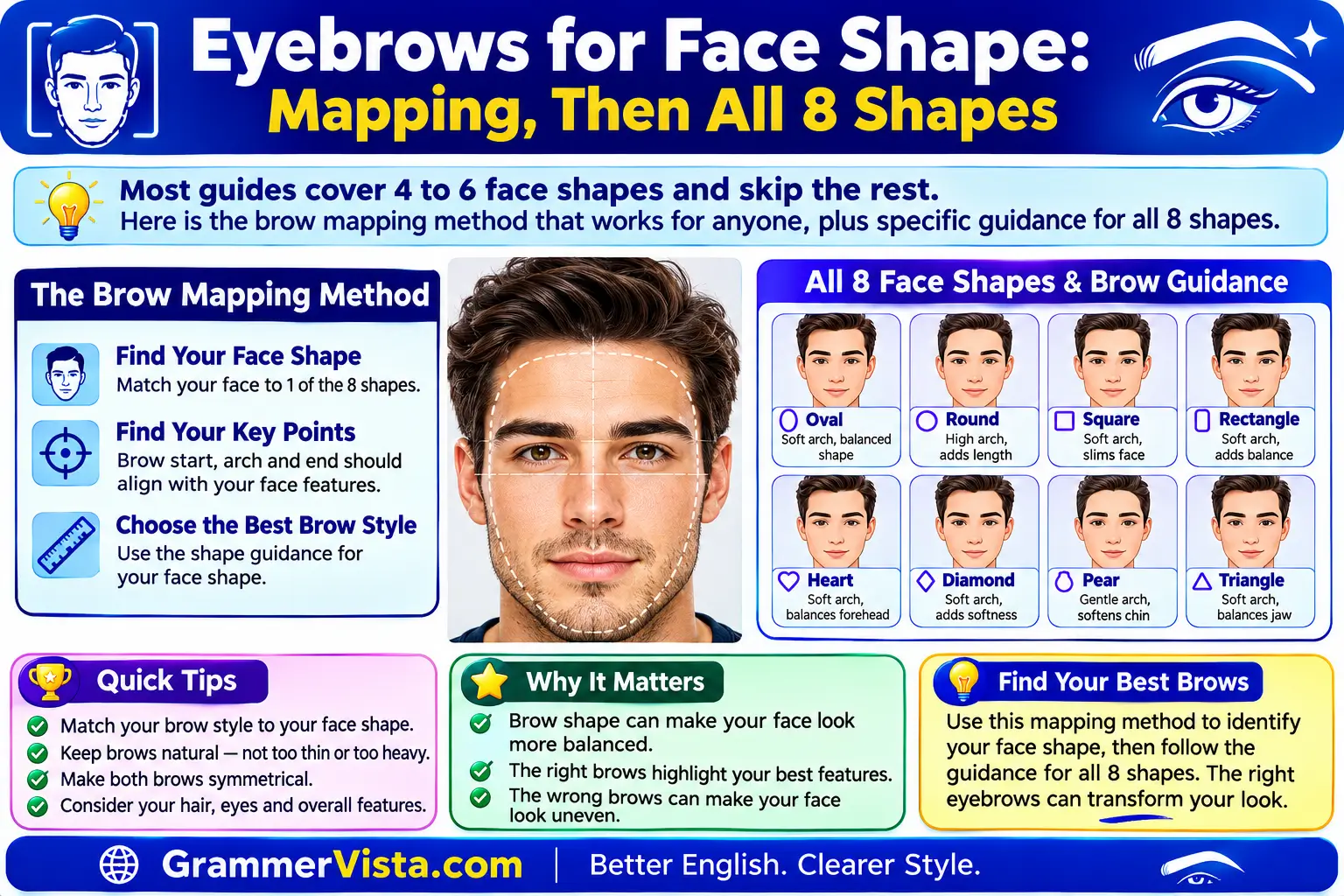
Quick answer:
Your eyebrows can change how your whole face reads in under five minutes, more than almost any other single styling choice. The general pattern: rounder, softer faces benefit from a defined arch that adds height, and angular faces benefit from a curved brow that softens the line.
But the shape of your brow is decided by three measurable points, not by guessing, and the mapping method below finds them precisely. The shape by shape table covers all 8 face shapes, not the 4 to 6 that most guides stop at.
The three points that actually decide your brow shape
Before any face shape advice, get these three points right. Every brow has a start, an arch, and an end, and there is a reliable way to find each one rather than eyeballing it.
| Point | How to find it | What it does |
|---|---|---|
| Start | Hold a pencil vertically against the side of your nose, lined up with the outer edge of your nostril. Where it meets your brow bone is your start point. | Marks where your brow should begin, preventing brows that start too close together or too far apart |
| Arch | Keep the pencil anchored at the same nostril edge, then tilt it so it crosses the centre of your iris while looking straight ahead. Where it crosses your brow is your natural arch point. | The single most important point. This is what most people guess at, and guessing is what causes an arch that looks off centre |
| End | Angle the pencil from the edge of your nostril past the outer corner of your eye. Where it meets your brow is where it should end. | Prevents a tail that stops too short or runs too long past your natural brow line |
One correction worth making directly: Tweezing hair from underneath your existing arch does not make the arch look higher. It only makes your brows thinner overall. If you want more height, the change happens at the arch point itself through shaping, not by removing hair below a point that is already in the right place.
Eyebrows for all 8 face shapes
Most guides stop at four to six shapes. This covers all eight, including the three that get skipped most often: oblong, rectangle and triangle.
| Shape | What works | What to avoid |
|---|---|---|
| Oval | Almost any shape works; a soft to medium arch is the safest default | Nothing specific to avoid; this shape has the most freedom |
| Round | A higher, more defined arch, which adds visual length and lift | Flat or heavily rounded brows, which echo the curve already in the face and can make it look rounder |
| Square | A soft curved arch to soften the jaw, or a straighter, more defined brow to match it deliberately | A hard, sharply peaked arch if softening is the goal, since it adds a third angle to an already angular face |
| Oblong | A flatter, straighter brow with minimal arch height, which keeps the face from reading any longer | A steep, high arch, which adds vertical line to a face that is already long |
| Rectangle | The same flat, low arch guidance as oblong, since length is the shared concern | A high dramatic arch, for the same reason as oblong |
| Heart | A soft, rounded arch that does not add extra width at the temples | A very high, sharply angled arch, which draws more attention to an already wide forehead |
| Diamond | A curved or gently arched brow, easing the cheekbone angle rather than matching it | A hard angled arch with a sharp peak, which repeats the angularity the face already has |
| Triangle | A fuller, slightly extended brow, which adds width at the forehead, the narrowest point on this shape | A thin, short brow, which leaves the narrowest part of the face with even less visual weight |
If none of that feels like your situation, or you are not sure which shape you are: a soft angled arch in medium thickness is the closest thing to a universal safe default. It is not extreme in either direction, which means it works reasonably well regardless of the exact shape underneath it. Confirm your actual shape with the face shape detector if you want a precise answer rather than a safe default.
Diamond deserves more than one line
Every other shape above got a full paragraph’s worth of coverage across the sources checked for this page. Diamond mostly did not. One source called it directly: diamond is one of the more underserved shapes in brow guidance generally, despite being a distinctive, striking shape on its own terms.
The actual guidance that does exist agrees on one thing: the brow’s job on a diamond face is to soften slightly, not compete. The cheekbones are already the widest, most defined point on this face. A curved or softly angled brow eases that angularity. A hard angled arch with a sharp peak does the opposite, adding a third sharp point to a face that already has enough of them at the cheekbones and the jaw.
How you shape it matters as much as the shape itself
Four common methods, each with a real tradeoff:
| Method | Best for | Tradeoff |
|---|---|---|
| Tweezing | Small touch ups, precision work | Slow for larger areas, easy to overdo one hair at a time |
| Waxing | Removing larger areas quickly | Less precise, harder to correct if too much comes off |
| Threading | Very precise line work | Takes practice or a skilled technician, can be more uncomfortable |
| Sugaring | A gentler alternative to waxing | Similar precision limits to waxing |
Whichever method you use, map your three points first with a brow pencil before removing anything. It is much easier to shape toward a plan than to correct a mistake afterward.
FAQs
What eyebrow shape suits my face?
It depends on your face shape. Round faces suit a higher, more defined arch. Square and diamond faces generally suit a softer, curved brow. Oblong and rectangle faces suit a flatter brow with minimal arch height. Heart and triangle faces both benefit from added width, through fullness rather than arch height specifically. The full table above covers all 8 shapes with what to avoid for each.
How do I find my natural eyebrow arch?
Hold a pencil vertically at the outer edge of your nostril, then tilt it so it crosses the centre of your iris while looking straight ahead. Where the pencil crosses your brow is your natural arch point. This is more reliable than guessing, since the arch is the single point most people get wrong when shaping at home.
Does tweezing under the arch make it look higher?
No, and this is a common mistake. Tweezing hair from underneath an existing arch only makes the brow thinner overall; it does not raise where the arch sits. If you want more height, the arch position itself needs to be reshaped, not thinned from below.
What eyebrow shape works for a diamond face?
A curved or gently arched brow that softens the cheekbone angle rather than matching it. Diamond faces are already the most angular at the cheekbones, so a hard, sharply peaked arch adds a third sharp point rather than balancing the face.
What if I do not know my face shape?
A soft angled arch in medium thickness is a safe universal default, since it is not extreme in either direction. For a precise answer, the face shape detector identifies your shape directly rather than requiring a guess.
Should oblong and rectangle faces avoid a high arch?
Yes, generally. Both shapes are already longer than they are wide, and a steep, high arch adds more vertical line to a face that does not need more length. A flatter brow with minimal arch height is the safer choice for both.
Reference on the anatomy discussed throughout: eyebrow.