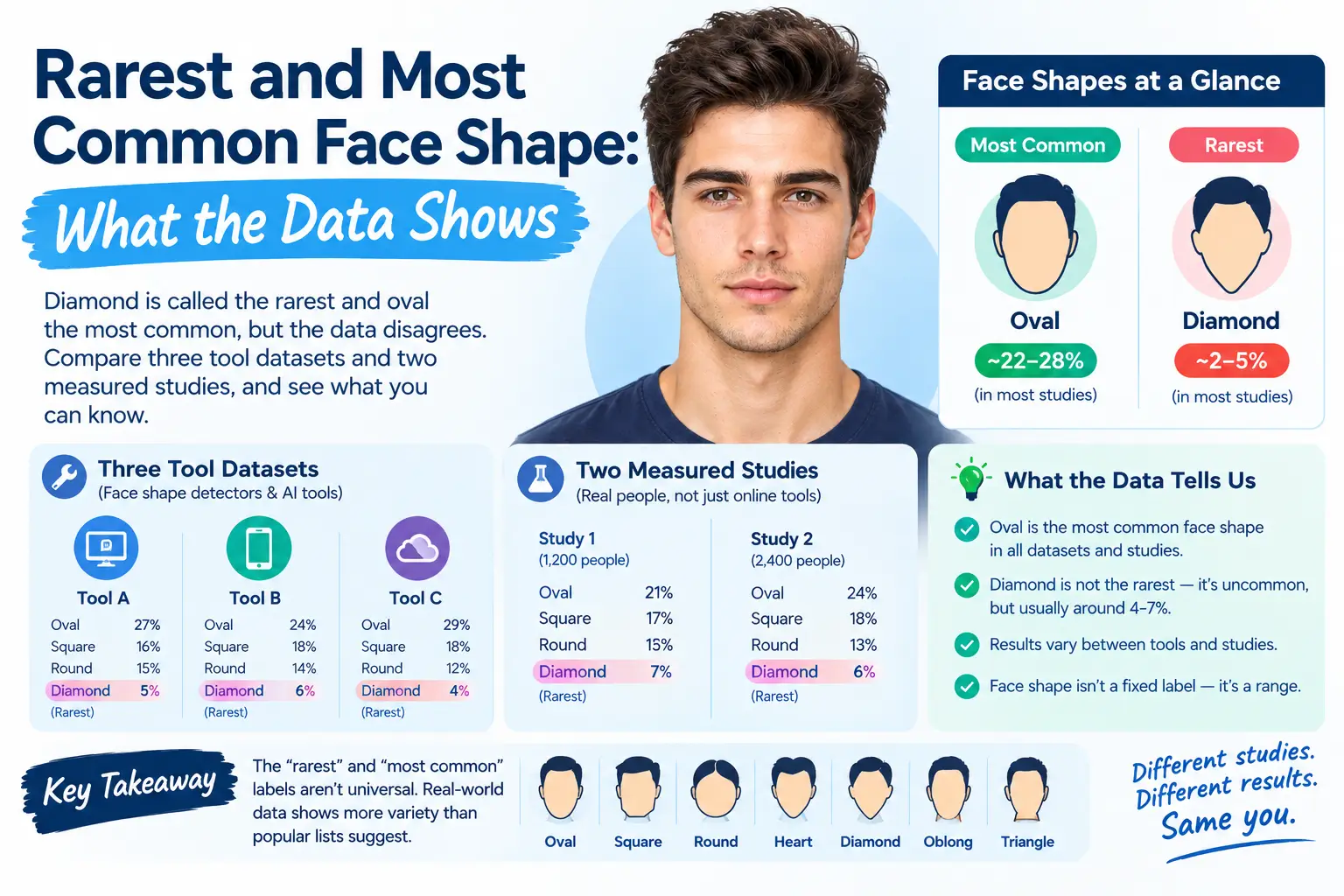
Diamond is the face shape most often called the rarest, and oval the most common, but the data behind those claims is weak. Three face shape tools that publish user counts all put oval first, yet diamond is about 5% of results in two of them and about 25% in the third. Measured population studies use a different system and show the most common face type changes from country to country. Here is what each source actually says.
What face shape tool data says
Most percentages you see online come from websites that run face shape tools and count their users’ results. Here are three that publish full breakdowns.
| Face shape | OblongFaceShape (51,247 analyses) | The Face Report (15,429 analyses) | FaceAura AI (18,041 scans) |
|---|---|---|---|
| Oval | 28.4% | 49.2% | 38.78% |
| Oblong | 21.7% | 14.0% | 1.09% |
| Round | 17.3% | 10.9% | 8.16% |
| Heart | 14.1% | 7.6% | 25.69% |
| Square | 9.5% | 12.9% | 1.23% |
| Triangle | 8.6% | Not reported | 0.05% |
| Diamond | about 5% | 5.4% | 24.99% |
Two patterns stand out. Oval comes first in all three, so “oval is the most common result” is the one claim they agree on. After that they split: diamond is near the bottom in two datasets and near the top in the third, and oblong ranges from about 22% to about 1%.
All three sites say their data comes from people who chose to use their tools, not from a random sample of the population (OblongFaceShape; The Face Report; FaceAura AI).
Why the numbers disagree so much
The disagreement comes from how the data is collected and labelled, not from faces changing between websites.
- Self-selected users. People who search “what’s my face shape” are not a random cross-section of everyone, and each site attracts a different audience.
- Different shape lists. Some tools use six or seven shapes, others eight. The Face Report has no triangle category, for example, so those faces land somewhere else.
- Different rules for borderline faces. Many faces sit between two shapes. Each tool decides those cases its own way, for example by giving the single strongest match, and that choice moves whole percentage points.
- No outside check. The sample sizes are real, but nobody has checked whether each face was labelled correctly against careful hand measurements.
So the honest summary is: oval is common in tool results, and nothing reliable says which shape is rarest.
What measured population studies show
Scientists who measure faces directly use a different system. They calculate the facial index: face height divided by face width. Results are grouped from very broad faces (hypereuryprosopic) to very long faces (hyperleptoprosopic). These groups do not match oval, round or diamond, but they are measured by trained researchers on real samples.
| Facial index type | Turkey, men (470) | Turkey, women (533) | Nepal, students (222) |
|---|---|---|---|
| Very broad | 18.1% | 15.6% | Not reported |
| Broad | 35.3% | 34.3% | Under 1% (1 student) |
| Medium | 33.2% | 34.3% | 4.5% (10) |
| Long | 8.7% | 11.8% | 19.4% (43) |
| Very long | 4.7% | 3.9% | 75.7% (168) |
In the Turkish study of 1,003 adults, broad and medium faces were most common and very long faces were least common (Ozsahin and colleagues, 2016). In the Nepalese study of 222 medical students, very long faces made up three quarters of the sample (Mansur and colleagues, 2020).
The two studies used different groups and possibly different measuring points, so their numbers should not be compared directly. But they show the key point: the most common face type depends on who you measure and how. One worldwide answer does not exist.
Rarest and most common face shape for men, women and India
- Men and women: the Turkish study is one of the few that splits results by sex. Broad faces were most common for men (35.3%). For women, broad and medium were tied (34.3% each). Very long faces were least common for both.
- India: we found no published population study of face shape categories for India. Claims about the “most common face shape in India” are not backed by data we could verify.
- “In the world”: no worldwide study exists. Any global ranking is a guess or a tool dataset.
If you searched “worst” or “ugliest” instead
No face shape is worse or uglier than another. Rare and common describe how often something appears, not how it looks.
The idea that some shapes need “fixing” comes from 1930s Hollywood styling, which treated oval as the ideal and described every other shape by how far it was from oval (Cosmetics and Skin). For the research on whether any face shape is more attractive than another, see is there a most attractive face shape?
What you can actually know
You cannot reliably know how rare your face shape is. You can know your own measured shape, which is more useful for choosing hair, glasses or a beard.
- The face shape detector measures your proportions from one photo.
- The face shape calculator does the same from four tape measurements.
- The face shape chart shows how all eight shapes compare.
Rarest and most common face shape FAQs
What is the rarest face shape?
There is no reliable answer. Diamond is the shape most often named rarest, and two tool datasets put it near 5%. A third puts diamond at about 25%, just behind oval and heart. No population study has measured the eight style face shapes.
What is the most common face shape?
In published face shape tool data, oval is the most common result, at 28% to 49% of users. These are self-selected users, not population samples, and measured population studies show the most common face type differs between countries.
Is diamond really the rarest face shape?
Not proven. Two tool datasets report diamond at about 5%, but another reports it at about 25%, third after oval and heart. Treat the claim as unverified.
What is the rarest face shape for women?
No data reliably answers this for the style face shapes. In a measured Turkish study, very long faces were the least common face type for women, at 3.9%.
What is the rarest face shape for men?
No data reliably answers this for the style face shapes. In the same Turkish study, very long faces were also the least common type for men, at 4.7%.
What is the most common face shape in India?
We found no published population study of face shapes in India. A study of medical students in Nepal found very long faces most common, but that does not represent India.
How many face shapes are there?
This site uses eight: oval, round, square, oblong, rectangle, heart, diamond and triangle. Other sources use six or seven, often merging oblong and rectangle.
Can I find out how rare my face shape is?
Not reliably, because no trustworthy population data exists for face shape categories. You can find your own measured shape with the face shape detector or calculator.
Sources
- Ozsahin E, Kizilkanat E, Boyan N, Soames R, Oguz O. Evaluation of face shape in Turkish individuals. International Journal of Morphology, 2016.
- Mansur DI and colleagues. Measurement of cephalic and facial indices among students of KUSMS. Journal of Chitwan Medical College, 2020;10(1):31-35.
- OblongFaceShape. Face shape statistics: data from 51,247 analyses (July 2026).
- The Face Report. Face analysis study, 15,447 analyses (September 2026).
- FaceAura AI. Most common face shapes, 18,041 scans (September 2026).
- Cosmetics and Skin (James Bennett). Face shapes: history of styling by face shape.
2 thoughts on “Rarest and Most Common Face Shape: What the Data Actually Shows”