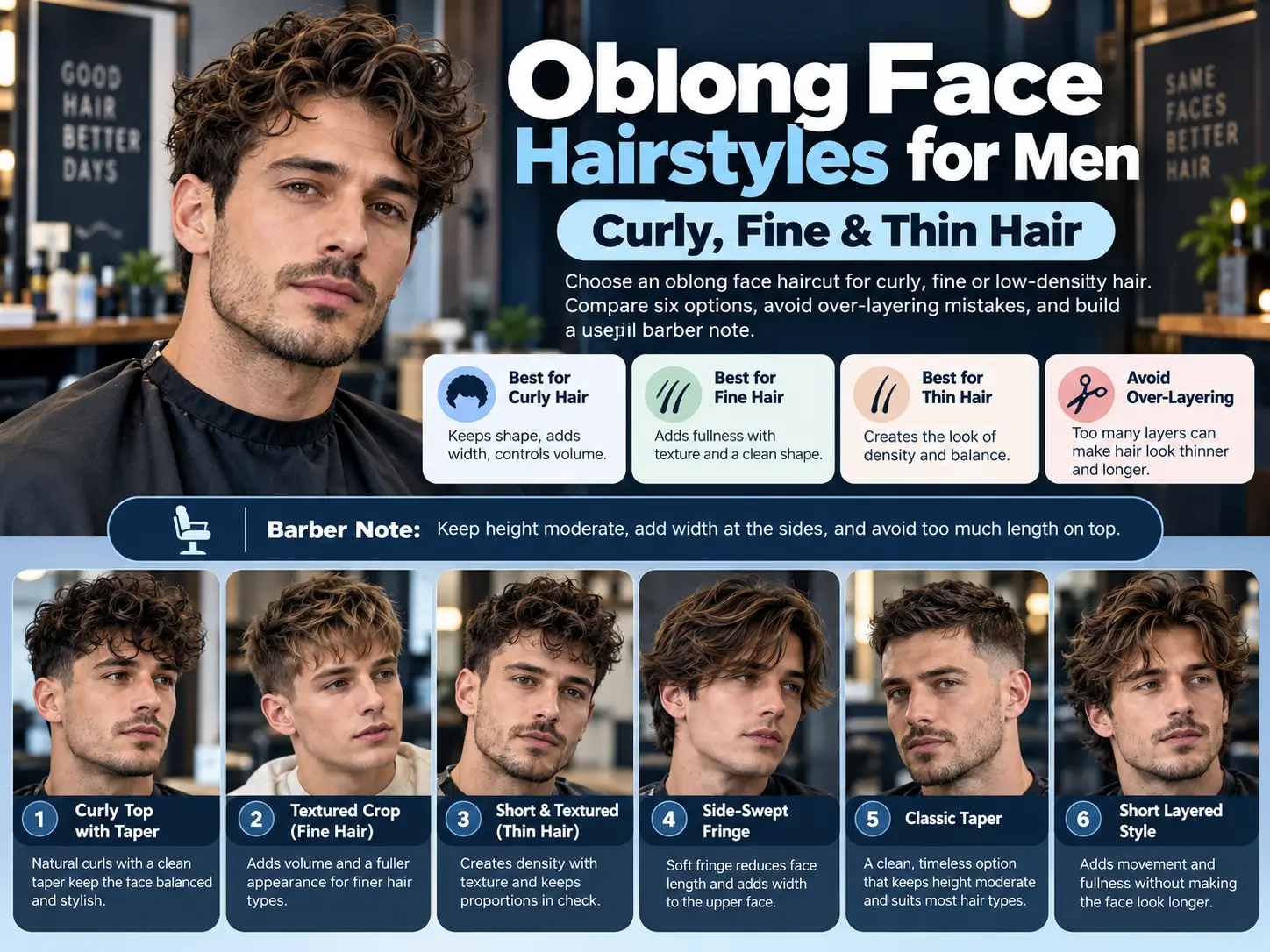
Long face, curly or fine hair? Start with what your hair does.
Separate curl pattern, strand thickness and density. Then choose a cut with realistic dry length and maintenance.
Compare the six cuts ↓Choose the effect you like. Your face does not need correcting.
Build your salon note
Choose a starting cut and your routine. This makes a request to discuss, not an AI prediction.
What works for an oblong face with curly or thin hair?
A soft crop, curly fringe, side part or longer shaped cut can work. Choose by curl pattern, strand thickness and density—not by treating curly and thin as opposites. If you want a less elongated outline, discuss lower top height, some side coverage or a fringe.
Those are optional effects. You can prefer a high fade or a taller top. For general cut ideas, start with oblong hairstyles for men. This page focuses on the texture and density questions that change the plan.
Curly, fine and thin are different descriptions
| Description | What you are describing | Can it overlap? |
|---|---|---|
| Curly or coily | The shape or bend of the strands. | Yes: curls can have fine or coarse strands and lower or higher density. |
| Fine | A smaller individual strand diameter. | Yes: someone can have many fine strands. |
| Thin / low density | Fewer strands filling an area. | Yes: the remaining strands can be fine, medium or coarse. |
| Thinning | A change in coverage over time. | A haircut can change styling; it does not explain the cause of a change. |
If you are unsure, explain the problem you see: the fringe separates, the sides puff out, the crown lies flat, or the cut shrinks too short after drying. That is more useful than guessing a hair-type number.
Six starting cuts and practical requests
Showing all six cuts.
Soft curly crop
A compact cut can keep natural curl movement while controlling the outline. Short curls are not automatically wrong for a long face.
Before choosing: The front may spring up when dry. A very close side can expose more of the face outline.
Ask your stylist: “Keep a soft front and check the dry curl position. Decide with me how much side coverage to keep before taking the sides shorter.”
Compact cut with a light side sweep
A shorter, gently directed top can give fine hair an intentional shape without demanding a tall quiff.
Before choosing: Extra texturizing may make low-density ends look more separated. A sweep should follow the growth pattern.
Ask your stylist: “Keep useful weight in the top and make the sweep follow my natural direction. Avoid removing bulk where coverage is already light.”
Curly fringe with a scissor-shaped outline
A front curl changes forehead coverage while the sides can retain the width you want.
Before choosing: A long wet fringe may become short when dry. Keeping every curl identical in length may not create an even outline.
Ask your stylist: “Check my fringe dry and shape the sides around the curl pattern. Keep the front comfortable above my eyes without assuming all sections shrink equally.”
Soft side part with controlled layering
A moderate length offers movement and some coverage without requiring a very layered finish.
Before choosing: Longer fine strands can separate or fall differently after washing. Do not promise volume from length alone.
Ask your stylist: “Keep enough length for my natural part, but preserve the perimeter and areas that look less dense. Show me a low-product finish.”
Longer curls with distributed fullness
You can keep length and decide where fullness sits. Some people prefer side movement; others like a higher outline.
Before choosing: More length does not guarantee that every curl will fall outward. Density, curl pattern and styling still matter.
Ask your stylist: “Keep my main length and assess the outline dry. Place layers only where they help the shape we agree on, rather than making the crown short by default.”
Longer fine hair with minimal layers
Keeping longer hair is possible if you enjoy it. A restrained outline can preserve ends and tying-back options.
Before choosing: A heavily layered inspiration may be a poor match for lower density. Ask what happens without a blowout.
Ask your stylist: “Keep the main length and useful weight at the ends. Make face framing optional and show me how the hair will fall with my normal wash-and-dry routine.”
For curls: agree the dry outline
Ask where the shortest front curl will sit once dry and where you want fullness. Do not assume longer curls always add width or short curls always add height. Different parts of the same head can behave differently.
If you want a lower crown, discuss the overall silhouette before simply cutting that area shorter. A short section can spring up or stand away from the head. The best question is what the proposed cut will do with your curl pattern, not which section is always forbidden.
Show the barber your normal finish: air-dried, diffused or stretched. A haircut chosen from a stretched style may feel very different when you wear it naturally. Keep the reference routine close to your own.
For fine or low-density hair: protect useful weight
Ask how much layering or texturizing the hair can support. More texture is not always more fullness: separated ends can show less coverage. A clean perimeter and selective movement may be a better starting point than removing weight throughout the cut.
Try the smallest useful amount of styling product first, then judge the result after it dries. Product names alone do not tell you whether a formula will feel heavy on your hair. If a reference needs daily lift from blow-drying, ask whether that matches your routine.
A cut can change how coverage appears. It does not increase the number of strands. If you are concerned about a new or ongoing change in density, the barber can discuss styling but should not be expected to diagnose the cause.
Choose the taper separately from the top
A taper can tidy the sideburn and neckline areas while retaining more hair elsewhere. A wider fade removes hair across a larger area. Ask where the short zone will sit and whether the upper-side weight you want will remain.
For fine sides, compare the contrast before going very short. For curls, decide how the longer area connects to the taper. Neither a high fade nor a short curly cut is banned for oblong faces. Use the mid taper fade guide to clarify the wording before your appointment.
A useful appointment plan
- Describe curl pattern and coverage separately.
- Bring a reference showing a similar texture and normal finish.
- Agree the shortest dry fringe, not just the wet cutting length.
- Ask where weight will be kept and where it will be removed.
- Try the everyday finish and discuss how the shape will grow out.
If you want more layering, compare the wolf cut guide. If you are unsure about the face label, use the oblong photo tool as an estimate rather than a cutting instruction.
Curly and fine-hair questions
Can curly hair also be fine?
Yes. Curl pattern describes the bend; fine describes the thickness of a strand. Density is a third question.
Should I avoid every short curly cut?
No. Judge the dry outline and the amount of side coverage you like. A short curl pattern does not create the same result on everyone.
Does thin hair always need more texture?
No. Excessive layering or texturizing can remove useful weight. Ask to see where coverage will remain.
Can I keep long fine hair with a long face?
Yes. You may prefer the outline and flexibility. Discuss restrained layers and a realistic everyday finish instead of treating length as forbidden.
Is this a treatment guide for thinning hair?
No. It helps with haircut communication and appearance. It does not diagnose changes in density or prescribe treatment.
Sources and scope
Davines’ explanation of fine versus thin hair supports the distinction between strand thickness and density. CADMEN’s barber-training guide to oblong faces describes conventional height/width styling choices while acknowledging preference. The cut requests above are our editorial examples, not a personal consultation.
2 thoughts on “Oblong Face Hairstyles for Men”