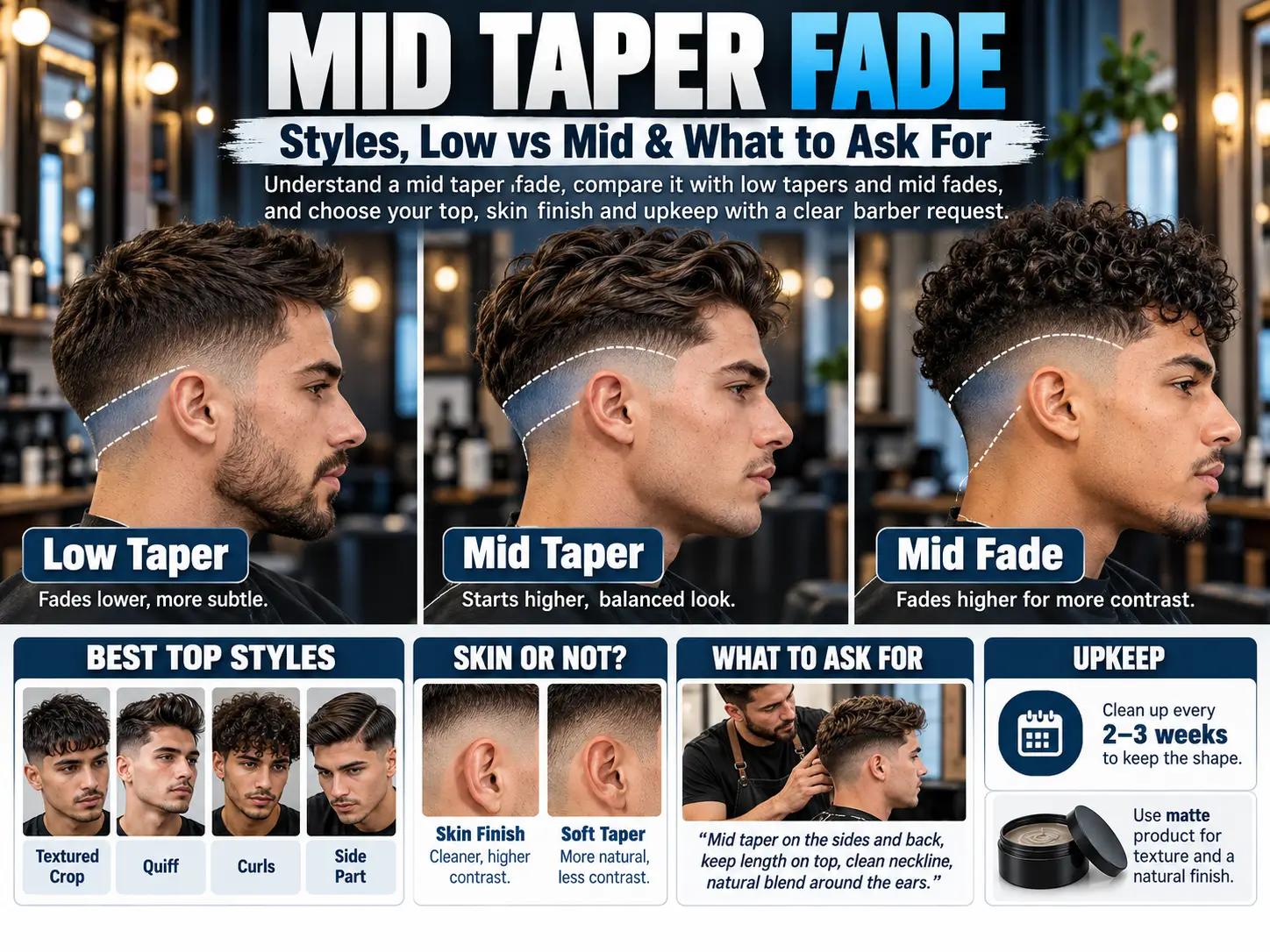
Mid taper fade: ask for the right amount of short.
Understand taper height, skin finish and side coverage before choosing the top. Build a request your barber can clarify.
Compare the six cuts ↓Choose the effect you like. Your face does not need correcting.
Build your salon note
Choose a starting cut and your routine. This makes a request to discuss, not an AI prediction.
What is a mid taper fade?
A mid taper fade usually means a gradual short transition at the sideburn or temple areas and the neckline, placed higher than a low taper while retaining more hair elsewhere. A mid fade usually takes a broader band short around the sides and back. Barber terminology varies, so confirm the actual area before cutting.
“Mid” does not tell you how long the top should be, whether skin will show, or how the beard connects. Those are separate decisions. A side-and-back reference is more useful than a name alone.
Low taper vs mid taper vs mid fade
| Request | What you are discussing | Confirm in the mirror |
|---|---|---|
| Low taper | A lower, more limited edge transition. | Where it starts and how much sideburn stays. |
| Mid taper | A higher or more visible edge transition, with side coverage retained elsewhere. | The exact boundary at the temple and nape. |
| High taper | A higher-reaching version of the localized transition. | How much upper-side weight it removes. |
| Mid fade | A broader short band through the sides and back at a middle height. | Whether the short area wraps around the head. |
| Skin finish | The shortest area blends to exposed skin. | Whether you want this at all; “mid” does not imply it. |
There is no universal distance above the ear that every barber calls mid. Some shops use “taper fade” broadly. Say whether you want localized edges or an all-around fade, and let the barber point out the planned boundary before starting.
Six ways to pair the taper with the top
Showing all six cuts.
Short textured top with a mid taper
A short top can keep the daily routine compact while the edge transition provides definition.
Before choosing: Short top does not mean skin at the sides. Decide the lowest length and the transition area separately.
Ask your stylist: “Keep the top short with light movement. Show me the mid taper area at the sideburns and nape before cutting, and confirm whether the shortest part will reach skin.”
Forward crop with a mid taper
A forward front gives a clear fringe line while the taper tidies the edges.
Before choosing: A cowlick can lift the fringe. A full wraparound fade creates a different side outline from a localized taper.
Ask your stylist: “Keep the fringe at the dry position we agree on. I want localized tapered edges, with the remaining side weight checked before you remove more.”
Curly top with a mid taper
The taper can define the edges while the longer curls remain the focus.
Before choosing: The top may shrink noticeably when dry. The transition should connect to the actual curl outline.
Ask your stylist: “Keep my curls shaped around their dry length. Agree the short zones at the temple and neckline, and retain the upper-side fullness I choose.”
Side part with a mid taper
A side-directed top and defined edges create a more structured outline.
Before choosing: A hard shaved part is a separate choice. You do not have to add one to make the cut a taper.
Ask your stylist: “Follow my natural part without shaving a line unless I ask. Keep the taper localized and blend into the side weight we decide to retain.”
Curtains with tapered edges
Longer front pieces can stay flexible while small edge areas are shortened.
Before choosing: If the short zone rises into the curtains, you may lose the coverage that makes the reference appealing.
Ask your stylist: “Keep the front long enough to fall naturally. Mark the taper boundary before cutting and do not take it into the side sections I want to keep.”
Long top with a subtle connection
A longer top or tied-back section can be paired with tapered edges without turning the whole side into a skin fade.
Before choosing: An undercut is a different connection choice. Ask whether longer hair will overhang the short area or blend into it.
Ask your stylist: “Keep the top length and discuss the connection first. I want to see where the taper stops and whether the remaining hair blends or sits over it.”
The four decisions that prevent a mismatch
- Area: sideburns and nape only, or a broader fade around the head?
- Height: ask the barber to point to where the short transition will stop.
- Shortest finish: skin, visible stubble or a longer clipper finish?
- Connection: keep upper-side weight, blend into the top, or leave an intentional disconnection?
Then discuss the front, top and beard separately. If you say only “mid taper with a number two,” the barber still needs to know which area that number describes. Guard lengths also depend on the equipment; a reference and a mirror check reduce the ambiguity.
Does a mid taper suit your face shape?
It can suit different outlines. Removing side coverage increases contrast with the top. More top height can create a taller silhouette; a flatter top or fringe changes the effect. Decide whether you want that contrast rather than choosing from a rigid list of approved face shapes.
For a long face, consider how much upper-side hair remains and how tall the top will be. For a round face, you may like either a taller shape or a fuller, softer one. Neither face needs correcting. Compare oblong hairstyles, round hairstyles or oval hairstyles for the overall cut, not just its edges.
Straight, curly and coily versions
Straight hair can make a transition and any heavy line easier to see. Ask how the longer area will lie once dry. Curls and coils can create more visible contrast between the top and close edges; agree the dry outline before changing the length.
Fine strands and lower density are separate from curl pattern. If retaining coverage matters, show which area you do not want taken shorter. You can also prefer a close finish; the important point is choosing it deliberately. A taper does not create new density or guarantee a particular look from one photograph.
What about maintenance and cost?
Short edges lose their crisp appearance as hair grows, but the time before you want a tidy depends on the finish and your preferences. Skin at the bottom and a more blended, longer finish do not look identical as they grow. Ask to see examples beyond the fresh-cut day if available.
Before booking, ask what the price includes: top cutting, beard work, wash or an edge-only tidy. Prices vary between cities and shops in the USA and India, so a universal price would be misleading. Agree whether you want a full haircut each visit or occasional edge maintenance between shape appointments.
If you are growing a wolf cut or curtains, explain that goal before every tidy. Repeatedly taking the sides high can remove the length you are trying to grow.
Mid taper fade questions
Is a mid taper the same as a mid fade?
Usually not: a taper keeps the shortest work more localized, while a fade commonly covers more of the sides and back. Usage varies, so confirm the actual area.
Does a mid taper have to go to skin?
No. Placement and shortest length are separate choices. Ask for the finish you want.
Can I keep long hair on top?
Yes. Agree whether the longer sections blend into or hang over the shorter area, and which side sections must remain.
Does a mid taper work with curly hair?
It can. Check the dry curl outline, the amount of side fullness and how the transition connects.
How often do I need a haircut?
There is no single interval for everyone. Ask what an edge tidy involves and decide how crisp you want the transition to stay.
What should I show the barber?
A front, side and back reference if possible, plus the shortest finish you are comfortable with. Point out what you want to keep as well as what should be shortened.
Sources and terminology limits
Tay’s Barbershop’s low-versus-mid comparison shows one shop’s use of the terms. It is not a universal specification for placement, workplace rules, prices or maintenance. Our guide emphasizes agreeing the actual area, height and finish because names alone are not consistent. For a professional demonstration, see Andis educator Hayden Cassidy’s classic taper with side part. It demonstrates a related taper technique, not one mandatory mid-taper specification. The requests are original editorial examples.
2 thoughts on “Mid Taper Fade: Styles, Low vs. Mid”