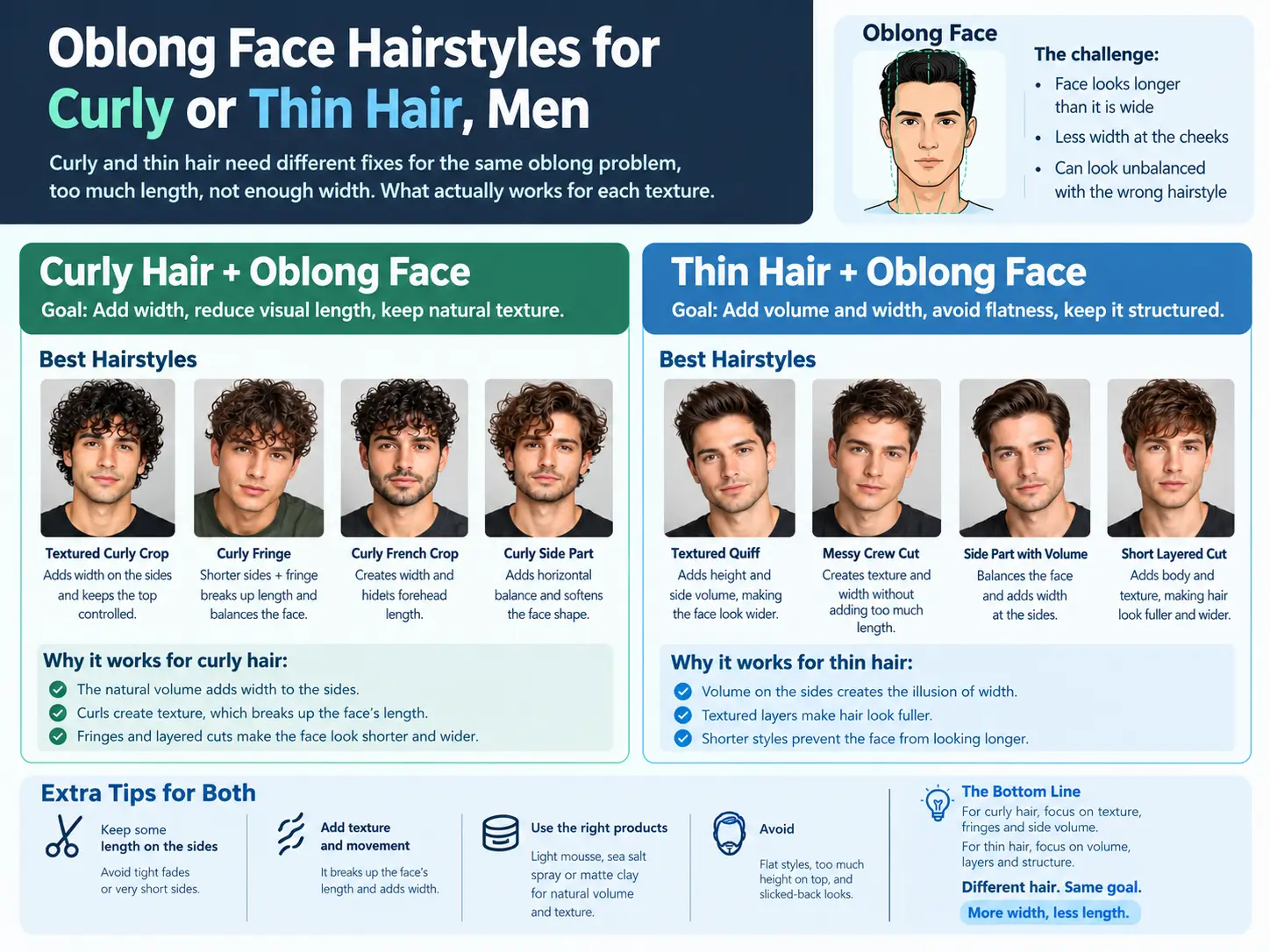
Same shape, same goal, different tools depending on what your hair actually does. An oblong face needs width added at the sides and length kept in check at the crown. Curly hair and thin hair get there in almost opposite ways.
Quick answer:
Curly hair should be grown slightly longer and left to do its own work, since tight curls add height you don’t need while looser, longer curls add width for free. Thin hair needs the opposite: a shorter, precisely cut style, since fine hair has no natural volume to lean on and length alone just goes flat.
The full oblong hairstyles for men guide covers the shape’s core principles in depth. This page is specifically about how curly and thin hair change the advice.
Curly hair
The instruction that matters most: don’t fight the curl by keeping it short. A tight, short curly cut concentrates volume upward, which adds crown height an oblong face doesn’t need. Grown out a bit longer, the same curls fall outward instead of up, adding side width naturally.
| Curl type | What works |
|---|---|
| Looser waves, 2A-2B | A low taper fade with length kept through the top, so the wave has room to fall outward rather than sit tight to the head |
| Defined curls, 3A | Grow it out rather than cutting short. A curly top fade, texture up top with a clean fade at the sides, avoids bulk while keeping the width the curls provide |
| Tighter coils, 3B and up | A medium length cut with the sides trimmed close works better than an even, all-over short cut, which tends to read as tall rather than wide |
One thing worth trying if you’re already curly: ask for length removed mainly at the crown, not the sides. Most barbers default to tapering evenly, which can quietly shrink the exact width the curl pattern was giving you for free.
Thin hair
Thin, fine hair works against an oblong face differently than curly hair does. There’s no natural volume to redirect, so the cut itself has to create the structure that texture alone won’t provide.
- Keep it shorter rather than longer. Long, thin hair goes flat and adds visual length exactly where an oblong face doesn’t need it. A shorter length holds its shape better and doesn’t stretch the face further.
- Ask for a textured fringe rather than one-length hair. Blunt, single-length fine hair reads as thin and flat. Textured ends, even short ones, add the illusion of density.
- A low taper, not a high one. The same rule as the main oblong guide, doubled in importance here, since thin hair at the temples already reads sparse. A high fade removes width right where fine hair can least afford to lose it.
- Light products only. Heavy pomades weigh fine hair down further. A light matte clay or sea salt spray adds texture without collapsing what little natural volume is there.
What both textures should avoid
- Long, one-length hair with no layers or texture, curly or straight. It reads as pure length with nothing to break it up, the one thing this shape has enough of already.
- A high fade on either texture. It removes width at the exact point- the temples- where both curly and thin hair benefit most from what’s already there.
- Heavy product that flattens curl or weighs down fine hair. Both textures need to keep whatever natural width they contribute, and heavy styling products work against that either way.
FAQs
What’s the best haircut for an oblong face with curly hair?
Growing the curls out slightly rather than cutting them short is the most consistently recommended approach. A curly top fade, with texture kept up top and a clean fade at the sides, adds width from the curl itself without adding unwanted height.
What’s the best haircut for an oblong face with thin hair?
A shorter length with a textured, layered fringe works better than long, single-length hair, which tends to go flat and add visual length. A low taper rather than a high fade keeps width at the temples, where thin hair can least afford to lose it.
Should curly hair be kept short for an oblong face?
Generally no. Short, tight curls concentrate volume upward and add crown height an oblong face doesn’t need. Slightly longer curls fall outward instead, adding side width for free.
Does thin hair make an oblong face look longer?
It can, mainly when worn long and one-length, since fine hair without texture or layers goes flat and adds visual length with nothing to break it up. A shorter, textured cut avoids this.
Is a high fade ever a good choice for an oblong face?
Not for either curly or thin hair specifically. A high fade removes width right at the temples, which is the one place both textures benefit most from keeping what they naturally have.
Reference on hair texture classification discussed above: hair typing.