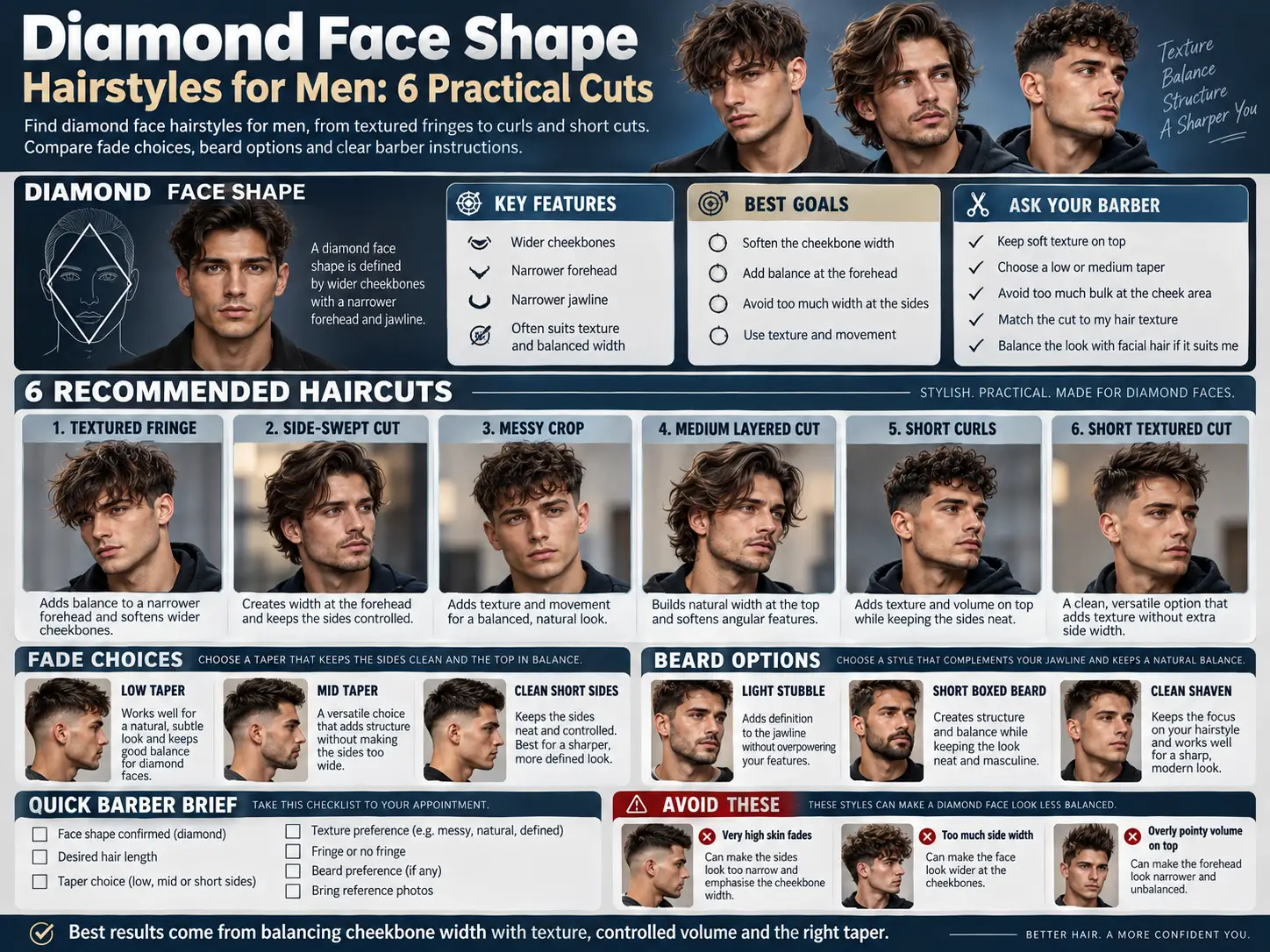
Men’s haircut guide · Diamond
Diamond Face Shape Hairstyles for Men
Choose how much of your cheekbone-led outline to show. Compare fringes, curtains, curls and shorter cuts—with practical barber requests for each.
Which hairstyles suit a diamond face for men?
A textured fringe, soft curtains, side-swept top or layered curly cut can be good starting points. If you want more fullness around a narrower forehead, leave useful coverage near the temples. If you prefer to show your cheekbones, a closer cut or swept-back finish can do that instead.
A beard is optional. You do not need to widen both ends of your face or hide your cheekbones. The useful question is which outline you prefer and whether your hair can create it with the routine you want.
Check width—not just “high cheekbones”
Diamond usually describes a face whose cheekbone area is wider than both the forehead and jaw. Height, width and projection of cheekbones are different features: having high cheekbones alone does not establish a diamond face.
Compare the forehead, cheekbone area and jaw from the same front-facing view. Camera angle, hair and beard can affect the apparent proportions. If the forehead is clearly widest, compare the heart face hairstyle guide. If the jaw leads, the triangle guide is more relevant.
Six haircuts to discuss with your barber
These options differ in coverage, length and styling effort. A haircut name does not specify exactly how much hair stays at your temples or how a fringe falls. Illustrations show simplified outlines, not exact haircut instructions or photo predictions.
Fades: choose the coverage, not a blanket rule
If your goal is more fullness around the temples, taking that area very close removes hair you might want to keep. A low taper or scissor finish can leave coverage while tidying the edges. But a high fade may be exactly the sharper, exposed look you prefer.
Show a front and side reference together. Ask where the shortest area will end and whether skin exposure is part of the request. “Low” describes placement; it does not tell your barber how long the top should be. A textured crop with a low fade and one with fuller sides can look noticeably different.
If you prefer no beard
Choose your hairstyle on its own merits. You can emphasize your cheekbones, use a fringe, wear longer layers or go short. Hair and facial hair are styling choices, not two compulsory halves of a correction. If you do wear a beard, decide whether you want fullness at the jaw corners or more length at the chin; each changes the outline differently.
Adapt the cut to your hair and routine
Fine, thick, wavy or curly
Fine hair is not automatically flat, and thick hair does not automatically need thinning. Tell your barber where the hair falls apart, lifts up or looks too dense. A light fringe needs enough hair to sit as intended; a longer curtain style may be easier or harder depending on your growth pattern.
For waves, try styling along the natural bend. For curls and coils, discuss dry length and the amount of side expansion you like. If you want twists or another textured style, consult someone experienced with that service rather than choosing it from a face label alone.
Hairline and everyday upkeep
If your hairline is changing, you can choose to show it or discuss realistic coverage. Do not force a long fringe that needs constant adjustment if you prefer a simple routine. Face-shape styling is not a treatment for hair loss.
Check the cut when it is dry before leaving. Note whether the fringe blocks your view or the side pieces catch behind glasses. At the next appointment, explain what stopped working rather than following a universal three-week fringe-trim rule. Visit the beard guide if you want to coordinate facial hair separately.
Your barber brief
“I like this soft fringe. I want to keep some coverage at the temples while showing my cheekbones. Please avoid removing more side fullness than necessary, and show me how the fringe will sit with my natural texture. I prefer a finish I can manage without a long daily routine.”
Bring front and side reference photos with a texture similar to yours. Before cutting, agree on the fringe’s dry length, top shape, side coverage and neckline. Ask what styling is needed at home and what will change as the cut grows out.
For a reusable request based on your preferences, use the men’s haircut brief builder. It creates a conversation starter, not an AI prediction.
Common questions
Does a diamond face need a beard?
No. A beard can change the visible lower-face outline, but it is optional. Clean-shaven men can wear any of the styles here. Choose facial hair because you want it, not because a face category supposedly requires it.
Can men with a diamond face wear a buzz cut?
Yes. A buzz cut shows more of your natural proportions. If you like a very short finish, discuss the length and side contrast. There is no requirement to hide narrow temples or pair the cut with a full beard.
Is diamond the same as high cheekbones?
No. Diamond concerns the relationship between the widths of the cheekbone area, forehead and jaw. “High cheekbones” describes vertical placement, although people also use the phrase loosely for prominence. See the high cheekbones guide for the distinction.
Which haircut is useful for diamond-shaped faces and thin hair?
A short crop or crew cut may be worth discussing, depending on density, texture and coverage preferences. “Thin hair” can refer to fine strands or lower density, which are not the same. Ask how the cut will look in your normal lighting without relying on heavy styling.
Are there separate diamond-face cuts for Indian men?
No separate face-shape formula is needed. Pick by actual texture, density, hairline and routine. A quiff, crop or longer sweep may be an option; nationality does not establish which of those your hair can support.
Can I use celebrity photos as a reference?
Yes, for the haircut. You do not need to prove that the celebrity has your exact face shape. Bring photos showing the fringe and sides clearly, and ask which details can realistically be adapted to your own hair.
Sources and editorial approach
The recommendations describe optional visual effects and haircut trade-offs. The sources below provide practitioner perspectives on face shape and consultation; our six examples are an editorial shortlist, not measured predictions. We do not rank face shapes by attractiveness or claim a validated “perfect haircut.” For other categories, use the men’s face shape hairstyle comparison.
1 thought on “Diamond Face Shape Hairstyles for Men: 6 Practical Cuts”