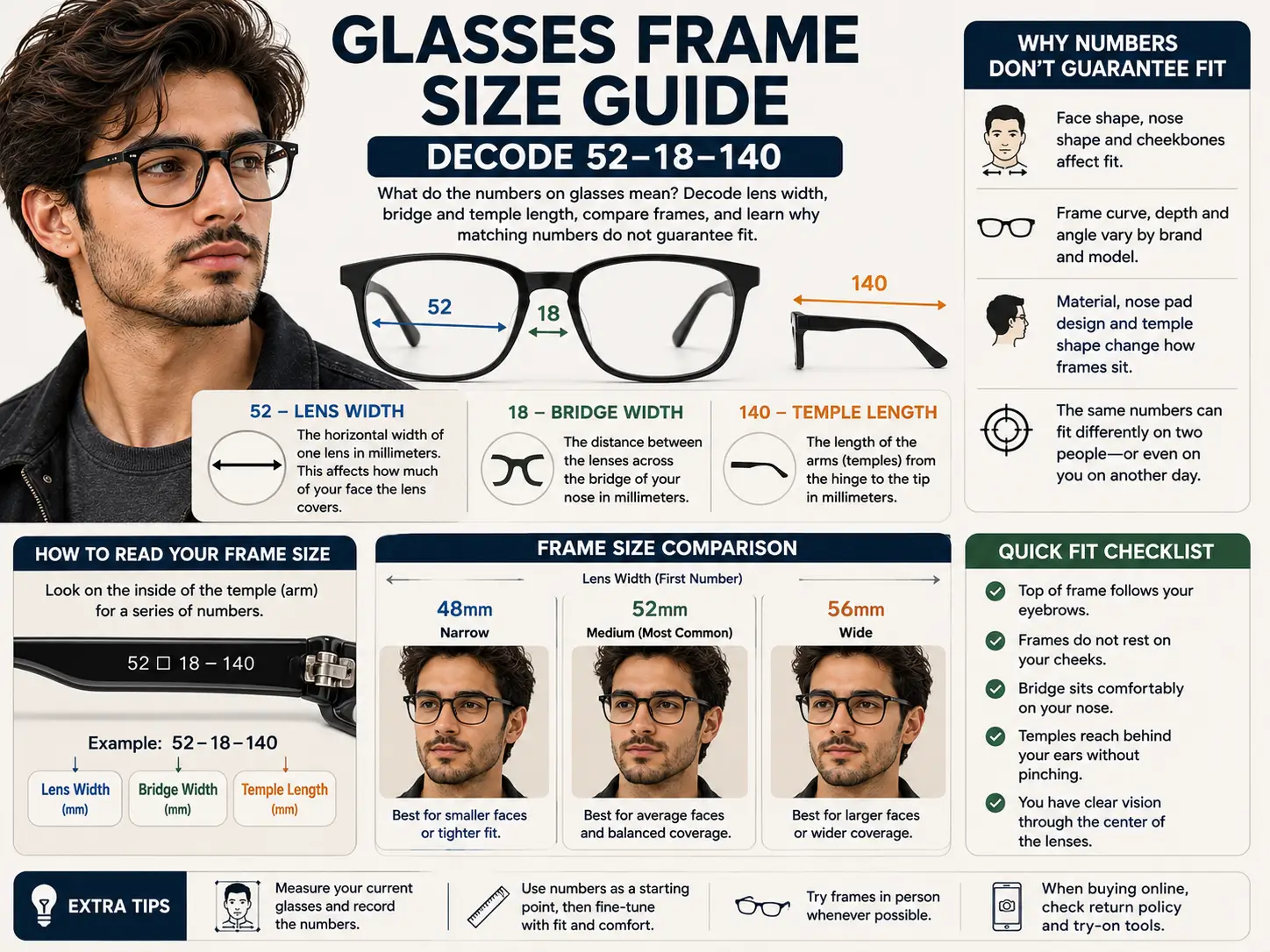
Glasses frame sizes: what do the numbers mean?
Read lens width, bridge size and arm length. Decode a common frame marking, then learn what those numbers cannot tell you.
Illustration only. Frame markings do not measure your face.
Decode your frame numbers
Enter only the three size numbers, for example 52 □ 18 – 140. This explains a marking; it does not recommend a size.
These are the values you entered, not independently measured dimensions. They are not PD, prescription or a fit recommendation.
By Rizwan Aslam · Updated · Editorial policy · Suggest a correction
What does 52–18–140 mean on glasses?
In a common three-number frame marking, 52 means one lens is 52 mm wide, 18 is the bridge size in millimeters, and 140 is the temple or arm length in millimeters. These are frame dimensions, not your prescription or your pupillary distance.
You may see a small square between the first two numbers, spaces instead of dashes, or the arm length printed separately. Model and color codes may appear nearby. Read the measurement group rather than assuming every number inside the arm describes size.
The three measurements, explained
| Example | What it describes | What it does not establish |
|---|---|---|
| 52: lens width | The horizontal width of one lens, often called eye size. | The total outside width of the complete frame. |
| 18: bridge size | The frame’s labelled distance between the lenses. | The full shape of the bridge or how it rests on your nose. |
| 140: temple length | The length of one side arm, including its bent section. | The straight-line distance from the front to your ear. |
All three are normally expressed in millimeters. A brand may also list lens height, overall frame width and a model-specific size category. The Lenskart frame-fit guide illustrates the main components and size terms.
Where to find the numbers
Look along the inside of each arm and around the bridge. If the writing is worn away, check the model’s product listing, order confirmation or original packaging. An optical store may be able to identify or measure the frame.
Copy the model name as well as the size group when you are shopping for the same frame. A long identifier can be a model or color code; this page’s decoder deliberately does not guess which digits to extract from a full product code. If only two measurements are visible, do not invent the third.
Zenni’s explanation of frame markings describes why identification codes and measurements are different. Some brands use their own product identifiers, so the retailer’s listing can be more useful than a universal-looking code.
Why 52 + 52 + 18 is not the total frame width
Adding the two lens widths and the bridge gives 122 mm in this example. That is not a reliable measurement of the outside edge of the finished frame. It leaves out parts of the frame front, including the material and endpieces beyond the lens areas.
For an outside-width comparison, use the manufacturer’s stated overall frame width and check how it is measured. Zenni’s frame-measurement guide distinguishes overall width from the numbers usually printed on an arm. Do not enter 122 mm as your face width or PD just because it comes from this arithmetic.
Will identical numbers fit the same?
Not necessarily. Two frames marked 52–18–140 can have different lens shapes, different bridge profiles and different curves around the sides. They may also place the lenses differently in front of your eyes. Matching numbers can narrow a search, but cannot finish a fitting.
Compare the exact model if you want the closest replacement for a comfortable pair. If changing models, keep a record of what works about the current fit and what you want to improve. “This pair stays stable but presses behind my ears” is useful information to take to an optician.
If you are comparing a molded bridge with adjustable nose pads, the same printed bridge number is not a promise that they will feel alike. The low-bridge fit guide covers that design question separately.
Frame size, PD and prescription are different
Frame measurements describe the glasses. Pupillary distance, usually shortened to PD, describes the spacing of the pupils. Prescription values describe the lens correction. They are not interchangeable, and this decoder does not calculate any prescription or facial measurement.
A fitting may also need measurements related to the selected frame and lens design. Ask the optical provider what is required for your order. A frame-size code or face-shape photograph cannot supply all of those details.
For the optical context, see Specsavers’ PD guidance. This page focuses on reading frame markings, not taking a new PD measurement or prescribing lenses.
A practical way to compare two pairs
- Choose a reference. Start with a pair whose fit you like, not simply one you happen to own.
- Record the details. Keep the model, size group and overall frame width if available.
- Describe the difference you want. More lens depth, a different color or less pressure are different goals.
- Compare the construction. Look at the bridge, nose pads, hinges and arm shape, not just the three numbers.
- Try the candidate. Notice movement and pressure during ordinary use, and discuss them with a fitter.
- Confirm the order. Check lens suitability, adjustment support and the return or remake terms.
Do not assume small, medium and large are universal dimensions. Read the size chart for the particular brand and model. USA and India retailers both use millimeter markings, but their retail size labels and service terms may differ.
Choose style after understanding size
Once you understand the numbers, compare outlines you like. A round face does not automatically require a large frame; a narrow chin does not automatically require a small one. Style categories cannot determine bridge contact or arm pressure.
Use the round-face, square-face and heart-face glasses guides for visual comparisons. The main glasses guide connects the wider cluster. Keep the fit conversation separate from the effect of curves or corners.
Frame-size questions
Is 52 my glasses prescription?
No. In a common frame-size group it is the horizontal width of one lens in millimeters.
Is the bridge number my nose width?
No. It is a labelled frame dimension, not a complete measurement of your nose or the bridge’s contact shape.
Can I calculate my PD from the frame numbers?
No. Frame size and your pupil spacing are different measurements.
Does a larger lens number mean a wider overall frame?
It can indicate a larger lens, but the complete frame also depends on bridge, rim and endpiece design. Compare overall width directly.
What if my glasses only show a model number?
Use the manufacturer’s listing or ask an optician. Do not treat a model identifier as three measurements.
Does this tool tell me what size to buy?
No. It explains a common three-number marking. It cannot assess your face, pressure, comfort or lens fit.
Sources and limits
The linked Lenskart, Zenni and Specsavers resources explain frame components, markings and optical measurements. The comparison checklist is editorial guidance by Rizwan Aslam. No individual fitting or eye examination has been performed through this page.
2 thoughts on “Glasses Frame Size Guide”