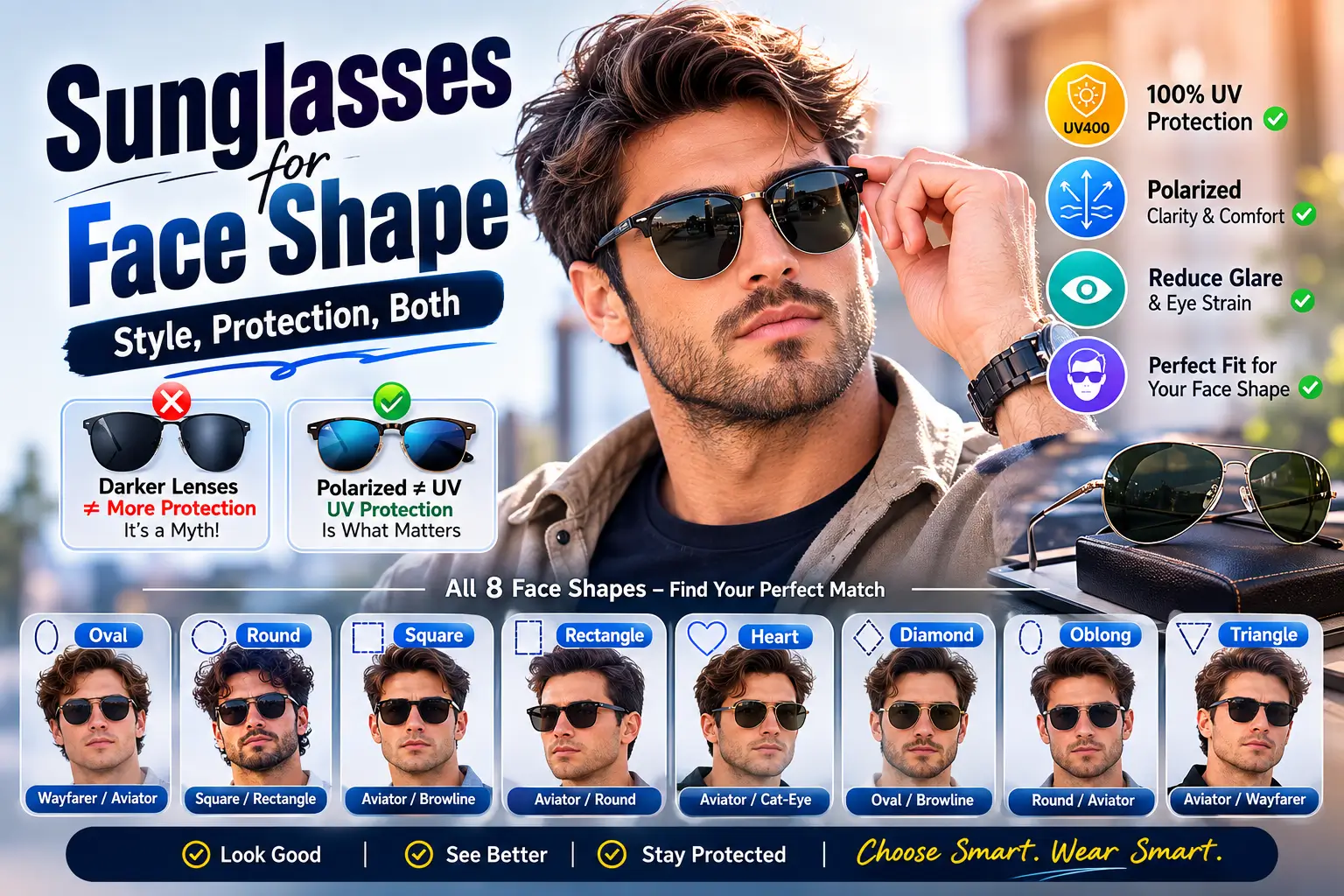
Quick answer:
Two separate questions, and most guides only answer one of them.
- For protection: look for a label that says 100% UV protection or UV400, not darker lenses, since tint colour and darkness have nothing to do with UV filtering.
- For style: frames that contrast with your face outline generally suit you best, the same principle used throughout this site for hair, glasses and necklines, though sunglasses lean bigger and bolder than everyday prescription frames because more lens coverage also means more protection. The shape by shape table is below, and the protection science comes first, because it is the part most guides skip or get quietly wrong.
UV protection and polarization are not the same thing, and this trips people up constantly
Both properties can sit on the same pair of sunglasses, and marketing blurs the two together so often that most people assume one implies the other. It does not.
| UV protection | Polarization | |
|---|---|---|
| What it does | Blocks ultraviolet radiation from reaching your eyes | Reduces glare bouncing off flat, reflective surfaces like water or a road |
| What it protects against | Long-term eye damage: cataracts, macular degeneration, corneal damage | Nothing about eye health directly, it is a comfort and visibility feature |
| How to check for it | A label reading “100% UV protection” or “UV400” | A label reading “polarized,” often confirmed with a quick photo test on a phone screen |
| Does one include the other? | No | No, polarized lenses need to separately state UV protection to have it |
The practical instruction: check for both labels independently. A polarized pair with no UV protection claim genuinely may not have any, and a cheap, clear, or lightly tinted pair can carry full UV protection even without polarization. Neither label guarantees the other.
The myth worth killing directly: darker lenses are not more protective
This is one of the most common and consequential misunderstandings in eye protection. Ophthalmology sources are direct about it: the darkness of a lens is a style property, not a protection measurement. A very dark lens with no UV coating can be worse than no sunglasses at all, because darkness makes your pupil dilate to let in more light, and a dilated pupil with no UV filter lets in more ultraviolet radiation than an undilated one would in daylight.
What tint colour actually affects is contrast and comfort, not safety:
| Tint | What it does |
|---|---|
| Grey | Preserves true colour perception, an all-purpose choice |
| Brown or amber | Boosts contrast, popular for driving, golf, and other sports |
| Green | Balances contrast and colour accuracy |
| Mirrored | Cuts glare further and reduces visible eye contact, a style choice more than a protection one |
What actually determines protection level
Three things, in order of how much they matter:
- The UV rating itself. 100% UV protection or UV400 is the number that matters. This is independent of price, darkness, and brand.
- Lens material. Polycarbonate lenses are naturally UV protective in addition to being lightweight and impact resistant, which is one reason they show up so often in sport and kids’ sunglasses.
- Frame coverage. Wraparound styles and larger, closer-fitting frames block more UV from the sides and top than small, straight frames do. This is where protection and current style trends actually agree with each other, since oversized frames are also fashionable right now.
Photochromic lenses, which darken automatically in bright light, are worth knowing about if you want one pair that adjusts. The one limitation worth flagging: they do not activate behind a car windshield, because glass blocks the UVB wavelength that triggers the reaction.
Sunglasses by face shape
The underlying principle is the same one used for prescription glasses on this site: contrast softens, repetition reinforces.
Sunglasses tend to run larger and bolder than everyday frames, partly for style and partly because more coverage genuinely means more UV protection, so the effect of any given shape is often stronger here than in prescription eyewear.
| Shape | Frames that contrast (soften) | Frames that echo (showcase) |
|---|---|---|
| Oval | Nearly everything works, size matters more than shape here | Also nearly everything, this shape has the most freedom |
| Round | Angular or rectangular frames, browline styles | Round or oversized round lenses |
| Square | Round, aviator, or cat eye frames | Square or geometric frames |
| Oblong | Wide frames with depth, oversized round or square | Narrow, tall frames, generally worth avoiding for this shape |
| Rectangle | Round or wide frames with softer edges | Angular frames that repeat the jaw corners |
| Heart | Aviators or bottom-heavy, lighter frames | Heavy browline or top-weighted frames, generally worth avoiding here |
| Diamond | Cat eye or oval frames, or anything with detail at the brow line | Narrow rectangular frames, which can look severe on this shape |
| Triangle | Browline or cat eye styles that add width up top | Bottom-heavy frames, generally worth avoiding here |
The one sizing rule that applies regardless of shape: frames should be roughly as wide as the widest part of your face, and oversized styles specifically should not extend so far past your temples that the arms press or the frame overwhelms your features.
The full fit breakdown, including bridge width and temple length in millimetres, is on the glasses fit guide, since that technical detail does not change between prescription glasses and sunglasses.
A quick note on lens colour and vision needs
Some sources also link tint colour to how it interacts with your natural vision. Amber and brown tints are commonly recommended for near-sighted people, since the added contrast can make close and mid-range detail easier to pick out.
Light blue and green tints are more often suggested for far-sighted people. This is a comfort preference rather than a hard rule, and it is independent of both your face shape and your UV protection level.
FAQs
Are darker sunglasses more protective from the sun?
No, and this is one of the most common misconceptions about sunglasses. Darkness is a tint property that affects comfort and contrast, not UV filtering. A very dark lens with no UV coating causes your pupils to dilate without blocking the radiation coming in, which can expose your eyes to more UV than wearing no sunglasses at all. Always check for a 100% UV protection or UV400 label specifically.
Is polarized the same as UV protected?
No, they are separate properties that happen to often appear together. Polarization reduces glare from flat reflective surfaces like water or roads and improves visual comfort, but it does not block UV radiation on its own. A polarized lens needs its own separate UV protection rating to actually protect your eyes from sun damage.
What sunglasses shape suits my face?
The general rule is contrast: frames that differ from your face’s own outline tend to balance it, while frames that repeat your outline emphasise it. Round faces often suit angular frames, square faces often suit round or aviator styles, and oval faces have the most freedom of any shape. The full table above covers all 8 shapes individually.
Do bigger sunglasses protect your eyes better?
Generally yes, alongside their style appeal. Larger, wraparound, or close-fitting frames block more UV light from entering around the sides and top of your eyes compared to small, straight frames, so oversized styles offer a genuine protection advantage on top of being a current trend.
What sunglasses are best for round faces?
Angular or rectangular frames, and browline styles, since they contrast with the curves already present in a round face. Round or heavily oversized round lenses repeat the shape instead, which some people want deliberately and others prefer to avoid.
How do I know if my sunglasses actually block UV rays?
Check the label or product description for “100% UV protection” or “UV400.” Price, lens darkness, and brand name are not reliable indicators on their own. If a pair has no UV claim listed anywhere, treat it as unprotected regardless of how dark or expensive it looks.
External reference on eye protection standards: ultraviolet.
1 thought on “Sunglasses for Face Shape”