Round Face Shape Hairstyles for Men: 6 Cuts & Barber Tips
Choose the outline you want, then adapt the haircut to your hair. A round face does not require a high fade, a beard or a long daily styling routine.
What haircut suits a round face?
A textured crop, side part, small quiff, crew cut, curly taper or medium layered style can work as a starting point. If you want a taller-looking outline, discuss some top lift and less side bulk. If you prefer a softer or wider silhouette, you can choose that too.
Hair changes the outline around your face; it does not change the underlying face shape. There is no single best cut for everyone with a round face.
Check the round face guide and photo tool if you are unsure. A soft jaw alone does not prove round—oval and oblong outlines can also have soft jaws.
Three details that change the same haircut
Top direction
Forward, sideways and upward styling give different outlines. A crop does not always point up, and a side part does not always sit flat.
Fringe edge
A blunt edge gives a clearer horizontal line. A broken or diagonal edge looks less uniform. Choose the effect and the amount of forehead coverage.
Side coverage
Removing side bulk can create more contrast with the top. Leaving coverage gives a softer transition. Fade height and shortest length are separate choices.
What you can maintain
A cut can be easy to style but need regular barber visits. Decide which kind of effort you are willing to repeat.
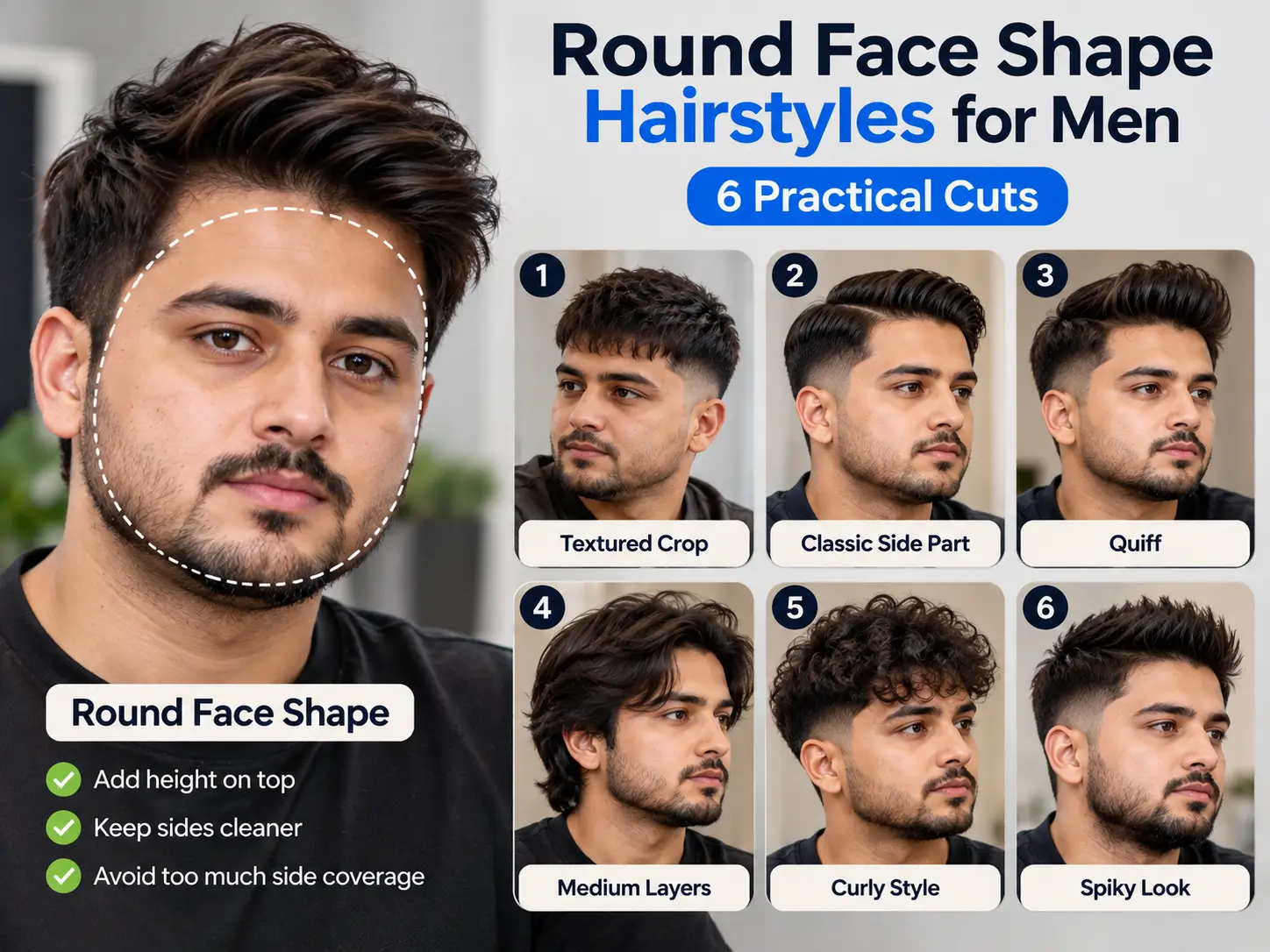
Six adaptable haircut options
These are editorial options, not a ranking. Illustrations show simplified shapes rather than exact cutting instructions.
1. Textured crop with a broken fringe
A crop can sit forward, diagonally or with light lift. The fringe edge changes the look more than the haircut name alone.
Ask your barber: “Give me a textured crop with a broken or slightly side-swept fringe. Keep the side transition soft and show how much forehead stays visible.”
Check first: You can choose a blunt fringe if you prefer it. It creates a different line, not a wrong haircut.
2. Side part or loose side sweep
A change in direction makes the outline less uniform without needing a very tall top. It can be neat or relaxed.
Ask your barber: “Use my natural part and give the front enough length to move across. I do not want a shaved part unless we agree on it first.”
Check first: Check whether your hair will hold the direction with the routine you want.
3. Small quiff
Some lift at the front can give a taller-looking silhouette if that is your goal. It does not need a dramatic pompadour.
Ask your barber: “Keep a modest front lift, with a top I can style quickly. Remove the side bulk that sticks out, but show me the fade height before cutting.”
Check first: A dryer and product may be part of the routine; ask for a demonstration.
4. Crew cut with a little front length
A useful shorter choice if you prefer less hair to arrange. The front can stand lightly or sweep to one side.
Ask your barber: “Give me a short crew cut with a little more length at the front and a blended side finish.”
Check first: A crew cut and a uniform buzz are different. Show the exact version you mean.
5. Curly or coily top with shaped sides
Keep your natural pattern and decide where you want the most fullness. The sides can be closely faded, gently tapered or left fuller.
Ask your barber: “Shape the curls when considering the dry result. Keep the fullness here, and show how much hair would remain at the temples.”
Check first: A high fade is one option, not a requirement for curls or a round face.
6. Medium side-swept layers
A longer option if you want movement or prefer not to expose the sides. Layers can change where the hair expands.
Ask your barber: “Keep enough length for a loose sweep and movement. Show how the sides fall around my cheeks when air-dried.”
Check first: Do not select a longer cut only from a blow-dried reference if you normally air-dry.
Low, mid or high fade: decide the effect
A low fade keeps the shortest transition lower around the sides. A higher fade exposes more of the side area. Neither choice automatically guarantees a slimmer-looking result; the top, fringe and remaining width work together.
Tell your barber whether you want skin visible and where the shortest area should stop. “Low” does not mean “skin,” and a guard number does not describe the full transition. If you want to keep temple coverage, discuss a smaller taper or scissor finish.
The textured crop low fade guide separates those choices with a practical brief. Avoid asking for a fade only by name if your reference shows a very specific outline.
Fine, thick, wavy or curly hair
Fine hair: ask how much coverage the cut will keep and test a small amount of product. There is no rule that everyone must use clay or that every pomade is unsuitable; weight, hold and amount differ.
Thick hair: show where it becomes bulky or sticks out. Removing weight may help a particular style, but thinning is a technique to discuss with the barber, not an automatic instruction for every thick head of hair.
Waves, curls and coils: work with the pattern and its dry shape. You can choose a fuller silhouette or a closer taper. Neither a rounded afro nor a center part is forbidden because your face looks round.
High hairline or reduced front coverage: choose the amount of forehead exposure you are comfortable with. A short cut or forward texture may be an option, but no style can promise to conceal every hairline. Bring a reference with a similar starting point.
Do I need a beard or a strong jaw?
No. A buzz cut does not require an angular jaw, and a round face does not require a beard. You can wear a close cut because you like a simple, exposed outline.
If you do wear facial hair, more chin length and fuller sides create different shapes. Discuss the outline you prefer rather than assuming that every rounded beard must be removed. Our beard-by-face-shape guide offers other starting points.
Keep the routine realistic
Ask your barber to style the finished cut the way you plan to wear it at home. Note how much product was used and whether the look needed drying or brushing. A quick phone photo of the front and sides can help you explain what you liked next time.
Book a tidy-up when the cut no longer behaves as you want, not because a universal “round face” calendar says so. Ask separately about the price of an edge or side tidy; do not assume it costs half a full cut.
If you use heat, the American Academy of Dermatology’s hair-care advice recommends limiting heat exposure and using low or medium settings with protection.
Compare other options in the men’s hairstyle hub or try the hairstyle outline preview. The preview is a silhouette, not a realistic haircut prediction.
A clear request to take with you
“I want this crop with light texture, some forehead showing and tidy sides. Please keep the front easy to arrange, show me where the fade will finish, and leave enough coverage that it still looks good without a blow-dry.”
Change the request to match your goal. Include front and side reference photos and mention any cowlick that changes how your fringe sits.
Round-face hairstyle questions
Can a round-faced man wear a buzz cut?
Yes, with or without a beard. It shows the natural outline and gives fewer styling choices, which may be exactly what you want.
Is a high fade always better than a low fade?
No. It removes more side coverage, but the effect depends on the top and your preferred look. Agree the fade height and shortest length separately.
Are these hairstyles suitable for Indian men?
Choose by your actual texture, density, growth pattern and routine. Nationality does not determine which haircut your hair can support.
Should I avoid all fringes?
No. A blunt, broken and side-swept fringe create different effects. Decide how much forehead you want covered and ask for the dry length before cutting.
Sources and editorial approach
The cut shortlists and barber requests are our editorial suggestions, not guaranteed transformations. Wahl’s crop-fade education guide provides a professional example of the cut. American Academy of Dermatology hair-care guidance supports the heat-care advice. Neither source validates a perfect haircut for a face-shape label.
2 thoughts on “Round Face Shape Hairstyles for Men: 6 Practical Cuts”