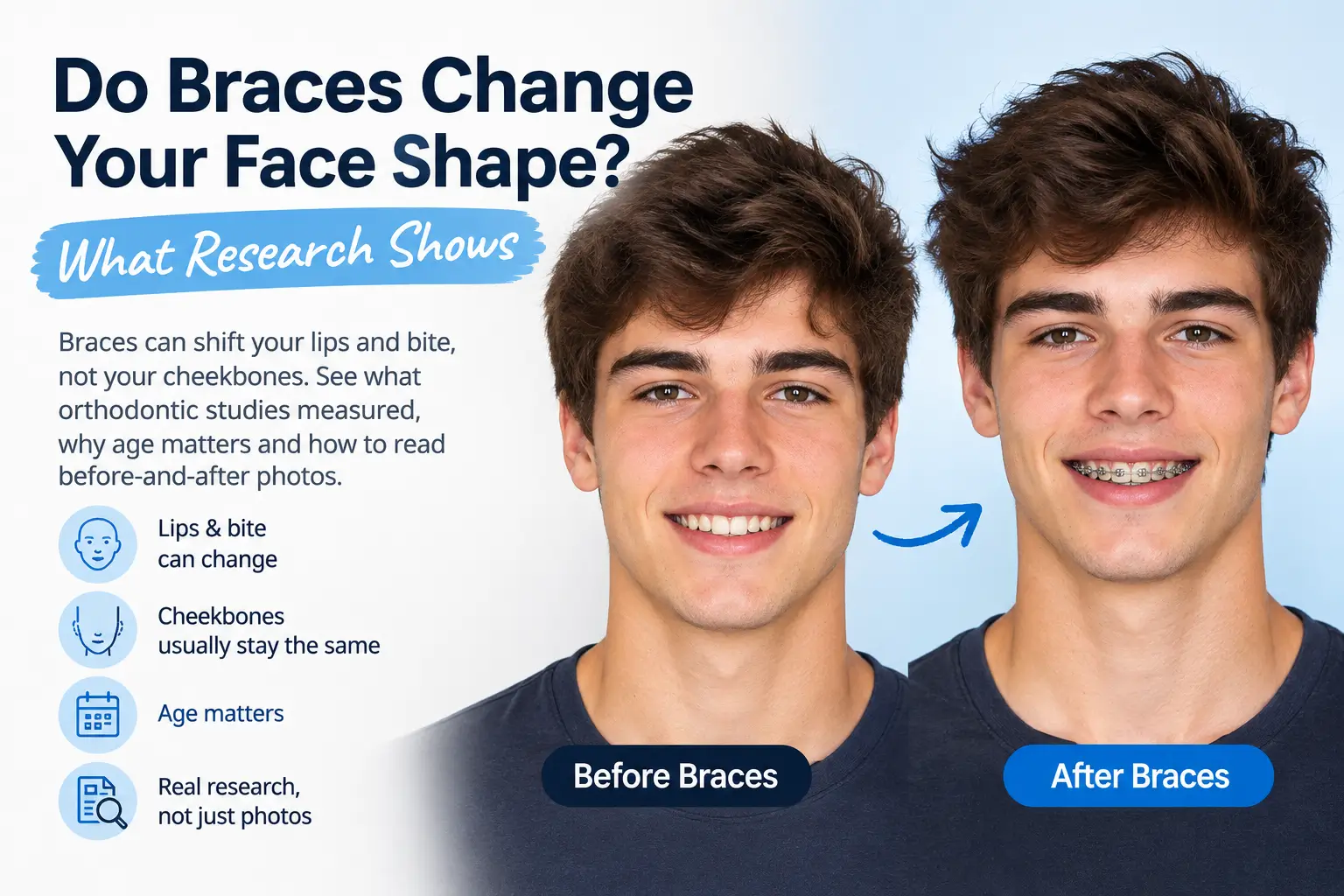
Braces can change how your face looks from the side, mainly around your lips and lower face, but they do not reshape your cheekbones, forehead or adult jawbone. Orthodontic studies measure the change in millimetres: when front teeth are pulled back, especially after tooth extractions, the lips usually move back a few millimetres, up to about 4.5 mm in the largest changes reported. Bigger changes to the jaw itself come from growth in children or from jaw surgery, not from braces alone. Below is what research actually shows, why age matters, and how to read before-and-after photos without being fooled.
What braces actually move
Braces and clear aligners move teeth through the bone that holds them. They do not move your cheekbones, your forehead or the main body of an adult jaw. That one fact explains most of what changes, and most of what does not.
Your lips and side profile
Your lips sit on top of your front teeth. When an orthodontist moves the front teeth back, the lips usually follow part of the way. When the teeth move forward, the lips can look fuller. This is why the biggest visible changes show up in a side view, not straight on.
Orthodontists also measure the nasolabial angle. That is the angle between the bottom of your nose and your upper lip. When the upper lip moves back, this angle opens up a little, which can make the nose look slightly different, even though the nose itself has not changed.
Overbite, underbite and open bite
How a bite fits together affects how the lower face looks at rest.
- Overbite (large overjet): upper front teeth sit well ahead of the lower ones. The upper lip can look pushed forward and the chin can look further back.
- Underbite: lower teeth sit ahead of the upper ones. The lower face can look more forward.
- Open bite: front teeth do not meet. Some people find it hard to close their lips without straining.
Correcting the bite can soften these effects. How much depends on whether the problem is in the teeth or in the jaw bones themselves, which only an orthodontist can tell from X-rays.
| Area | Can braces change it? | Why |
|---|---|---|
| Lip position and fullness | Yes, usually by a few millimetres | Lips rest on the front teeth that braces move |
| Side profile and nasolabial angle | Yes, slightly | Follows lip position |
| Bite and how the lower face sits at rest | Often | Teeth meeting differently changes jaw posture |
| Jaw growth | Only in growing children, with growth appliances | Works with natural growth, which ends in the late teens |
| Adult jawbone size and shape | No | Needs jaw surgery |
| Cheekbones, forehead, nose | No | Braces do not touch these bones |
Do tooth extractions make your face look flatter?
Extractions usually move the lips back by a small amount, but research does not show a predictable “flat” or “dished-in” face. This is one of the most common worries, so here is what the reviews measured.
- A 2018 meta-analysis compared people treated with and without premolar extractions. The extraction groups showed about 2 mm more lower-lip retraction and about 1.3 mm more upper-lip retraction on average, and a nasolabial angle about 4 degrees wider (Konstantonis and colleagues, 2018).
- A review of adults with lips that sat forward (bimaxillary protrusion) found upper lips moved back 2 to 3.2 mm and lower lips 2 to 4.5 mm after four premolars were removed. The authors described the change as predictable but small (Leonardi and colleagues, 2010).
- A review of overbite (Class II) cases found the nasolabial angle opened by about 1 to 7 degrees, with less lower-lip change when only two upper premolars were removed (Janson and colleagues, 2016).
- A 2024 review comparing four-premolar extraction with non-extraction treatment again found the lips moved back with extractions, and no clear difference in how attractive smiles looked after treatment (Elias and colleagues, 2024).
Two honest limits matter here. The 2018 authors rated the quality of the evidence as very low and said no consistent prediction can be made for an individual. Most studies also looked at people whose lips sat forward before treatment, so moving them back was often the goal.
The practical takeaway: if extractions are suggested, ask your orthodontist how they expect your lips to change, and whether a plan without extractions is realistic for your bite.
Teens vs adults: why age matters
Age is the biggest reason two people get different results from braces.
Growing children and teens still have jaw growth left. Orthodontists can use appliances that work with that growth. For example, a 2026 review of seven randomised trials (548 children) found that two common growth appliances, the Herbst and the Twin Block, both corrected overbite-type bites, with similar effects on facial soft tissues overall (Coronel-Zubiate and colleagues, 2026). These are not ordinary braces, and they only work while a child is still growing.
Adults have finished growing, so braces change the teeth and bite, not the size of the jaw. Changes to the face are smaller and mostly about lip position and profile. If an adult’s bite problem comes from the jaw bones themselves, braces alone may not fix it.
Does Invisalign change your face shape differently?
Not in principle. Clear aligners such as Invisalign and traditional braces both move teeth through bone, so the same rules apply. What changes the face is how far the front teeth move and in which direction, not the brand of appliance.
There is much less research measuring face changes after clear aligners than after braces, so be careful with any page that promises aligners will give a different face result. During treatment, the brackets and wires of braces can make your lips look a little fuller simply because they take up space. That goes away when the braces come off.
When the change comes from jaw surgery, not braces
Dramatic jaw transformations online are often jaw surgery, not braces. Jaw surgery (orthognathic surgery) moves the upper jaw, the lower jaw or both. It is used when a bite problem comes from the bones, not just the teeth, and it is usually combined with braces before and after the operation.
Because braces are worn throughout, these results often get shared as “braces before and after.” If a photo shows a clearly different chin or jaw position in an adult, surgery is a likely explanation. Only the treating team can confirm it.
How to judge braces before-and-after photos
Before-and-after photos are the main reason people expect big face changes from braces. Many of them are honest, but other things change during the year or more that most treatments take.
| Check | Why it matters |
|---|---|
| Same camera angle and distance? | A closer phone or a slight head tilt changes how wide the jaw and nose look |
| Same expression? | A relaxed face and a smile change lip shape and cheek width |
| Weight change? | Losing or gaining weight changes jaw and cheek definition more than braces do |
| Age gap? | Teens keep growing during treatment, so some change would happen anyway |
| Hair, lighting, makeup? | Shadows and contour can sharpen a jawline in one photo and not the other |
| Was there jaw surgery? | Surgery moves bone; braces alone do not |
If you want to compare your own face before and after treatment, take both photos the same way. Our guide on how to take a photo for face shape detection shows a simple, repeatable setup.
Questions to ask your orthodontist
If face changes matter to you, say so at the start. These questions help you get a specific answer instead of a general one:
- Is my bite problem in the teeth, the jaw bones, or both?
- How do you expect my lips and side profile to change?
- Do I need extractions? What would a plan without them look like?
- Am I still growing, and does that change the plan?
- Would braces alone get the result, or would jaw surgery be needed?
- Can you show predicted results for my case, not just other patients’ photos?
Braces and face shape FAQs
Do braces change your jawline?
Braces can change how the lower face sits by correcting the bite, which can make the jawline look slightly different in profile. They do not change the size or shape of an adult jawbone. Large jawline changes in adults usually involve jaw surgery.
Will braces make my face look thinner?
Not directly. Braces do not remove fat or bone from the cheeks. A face can look slimmer after treatment because of weight change, growth or a different lip position, but braces are rarely the main cause.
Can braces fix a weak chin?
Sometimes the chin looks weak because of an overbite, and correcting the bite can help it look more balanced. If the lower jaw itself is small in an adult, braces alone cannot make it bigger. In growing children, growth appliances may help.
Do braces change your nose?
No. Braces do not move the nose. The area under the nose can look different because the upper lip moves, which changes the nasolabial angle by a few degrees in some studies.
Are the changes from braces permanent?
Changes in tooth position stay only if you keep wearing your retainer as instructed, because teeth tend to drift back. Lip changes follow the teeth, so they last as long as the teeth stay in place.
Do braces make your lips bigger?
During treatment, the brackets can make lips look a little fuller. After treatment, lips may look fuller or slimmer depending on whether the front teeth moved forward or back.
Does Invisalign change your face shape?
It follows the same principle as braces: it moves teeth, which can shift the lips slightly. It does not change your bone structure, and there is less research on face changes after aligners than after braces.
At what age do braces change the face most?
During growth, usually before the late teens, because orthodontists can work with jaw growth. In adults, changes are mostly limited to lips and profile.
Sources
- Konstantonis D and colleagues. Soft tissue changes following extraction vs. nonextraction orthodontic fixed appliance treatment: a systematic review and meta-analysis. European Journal of Oral Sciences, 2018;126:167-179.
- Leonardi R and colleagues. Soft tissue changes following the extraction of premolars in nongrowing patients with bimaxillary protrusion: a systematic review. The Angle Orthodontist, 2010;80:211-216.
- Janson G and colleagues. Soft-tissue changes in Class II malocclusion patients treated with extractions: a systematic review. European Journal of Orthodontics, 2016;38:631-637.
- Elias KG, Sivamurthy G, Bearn DR. Extraction vs nonextraction orthodontic treatment: a systematic review and meta-analysis. The Angle Orthodontist, 2024;94:83-106.
- Coronel-Zubiate FT and colleagues. Herbst and Twin Block appliances in Class II malocclusion management for children: a systematic review and meta-analysis. Frontiers in Dental Medicine, 2026.
1 thought on “Do Braces Change Your Face Shape? What Orthodontic Research Shows”