Low Bridge Fit Glasses: Meaning, Signs & How to Choose
Tired of pushing your glasses up or feeling them touch your cheeks? Learn what low bridge fit changes and how to compare your options without guessing a size.
What are low bridge fit glasses?
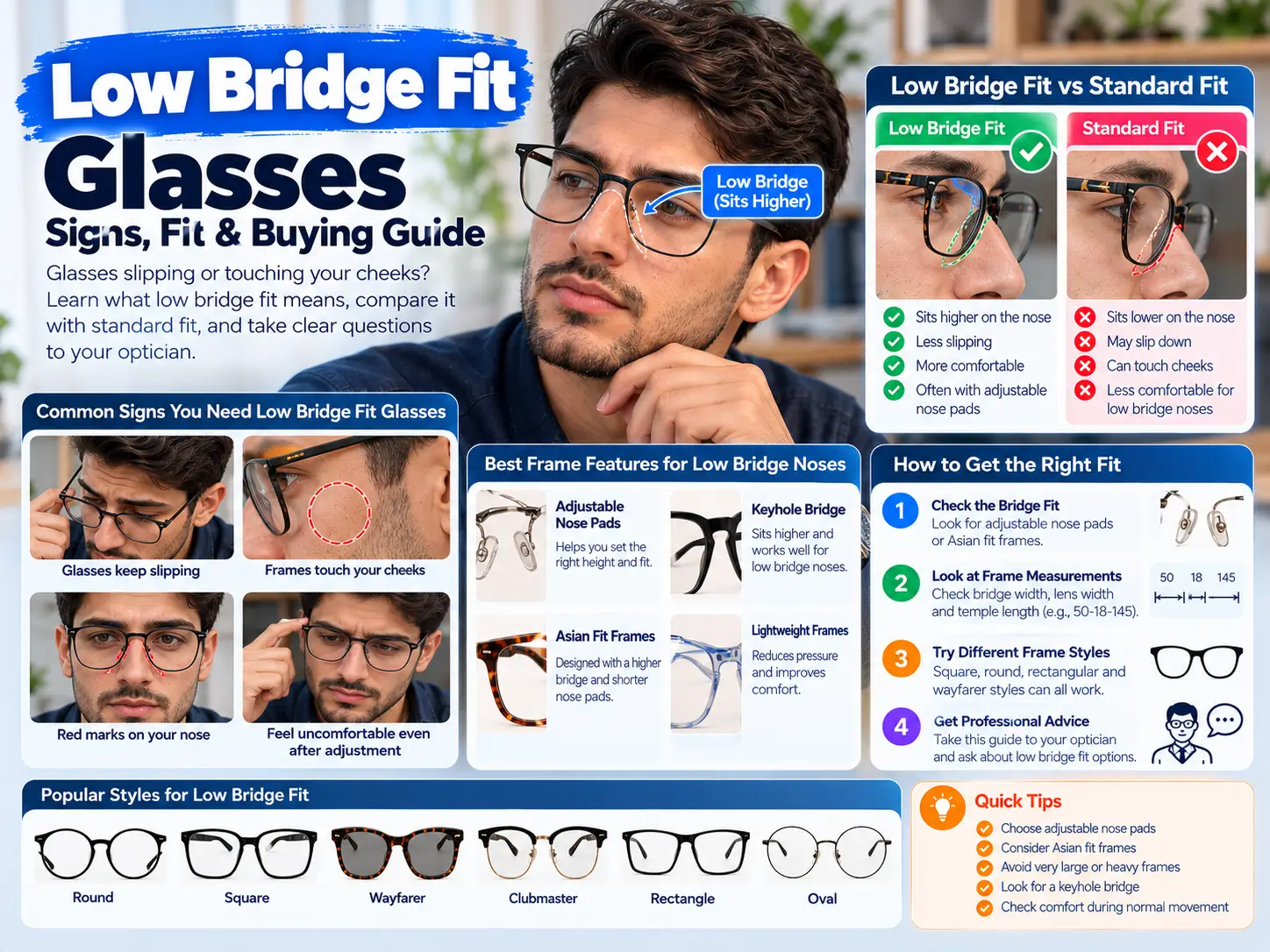
Low bridge fit glasses use a different bridge or nose-pad design to help the frame sit securely on a lower nose bridge. They may be worth trying if standard frames repeatedly slide or rest on your cheeks. They are a fit option, not a face-shape category or a guaranteed fix.
Some shops use terms such as alternative fit, universal fit or Asian fit. Read the actual product description because the designs and labels vary. Anyone can try the option if it meets their fit needs; an ethnic label is not a personal fitting rule.
Zenni’s explanation of low-bridge designs describes extended nose pads and a flatter frame front. Those features illustrate how support can change without simply shrinking the whole frame.
Low bridge fit versus standard fit
| Question | Standard or regular fit | Low bridge fit |
|---|---|---|
| What changes? | The maker’s usual bridge/pad arrangement for that model. | A modified support arrangement intended for a different nose/face fit. |
| Is it automatically narrower? | No: width depends on the individual model and size. | No: low bridge fit is not another name for narrow fit. |
| Who should start here? | Someone whose current standard frames already sit comfortably. | Someone who needs to compare a different support design after recurring fit problems. |
| Does it guarantee comfort? | No. Try the frame and check its contact points. | No. Total width, lens shape, balance and adjustment still matter. |
Warby Parker’s nose-bridge guide explains several bridge types. The useful question is where the frame rests on you, not whether one bridge is better in general.
When is it worth trying a different bridge design?
Notice what happens during normal wear. Are you repeatedly pushing the frame up? Do the rims rise when you smile? Does the frame rest lower than you want even after a professional adjustment?
These observations are starting points, not a diagnosis. A loose, heavy or poorly sized frame can produce similar frustrations. Warby Parker’s low-bridge discussion explains why adjustments and a different bridge design are separate options.
Record the problem in plain words: “It slides when I look down” is more useful at an appointment than “I think I have the wrong face.” Bring the pair that causes the problem and, if possible, one that feels better.
Why a smaller bridge number is not the whole answer
The printed bridge-width number is one measurement between the lenses. It does not describe the entire contact surface or how high the support sits. A frame with a smaller number can still be uncomfortable.
ZEELOOL’s fit explanation highlights bridge contour, pad position and the limits of photo try-on. Use the full design and a real fitting rather than converting the height of your nose bridge into a fixed 16, 18 or 20 mm recommendation.
For an example of reading the numbers, see our glasses sizing and style guide. Those numbers help compare products; they cannot decide comfort alone.
Three options to discuss with the optician
A different low-bridge model
Ask what changes in the low-bridge version: pad reach, bridge contour, front shape or another feature. A similar-looking model name does not tell the whole story.
Adjustable nose pads
Ask whether pad positioning can improve the frame you like. Adjustment has limits; the rest of the frame still needs to fit.
Another overall size or shape
Sometimes the better experiment is different side width or lens depth. Do not keep tightening the arms to compensate for a frame that is fundamentally wrong for you.
Your current pair, checked properly
If it fitted well before and now slips, ask whether a loose part or changed adjustment explains the difference. You may not need a new fit category at all.
Take this short brief to your fitting
“My current glasses [slide / touch my cheeks / press here]. This happens when I [look down / smile / wear them for a while]. Please compare the bridge support and total fit, and show me whether an adjustment or another frame is the better option.”
- Bring your current pair and its exact model/size if known.
- Explain the activity that exposes the problem, rather than only showing a still selfie.
- Compare two candidates while talking, smiling and moving normally.
- Ask the provider to confirm the frame works with your prescription and lens design.
- Ask what adjustment support is available after collection.
There is no need to rank your nose, face or cheekbones. The fitting conversation is about a product meeting your needs.
Buying online without relying on a filter
Check the exact fit version, size chart, front and side photos, lens options and current return conditions. Ask the seller to explain a “universal” label if the design details are missing. Return terms can differ for frames alone and completed prescription orders.
Use virtual try-on to choose an appearance, not to confirm physical support. Our oval-face frame guide compares styles; the same distinction between style and fit applies to every shape.
FramesDirect’s low-nose-bridge guide provides another retailer explanation of the terminology and options. Product ranges vary by country; this page does not promise a particular model, price or availability in the USA or India.
Mistakes that make the search harder
- Choosing by ethnicity: fit labels are not measurements of your own features.
- Assuming every slip proves a low bridge: ask what else about the frame could cause it.
- Choosing only a smaller bridge number: compare the whole support design.
- Accepting pressure as “secure”: tell the optician where it hurts.
- Trying aggressive bends or heat at home: have the frame assessed for a suitable adjustment.
If the finished glasses remain painful or vision seems wrong, ask your eye-care provider to check them. A style guide cannot assess that problem from a picture.
Low bridge fit questions
Do I need a low bridge face shape?
No. Low bridge fit describes a frame-fitting option, not one of the oval, round or square face-shape labels.
Is low bridge fit only for Asian people?
No. You may see “Asian fit” used as a retail label, but people from any background can need different bridge support. Choose by actual fit.
Can I have a wide nose and still need low bridge fit?
Width and bridge height are different features. Ask an optician to compare the actual support and total frame fit rather than choosing from one feature.
Will adjustable nose pads always solve sliding?
No. They may help positioning, but overall width, design and adjustment also matter. The frame must be assessed as a whole.
Can a selfie tell me which bridge size to order?
Not reliably. A normal photo does not measure contact pressure or show how the frame behaves in daily wear. Use it for style comparisons, not a guaranteed fitting.
Sources and editorial limits
References: Zenni on low-bridge construction, Warby Parker on slipping and bridge fit, ZEELOOL on design and try-on limits, and FramesDirect on low-bridge options. These are retailer explanations, not independent tests of every frame. This guide offers a comparison process and questions for a fitting; it does not prescribe lenses or guarantee a product result.