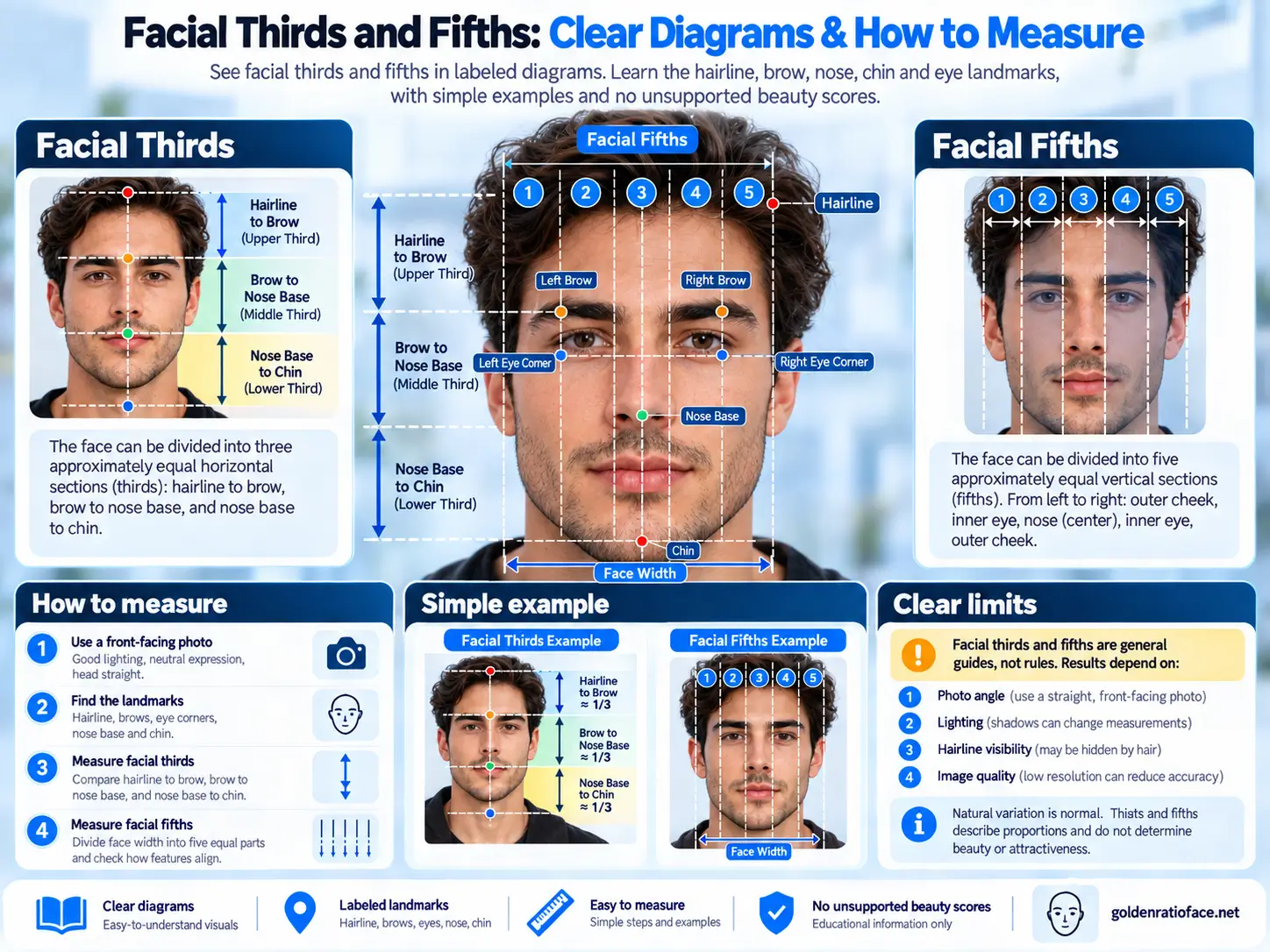
Facial thirds and fifths: diagrams, landmarks and examples
See where each division starts and ends, learn how to compare the measurements, and understand what the numbers cannot tell you.
What are facial thirds and fifths?
Thirds answer “How is the vertical length divided?” Fifths answer “How are the eyes and the surrounding widths spaced across the face?” Neither calculation uses 1.618. The golden ratio is a different comparison.
The diagrams below show an intentionally simplified, equal-division reference. Your face does not need to match it. Use the labels to understand the method, not to decide what your features should look like.
Facial thirds: diagram and landmarks
| Region | From | To |
|---|---|---|
| Upper third | Center of the hairline, called trichion | Glabella, the midline area between the brows |
| Middle third | Glabella | Subnasale, where the nose base meets the upper lip |
| Lower third | Subnasale | Lowest chin point used in this guide |
These are heights along the face’s vertical direction, not tape paths over its surface. The glabella is not the highest point of an eyebrow arch. The nose-base landmark is not the tip of the nose. Different references may use slightly different chin or upper-face definitions; write down which ones you use.
A higher or receding hairline changes the upper measurement. If it is hidden, record that limitation instead of guessing its original position. A beard can obscure the chin boundary. Those are reasons to treat a photo estimate cautiously, not reasons to substitute a preferred result.
Facial fifths: five widths across the face
- Outer strip: one face-outline edge to the outer corner of the nearby eye.
- First eye width: outer eye corner to inner eye corner.
- Middle strip: the gap between the two inner eye corners.
- Second eye width: inner eye corner to outer eye corner.
- Other outer strip: the outer eye corner to the opposite face-outline edge.
In the equal-fifths reference, all five widths match. The eye measurements use the corners of the eye opening, not the pupil centers or eyebrow lengths. The face-outline endpoints should be defined consistently in the front view; do not include the ears or hair.
The familiar “one eye between the eyes” rule checks only the center gap against an eye width. It does not test all five strips. The related idea that nose width matches the inner-eye gap is another comparison; a nose does not have to fit exactly into the center strip.
How to measure thirds and fifths from a photo
- Prepare the image. Use a straight-on, eye-level photo with a relaxed expression. Keep the original aspect ratio and make the hairline visible if possible.
- Mark the four height boundaries. Place horizontal guides through the hairline center, glabella, nose base and chin. Compare the three gaps along the vertical direction.
- Mark the five width intervals. Identify both eye corners and the two outer face boundaries. Use one consistent horizontal reference across the front view.
- Record the distances. Pixels or measurements on an undistorted print are sufficient for a ratio. Do not mix units.
- Check your marks again. If the endpoints are unclear or the head is turned, use a better image before interpreting a difference.
The golden ratio face calculator measures three other ratios. It does not automatically measure facial thirds or fifths. This guide provides the separate definitions so those methods do not get mixed together.
A worked example without a beauty grade
Suppose an illustrative photo has thirds of 60, 65 and 70 pixels. The total is 195 pixels. Divide each region by the total and multiply by 100:
- Upper: 60 ÷ 195 × 100 = 30.77%.
- Middle: 65 ÷ 195 × 100 = 33.33%.
- Lower: 70 ÷ 195 × 100 = 35.90%.
That tells you how the measured height is distributed. It does not establish a defect, diagnosis or attractiveness score. The equal-thirds reference would be approximately 33.33% each.
For fifths, illustrative widths of 25, 28, 27, 29 and 26 pixels total 135 pixels. Their shares are approximately 18.52%, 20.74%, 20.00%, 21.48% and 19.26%. The equal-fifths drawing would show 20% each. These invented examples explain the math; they are not population averages or suggested targets.
Do real faces have to match equal thirds or fifths?
No. These are reference schemes, not universal requirements. In a 2012 study, Jayaratne and colleagues tested neoclassical proportion rules using 3D images of 103 young Southern Chinese adults. The tested rules generally did not fit that sample. This finding challenges universal use; it does not create a new rule for every person of Chinese ancestry or any other population. Read the original study.
There is no validated “good thirds score” on this page. A photo also compresses a three-dimensional face into two dimensions. Perspective, pose and uncertain endpoints can change the apparent distribution. A precise decimal does not remove those limits.
Thirds, fifths, golden ratio and symmetry
| Method | Main question | Reference used |
|---|---|---|
| Thirds | How is face height divided? | Three equal height regions in the classical scheme |
| Fifths | How are eye widths and spaces arranged? | Five equal width intervals in the classical scheme |
| Golden ratio | How does one selected distance compare with another? | Phi, approximately 1.618 |
| Symmetry | How do selected measurements differ between sides? | A defined axis and matching feature comparisons |
A face can match one reference and differ from another because they ask different questions. For ratio instructions, see how to measure your golden ratio face. For a side-to-side photo comparison, use the face symmetry test.
Facial thirds and fifths questions
What does a longer lower third mean?
It means the nose-base-to-chin interval is longer relative to the other recorded intervals under your chosen definitions. It does not by itself identify a face shape, explain a medical condition or indicate a problem.
Are facial fifths the same as eye spacing?
Eye spacing is one part. The full reference also includes both eye widths and the outer strips between the eyes and face outline.
Can hair or a beard change the result?
Hair can hide the hairline and a beard can hide the chin or side outline. Styling can change the visible silhouette, but a styled edge should not silently replace the anatomical point you intended to measure.
Are these proportions different for men and women?
Individuals vary. This guide does not provide validated sex-specific or population-specific targets. Use the definitions to describe a measurement rather than judge someone against a universal ideal.
Are equal thirds the golden ratio?
No. Equal thirds compare three equal parts; phi compares two quantities in an approximately 1.618 relationship. They should not be used as interchangeable labels.
2 thoughts on “Facial Thirds and Fifths: Clear Diagrams & How to Measure”