Most people pick glasses the way they pick a photo filter: something looks nice, so they buy it. That works fine until the frame fights your face instead of working with it, which is usually the actual reason a pair looks “off” in person even though it looked fine on the shelf.
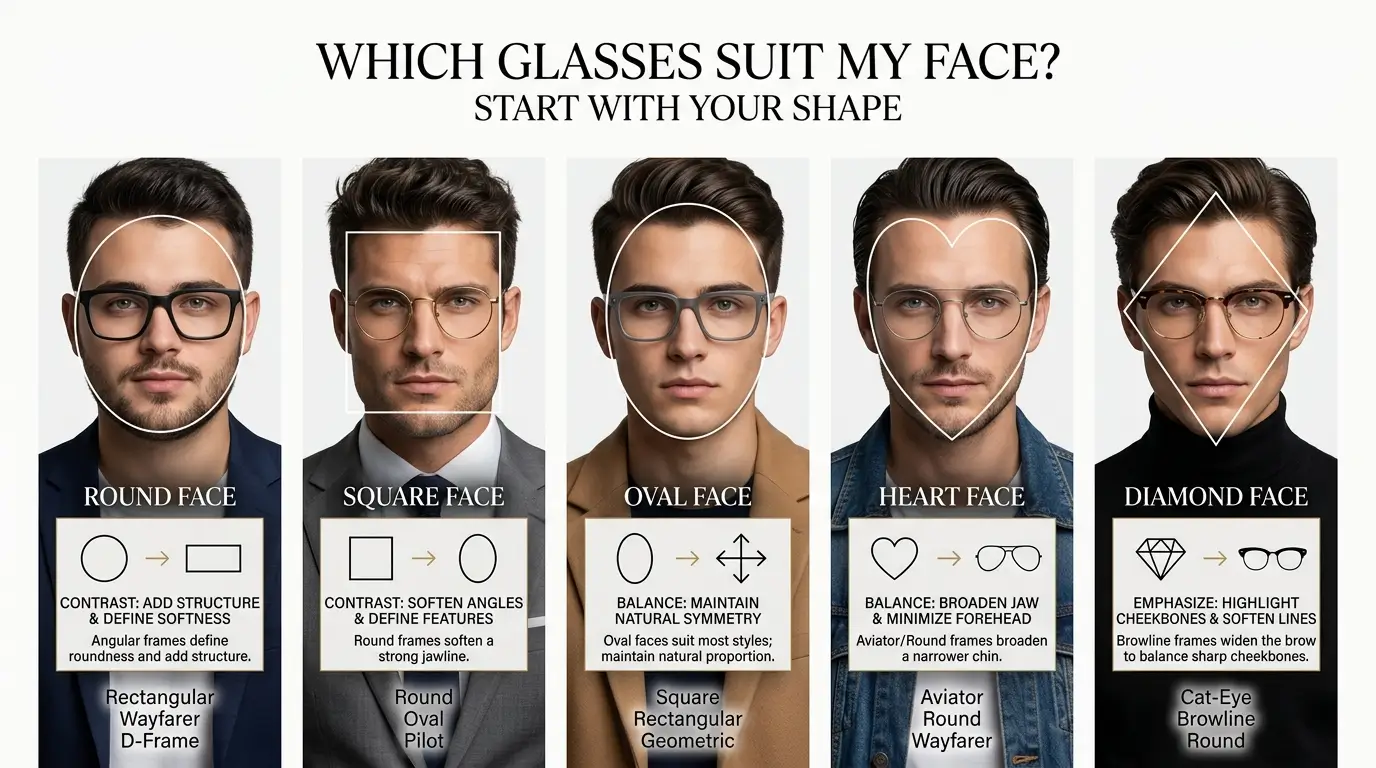
The short answer is that glasses generally work best when they contrast your face shape rather than repeat it. A round face tends to look sharper in an angular frame. A square jaw tends to soften with rounder lines. That’s the whole principle, but knowing why it works, and where it doesn’t apply cleanly, matters more than memorizing a shape-to-frame chart.
Why Contrast Works Better Than Matching
Your face has a dominant shape: Soft and curved, or angular and defined. A frame sitting right at eye level either continues that shape or breaks it up.
An angular frame on a round face adds a line the face doesn’t have on its own, which reads as more defined. A rounded frame on a square jaw does the opposite: it softens an edge that’s already strong. Repeating the shape instead, round frames on a round face, tends to just emphasize the roundness rather than balancing it.
This isn’t a hard rule. Plenty of people prefer leaning into their natural shape rather than contrasting it, and that’s a legitimate choice, not a mistake. The contrast principle is a starting point for people who aren’t sure what to try, not a law.
Your Shape, and What Actually Helps
Face shape comes down to two things: how your width compares to your length, and where that width sits- forehead, cheekbones, or jaw. Once you know both, the right frame direction usually becomes obvious.
| Your shape | What tends to help | Full guide |
|---|---|---|
| Round | Angular or geometric frames add definition the face doesn’t have on its own | Glasses for round face |
| Oblong / long | Frames with more depth than width shorten how long the face reads | Glasses for long face |
| Square | Rounder or oval frames soften a strong, angular jawline | Glasses for square face |
| Heart | Frames wider at the bottom balance a forehead that’s wider than the jaw | Glasses for heart-shaped face |
| Oval | Most shapes work reasonably well, since oval has the most balanced proportions to begin with | Best glasses for oval face |
Three Mistakes That Undo Good Shape Advice
Getting the frame shape right and still ending up with glasses that don’t work usually comes down to one of three things.
- Ignoring frame size relative to your face. A frame can be the correct shape and still be too large or small for your proportions. Oversized frames on a smaller face don’t look bold, they look like they’re wearing you.
- Assuming a friend’s flattering frame will work the same way on you. Face shape is only part of the picture. Bone structure, brow height, and even skin tone interact with a frame differently from one person to the next.
- Skipping the fit check on your nose bridge. A frame that constantly slides or sits crooked will look wrong no matter how correct the shape is on paper. Fit affects the overall impression as much as shape does.
Does Frame Color Matter as Much as Shape?
Shape has the biggest effect on overall balance, but color isn’t irrelevant. It generally tracks with skin tone rather than face shape: warmer skin tones tend to suit gold, tortoiseshell, and warm browns, while cooler skin tones tend to suit silver, black, and cooler grays.
Get the shape right first. Color and size are the details that fine-tune a frame that already fits the underlying logic, not a substitute for it.
What If I Don’t Know My Actual Face Shape?
This is the step that makes everything above useful instead of a guess. Estimating your shape from a mirror is the single most common reason people end up reading the wrong section of a guide like this one.
The face shape detector measures your real proportions from a photo in a few seconds, using the same forehead, cheekbone, and jaw measurements this article is built around. It’s a faster and more reliable starting point than eyeballing it.
Frequently Asked Questions
How do I know which glasses suit my face?
Confirm your actual face shape first, then look for frames that contrast it rather than repeat it, angular shapes for softer faces, rounder shapes for angular ones. The table above breaks this down shape by shape.
Is there one universal rule for glasses and face shape?
The closest thing to a universal rule is contrast over repetition. But it’s a starting point, not a law, and plenty of people get great results choosing frames that suit their taste over the general guidance.
Do oval faces really suit almost every frame shape?
Largely, yes. Oval is generally considered the most balanced face shape in terms of width-to-length proportions, so it has the least it structurally needs a frame to correct.
What’s the biggest mistake people make choosing glasses for their face shape?
Guessing their face shape rather than confirming it. Since the entire recommendation depends on knowing your actual proportions, an incorrect starting shape leads to advice that doesn’t apply to you.
Can I just choose glasses I like regardless of what suits my face shape?
Yes, and that’s a completely reasonable approach. This guidance exists to help people who aren’t sure where to start, not to override personal preference for people who already know what they like.
The Bottom Line
Frame shape works by either softening or adding an angle your face doesn’t already have. Confirm your actual shape, match it to the logic above, and treat size and color as the finishing touches rather than the starting point.