Quick answer:
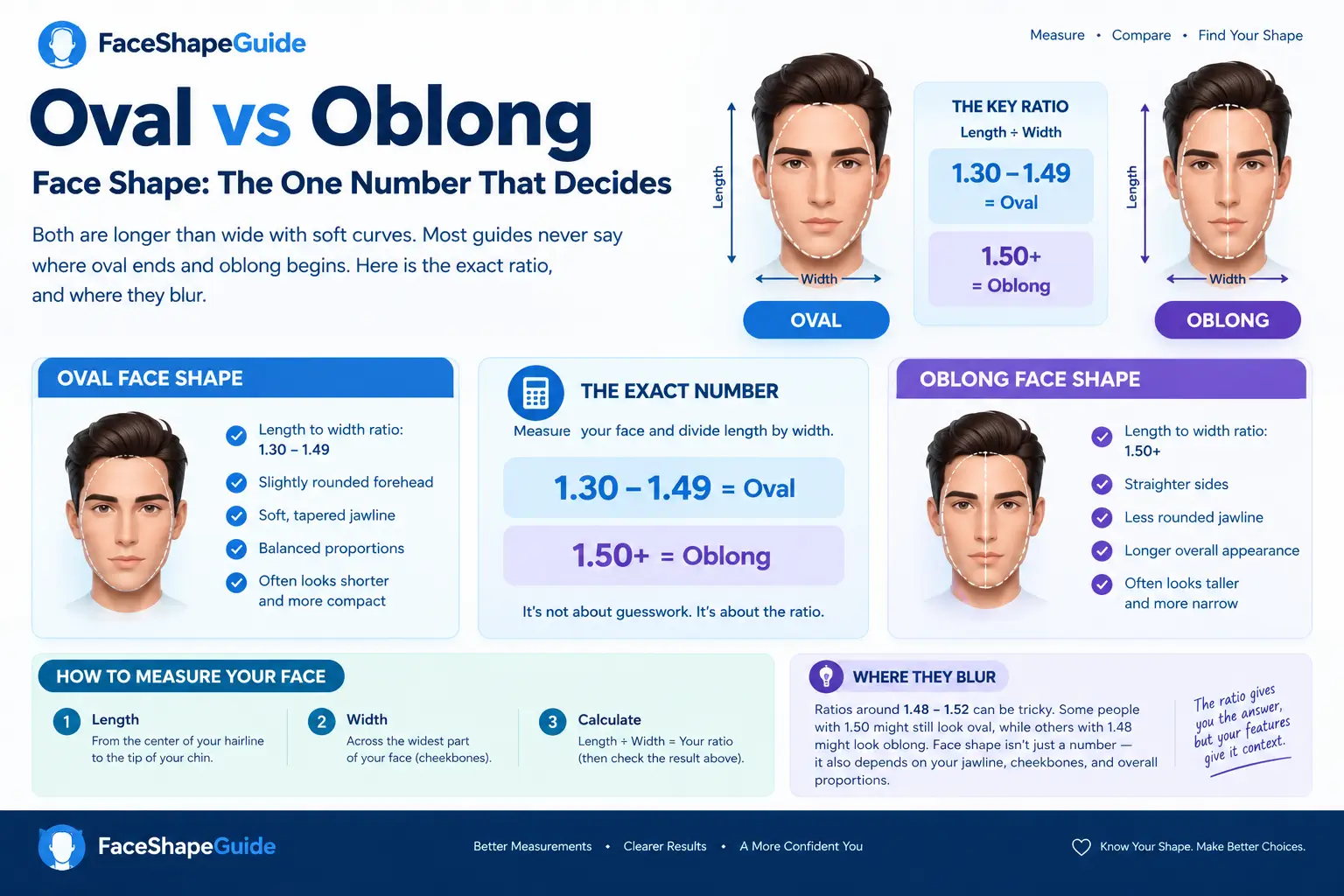
Both shapes are longer than they are wide with a soft, curved jaw, which is why they get confused more than almost any other pair. The difference is entirely about how much longer. Oval sits in a ratio band of 1.30 to 1.50 (length divided by cheekbone width). Oblong is 1.50 and above.
Most guides describing either shape never state a number at all, which is exactly why the confusion exists: without a threshold, “moderately long” and “clearly long” are just two people’s different impressions of the same face.
Why this pair gets confused constantly
Oval and oblong share almost everything: cheekbones as the widest point, a forehead just slightly narrower, a jaw narrower again, and a soft curved jawline with no corner. The only thing that separates them is length, and length is the one measurement people are worst at judging by eye.
Making this worse, several widely read styling guides describe an oval face as being “about one and a half times longer than it is wide.”
That description sits exactly on the 1.50 boundary that most systems, including this one, use to start oblong. A guide describing an oval this way is, on plenty of real faces, describing a face that would measure as oblong on a tape.
The comparison, directly
| Oval | Oblong | |
|---|---|---|
| Length divided by cheekbone width | 1.30 to 1.50 | 1.50 and above |
| Widest point | Cheekbones, by a small margin | Even across forehead, cheekbones and jaw |
| Jaw | Curved, tapering to a rounded chin | Curved, no corner |
| How it reads | Moderately longer than wide | Clearly, noticeably longer than wide |
| Sides | Curve inward gently from cheekbone to jaw | Run close to parallel |
The side line is the fastest visual check, if you do not want to measure. Trace from your temple down to your jaw. On an oval face, that line curves inward, which is why the cheekbones read as the widest point. On an oblong face, it runs nearly straight, since nothing along the way is meaningfully wider than anything else.
The measurement, if you want certainty
Divide your face length (hairline to chin) by your cheekbone width (the widest point across your cheekbones). That single number settles it more reliably than any visual impression:
- 1.30 to 1.45 clearly oval
- 1.45 to 1.55 genuinely borderline, and worth treating as such rather than forcing a label
- 1.55 and above clearly oblong
If your number lands in that middle band, you are not measuring wrong. Plenty of real faces sit close to this exact boundary, which is a property of the boundary, not a flaw in your tape measure.
Does the difference actually matter for styling?
Somewhat, and mainly around volume. Oval faces have no strong imbalance to correct, so styling advice for that shape is close to “anything works, choose by preference.” Oblong faces benefit specifically from width added at the sides and length avoided at the crown, since the face is already reading long.
A hairstyle genuinely fine for an oval face, like a lot of height at the crown, can work against an oblong face by adding more length to a face that has enough already. This is the practical reason it is worth knowing which side of 1.50 you actually fall on, rather than treating the two as interchangeable.
FAQs
Is oblong the same as oval?
No, though they are close. Both are longer than wide with a soft jaw, but oval measures 1.30 to 1.50 times as long as it is wide, and oblong is 1.50 and above. The confusion is common because several popular guides describe oval using a ratio that actually sits on the oblong boundary.
What is the main difference between oval and oblong face shapes?
Length. Oval is moderately longer than wide; oblong is clearly and noticeably longer than wide. Both share the same soft, curved jawline and the same cheekbone ledge width, so length is the only reliable way to tell them apart.
How do I know if I am oval or oblong?
Divide your face length by your cheekbone width. Below 1.50, you are oval. At or above 1.50, you are oblong. If your result lands between 1.45 and 1.55, treat it as genuinely borderline rather than forcing a label either way.
Why do some guides say oval is one and a half times longer than wide?
That description sits exactly on the boundary most measurement systems, including this one, use to start oblong. It is not wrong so much as imprecise, and on many real faces that exact ratio would measure as oblong rather than oval.
Does it matter which one I actually am for styling?
Mainly for one thing: crown volume. Oval faces can add height with little consequence, since there is no length to correct. Oblong faces should be more careful with crown volume, since the face already reads long and extra height adds to that rather than balancing it.
Reference on this proportion concept: aspect ratio.
1 thought on “Oval vs Oblong Face Shape”