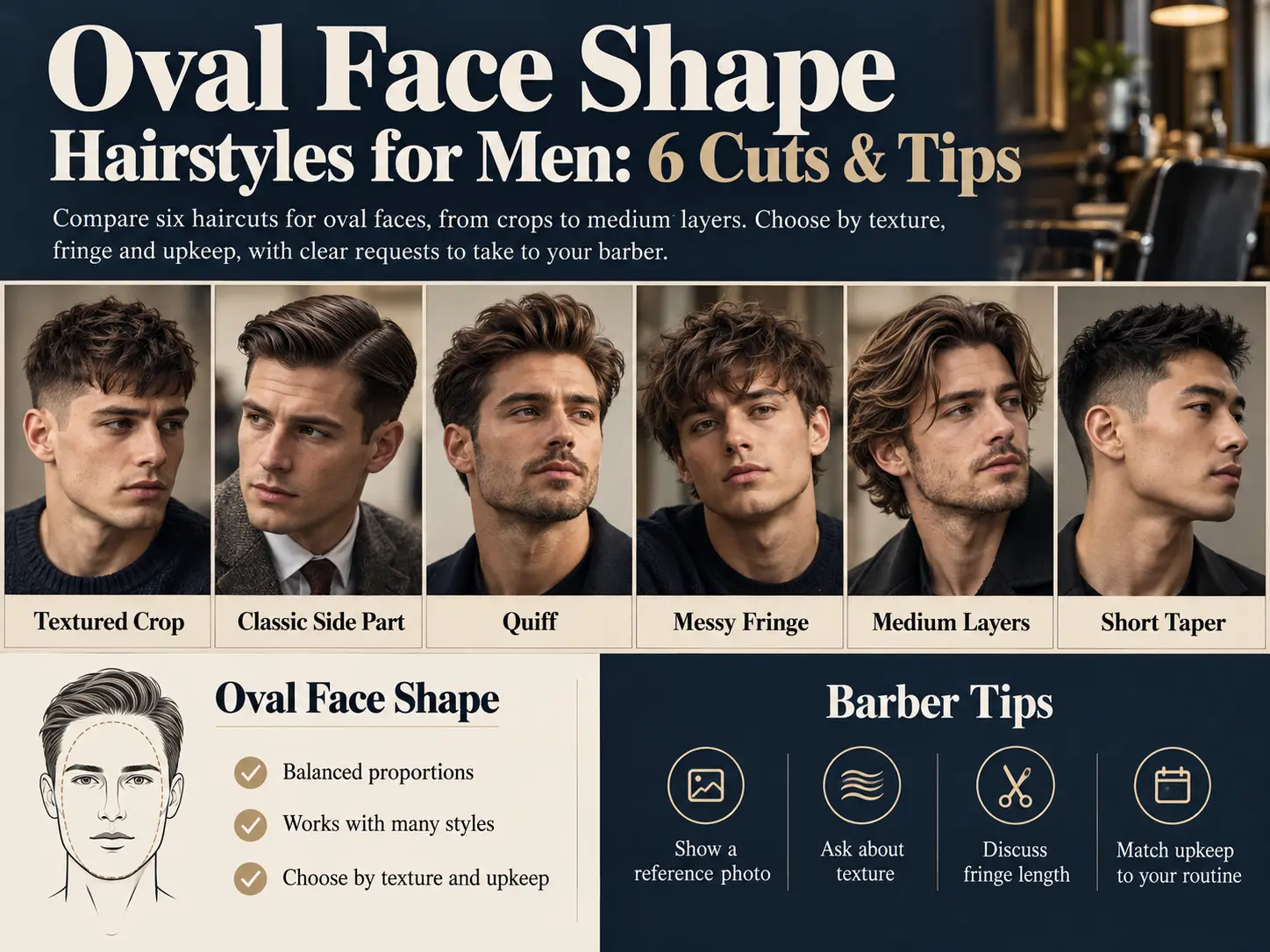
Oval Face Shape Hairstyles for Men: 6 Practical Cuts
Use your face outline to narrow the options, then choose by your hair and routine. Here are six adaptable cuts and the details worth agreeing before the scissors start.
Which hairstyles suit an oval face?
A textured crop, side part, crew cut, moderate quiff, curly taper or medium layered cut can be useful options for an oval face. The best choice depends on the version of the cut, your hair texture, density, growth pattern and how you want to style it.
Oval does not mean every haircut will behave equally well on your hair. It also does not mean you must avoid a fringe or long straight hair. Start with your preferred look and adapt the details.
Unsure about the label? Use the oval face guide and photo comparison or the shape chart. You do not need an exact category before a haircut.
Make these three choices first
- Forehead coverage: do you want the front swept back, partly covered or worn forward? This decides more than simply saying “short.”
- Side coverage: choose a close fade, a gentle taper or fuller scissor-cut sides. Show a side-view photo, not only the front.
- Daily effort: decide whether you will air-dry, use a brush, or style with a dryer. Ask to see a routine you will actually repeat.
If you want less visible height, choose a lower top rather than automatically adding a tall quiff. If you want a stronger vertical outline, some front lift may be a choice. Neither preference is a rule attached to oval faces.
Six cuts to discuss with your barber
The drawings show broad outlines only. They do not prescribe exact lengths, guard numbers or a guaranteed result.
1. Textured crop
A short top with separated pieces and a fringe you can wear forward or slightly across. It gives a clear shape without needing a tall front.
Ask your barber: “Keep the top textured, with a soft fringe. Show me where the fringe will sit when dry before taking it shorter.”
Check first: A dense straight fringe and a light broken fringe give different amounts of forehead coverage.
2. Classic side part
A defined or loose side direction can work for a tidy daily finish. You can change the height by styling closer to the head or with a little lift.
Ask your barber: “Follow my natural part and leave enough top length to sweep across. I want a soft blend rather than a disconnected shelf.”
Check first: A shaved hard part is an extra choice, not a requirement for a side-part haircut.
3. Crew cut or Ivy League
A shorter option when you want less hair to arrange. An Ivy League version leaves more front length for a small side sweep.
Ask your barber: “Keep the front long enough for this small sweep and blend the sides. Please show the shortest side length first.”
Check first: Short morning styling does not mean the edges stay freshly cut for months.
4. Moderate quiff
The front lifts upward while the rest of the top stays more controlled. Choose it because you like that shape, not because oval requires volume.
Ask your barber: “Leave a movable front with moderate height. Show me the quick styling routine using my own hair direction.”
Check first: A tall quiff needs different length and styling effort from a subtle front lift.
5. Curly or coily top with a taper
Keep your natural pattern visible while choosing how much fullness remains around the sides. A taper can tidy the edges without removing all side coverage.
Ask your barber: “Keep the curl shape I like and discuss shrinkage before cutting. I want the temples tidy but not automatically taken to skin.”
Check first: Judge the intended dry shape and avoid copying a reference with a very different curl pattern.
6. Medium layers or a relaxed flow
Useful if you want movement, tuckable sides or more ways to change your part. The outline can be fuller or closer to the head.
Ask your barber: “Keep enough length to move and tuck back. Shape the layers around how my hair naturally falls.”
Check first: Ask how it looks air-dried; a salon blowout may not match your everyday finish.
Adapt the choice to your actual hair
| Your starting point | What to discuss |
|---|---|
| Fine or lower-density hair | Keep enough coverage for your preferred finish. Heavy product or excessive removal of weight may work against it; try a small amount first. |
| Thick straight hair | Explain where the sides stick out. Ask the barber how they would manage weight without assuming the shortest cut is the only answer. |
| Wavy hair | Choose where you want the wave to sit. Compare a forward crop with a longer sweep rather than forcing one direction. |
| Curly or coily hair | Discuss dry shape, shrinkage, detangling and side fullness. Keep the reference close to your own pattern. |
These choices apply in the USA, India and elsewhere. Nationality does not tell you someone’s hair texture or density. Describe what your own hair does after washing and drying.
If your face looks closer to oblong
Oval and oblong are neighboring styling descriptions, not two categories separated by one universal decimal. The side outline, jaw and measurement method also matter. Do not switch your whole haircut plan because one app reports 1.49 and another reports 1.51.
If you prefer less apparent length, keep the front lift moderate and consider some side coverage. The oval-versus-oblong haircut comparison shows how the same cut can be adjusted. If you like height, you can still choose it.
Plan the grow-out as well as the first day
A crisp fade and a softer scissor finish need different kinds of upkeep. Ask which part of the cut will lose its shape first and whether an edge tidy is useful between full appointments. There is no universal trim schedule based only on face shape.
Start with a small amount of styling product and add only if needed. If you use a dryer, limit unnecessary heat; the American Academy of Dermatology recommends low or medium heat and heat protection. A haircut should not require you to force your hair into place with excessive heat every day.
For a detailed shorter option, read the textured crop with a low fade guide. For a broad comparison, use men’s hairstyles by face shape.
A barber request you can use
“I like this side-swept crop. Keep some forehead visible, a natural top and a soft taper. Please show me the dry fringe length, how much side coverage will stay, and how to style it quickly at home.”
Bring front and side references. Replace the details in that request with your own choices; a picture with similar texture is more useful than a celebrity’s claimed face-shape label.
Oval-face haircut questions
Can an oval face have a buzz cut?
Yes. A buzz cut exposes the outline and keeps styling simple. Choose the length and side finish you like; oval is not a requirement for wearing it.
Can I wear a fringe with an oval face?
Yes. A fringe changes how much forehead is visible. Decide whether you prefer a dense line, soft texture or a side sweep rather than banning all fringes.
What is a low-maintenance option?
A shorter crew cut or crop may be easier to arrange than a tall styled front, but a crisp fade can still need frequent tidying. Separate morning effort from barber upkeep.
Is an oval face the most attractive shape?
This guide does not rank faces by attractiveness. Oval is a description that can help organize styling ideas, not a better result.
Sources and editorial approach
The cut shortlists and barber requests are our editorial suggestions, not guaranteed transformations. Wahl’s crop-fade education guide provides a professional example of the cut. American Academy of Dermatology hair-care guidance supports the heat-care advice. Neither source validates a perfect haircut for a face-shape label.