Quick Answer:
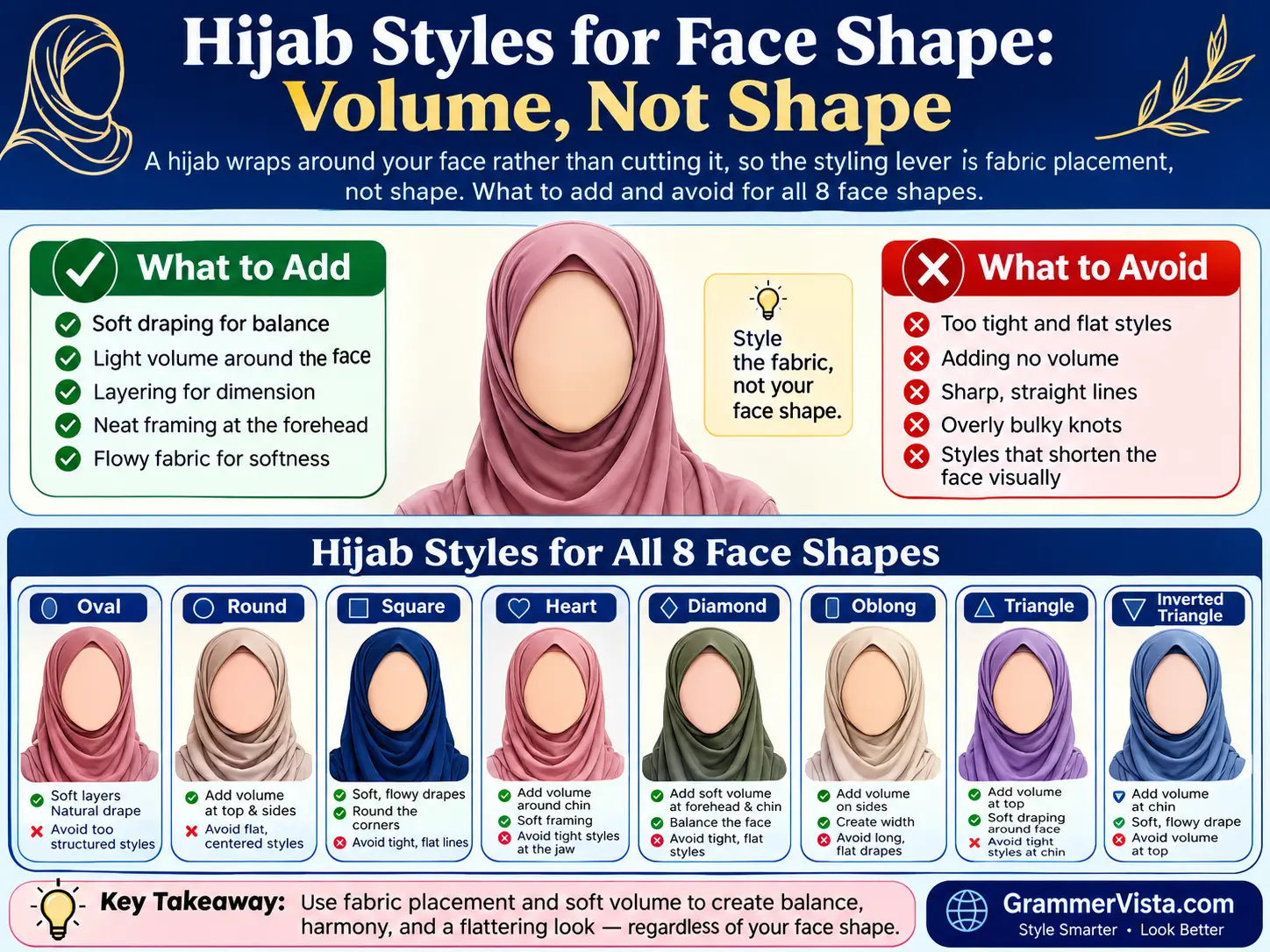
There is no wrong face shape for a hijab, and nothing below is a rule. It is a set of levers: crown volume adds height, side volume adds width, a lower front edge narrows a wide forehead, and fabric stiffness controls how strongly any of that reads.
The same underlying goal that governs hairstyles for your shape governs hijab styling too, since both are about adding fullness where the face is narrow and softening where the jaw is angular. The mechanism is just different: hair changes the outline, a hijab frames it.
The four levers, before the shape-by-shape guide
Every hijab styling decision comes down to these four choices. Learn them once and you can work out any shape yourself.
| Lever | What it does | Use it to |
|---|---|---|
| Crown volume | Adds visible height at the top of the head | Balance a short, wide face |
| Side volume | Adds visible width at cheek and jaw level | Balance a long, narrow face |
| Front edge height | How high or low the fabric sits on the forehead | A lower edge narrows a wide forehead, a higher edge opens it |
| Fabric stiffness | How strongly the drape holds its shape | Stiffer fabric (cotton, structured georgette) reads as defined lines. Soft fabric (chiffon, jersey) reads as curves |
Hijab styles for all 8 face shapes
| Shape | Add | Avoid |
|---|---|---|
| Oval | Almost anything works; this shape has no imbalance to correct | Nothing specific, this is the one shape with real freedom |
| Round | Crown volume, a front edge worn slightly higher, smooth fabric close at the cheeks | Side volume at cheek level, very rounded front edges, both add width where the face is already widest |
| Square | Soft, flowing fabric (chiffon, crepe) draped loosely around the jaw | Stiff fabric held tight and close to an angular jaw, which sharpens the corners rather than softening them |
| Oblong | Side volume at cheek level, a lower front edge, wide draping across the shoulders | Tall crown volume or a high volumising underscarf, which adds length to a face that is already long |
| Rectangle | Same side volume approach as oblong, plus slightly firmer fabric if you want to hold the structure the jaw already has | Tall crown styles, for the same length reason as oblong |
| Heart | A front edge worn lower, close framing at the forehead, fullness in the drape near the jaw and chin | High, wide front edges exposing the full forehead, tight wraps at the jaw that emphasise the taper |
| Diamond | Fullness directed at the forehead and chin, stiffer fabric for defined horizontal lines at the temple | Tight wraps pulled in at the cheekbone level, which draws a line across the widest part of the face |
| Triangle | Crown and forehead volume, a padded or volumising underscarf for upper face emphasis | Side volume at jaw level, which adds width to a jaw that is already the widest point |
Notice the pattern. Every “add” column matches the same width or height goal already covered on this site’s hairstyle and beard guides for that exact shape, since the underlying geometry never changes, only the tool being used to address it does.
What the underscarf is actually doing
The underscarf sets your frame line more than most people realise. A volumising underscarf raises crown height, which helps round and triangle faces and works against oblong and rectangle faces. How high or low it sits on the forehead directly changes your visible face length, the same way a hairline does for hair styling. If you remember one thing from this section: the underscarf is not just a base layer, it is doing real styling work of its own.
Fabric, matched to effect rather than to trend
- Soft, fluid fabrics (chiffon, crepe, soft jersey) drape into curves with very little effort, which suits round and square faces where softening is the goal
- Stiffer, structured fabrics (cotton, structured georgette, linen) hold clean lines, which suits oblong, rectangle and diamond faces where defined horizontal structure is the goal
- Lightweight fabrics drape close to the face with minimal added volume, which suits heart faces, where extra forehead volume works against the goal rather than for it
FAQs
What hijab style suits a round face?
Crown volume and a front edge worn slightly higher, with fabric kept smooth and close at the cheeks. The goal is added height, since a round face has no length to spare and side volume would add width where the face is already widest.
What hijab style suits a long or oblong face?
Side volume at cheek level rather than crown height, a lower front edge, and wider draping across the shoulders. This is the opposite of the round face approach, since an oblong face needs width added rather than more length at the top.
Does fabric choice actually matter for face shape styling?
Yes, more than most guides admit. Soft, fluid fabrics like chiffon drape into curves with almost no effort, which helps soften an angular jaw. Stiffer fabrics like structured cotton hold clean lines, which helps a long face read as more structured and balanced rather than adding unwanted softness.
Is there a wrong face shape for hijab styling?
No. Every shape has styles that work well, and the differences above are about which effect a style produces, not about correcting anything. Oval faces in particular have very few real restrictions, since there is no imbalance in that shape’s proportions to work around.
How is hijab styling different from choosing a hairstyle for my face shape?
The underlying goal is identical: add width or height where your face is narrow, soften where the jaw is angular. The tool differs: a hairstyle changes the outline of your hair itself, while a hijab wraps around your existing outline, so the same effect comes from fabric placement, front edge height and underscarf volume instead of cutting or layering.
Should I take my hijab off to find my face shape?
Yes, ideally. A hijab covers the hairline and can hide temple width, both of which the face shape detector and other measurement tools on this site rely on. A photo without it, or the measurements tab using a tape, gives the more accurate reading.
Reference on the garment discussed throughout: hijab.