Glasses for Small Faces: Petite Frames That Fit
If adult frames keep slipping or looking wider than you want, compare petite, narrow and extra-narrow options. Size comes first; your favorite style can follow.
Compare your options ↓Choose a look you enjoy. Your face does not need correcting.
Compare frame outlines
Choose a look to explore. This is an illustration, not a virtual try-on or a fit prediction.
A compact angular frame can be bold without being physically wide. Compare the actual overall width.
What glasses work for small faces?
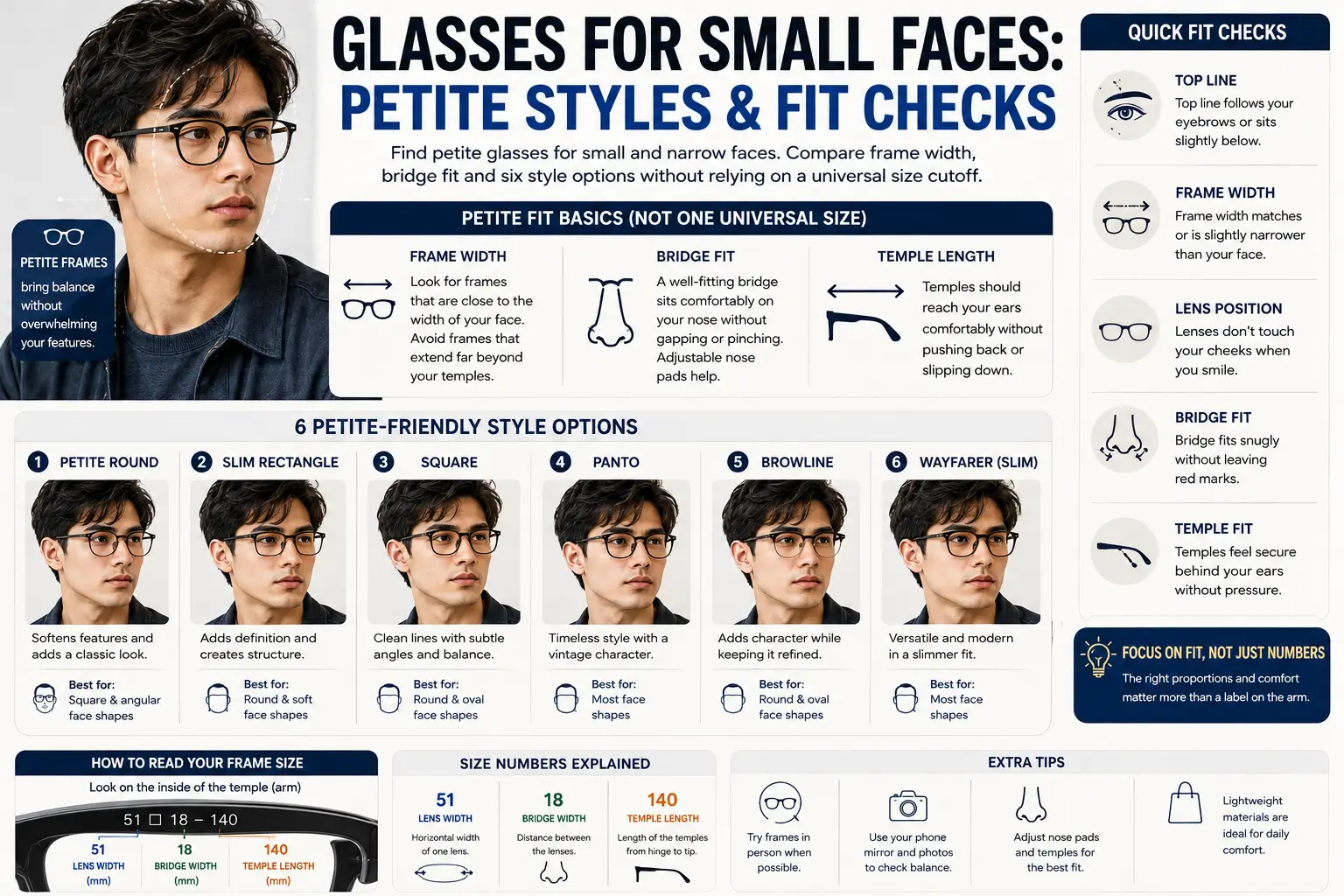
Start with frames sold as petite, narrow or extra narrow, then compare actual measurements and fit. Compact rectangles, panto shapes, small ovals, modest cat-eyes, slim rounds and fine-rim squares are options. You do not have to settle for a style you dislike just to find a smaller size.
Small describes overall scale; narrow describes width. A narrow face can still be long. Neither word tells you the exact bridge design or temple length you need. There is no single lens-width number that identifies the right frame for every small face.
Six styles worth trying in a smaller fit
| Style | Why you might like it | Keep an eye on |
|---|---|---|
| Compact rectangle | Straight lines without a large lens opening. | A very shallow frame may not suit every lens design; check with your dispenser. |
| Panto | A curved lower edge with a slightly flatter upper line. | Compare lens depth if the bottom rim touches your cheeks. |
| Small oval | A quieter outline with gentle curves. | Choose enough lens area for the lenses you need, rather than the smallest pair available. |
| Modest cat-eye | An expressive corner in a compact design. | Decorative corners can project beyond the actual hinge position. Check the real fit. |
| Slim round | A softer look with a light visual outline. | The bridge can fit differently from a similar-sized rectangle. |
| Fine-rim square | Defined corners without a heavy-looking border. | Fine rims are not automatically lighter or more comfortable in every prescription. |
How to compare sizes without guessing
Start with a pair that already fits, if available. Record the model and the three printed size numbers. They normally describe lens width, bridge width and temple length in millimeters. Those numbers are useful references, but they do not describe every part of the frame.
Ask for the overall frame width as well. Two frames with the same lens width can have different rims, hinges and bridges. Avoid selecting a pair just because an online guide gives a supposedly perfect lens width for petite faces.
Compare the exact product’s measurements across retailers. “Small,” “narrow” and “petite” are shopping categories, not interchangeable international sizes. In India, Lenskart India: narrow frame category provides a narrow category; elsewhere you may see petite or extra-narrow collections. The label is a starting filter, not confirmation of fit.
Try these checks before ordering
Look straight ahead and check how far the frame extends beyond the sides of your head. Notice whether the arms feel loose or press outward. Then smile and look down. Frames should remain comfortably supported instead of dropping onto your cheeks or needing constant repositioning.
Bring any persistent slipping or pressure to an optician. A different bridge design or adjustment may be needed even when overall width seems right. Do not assume a narrower bridge number is always the solution.
For bridge support and cheek-contact issues, see low bridge fit glasses. For a longer outline with limited width, see long-face glasses. You can use advice from both guides without needing a perfect face-shape label.
Can a small face wear bold glasses?
Yes. Bold color and a thicker rim are style choices. You can choose a strong-looking frame in a physically smaller size. “Oversized” as a fashion effect does not require arms that are loose or a bridge that slides.
Try a compact black frame next to a translucent frame of similar dimensions. Decide how visible you want your glasses to be. Then compare a curve with a straight edge. Changing one feature at a time makes the choice easier.
Retail petite ranges are sometimes shown mainly on women, but fit is not determined by a men’s or women’s category. Use measurements, bridge construction and your own preference to search across suitable collections.
Should adults with small faces buy children’s glasses?
A children’s frame might fit some adults, but do not assume it is the automatic solution. Temple length, bridge design and available lens options still need checking. Begin with adult petite collections if you want adult styling, then ask a dispenser to compare other options if necessary.
Likewise, children should have eyewear fitted for their own needs rather than following an adult style guide. This article is for adults choosing a smaller frame. A child’s growth and daily use need an appropriate fitting discussion.
A short shopping note to take with you
Use this example: “Adult frames often feel too wide. I want to compare a narrow rounded square and a small oval. Please check the bridge, arm length and compatibility with my prescription.” Add what happens with your current pair rather than a guessed ideal size.
Ask about returns and adjustment support before buying online. A photograph can help with appearance but cannot tell you exactly how a bridge feels. For a structured comparison, use the five-step glasses try-on guide. The face-shape chart offers optional style ideas after you have a comfortable size shortlist.
Questions people ask
What size glasses should a small face wear?
There is no universal size. Compare a well-fitting existing pair, overall frame width and bridge construction, then try petite or narrow options.
Are narrow faces and small faces the same?
No. Narrow refers mainly to width. A face can be narrow and long, or small overall. That distinction helps when choosing lens depth and temple length.
Can men wear petite glasses?
Yes. Petite describes a fit category. Adults of any gender can need a smaller frame; compare the actual dimensions and style.
Will a narrower frame stop my glasses slipping?
It may help if width is the problem, but bridge shape and adjustment also matter. Have the specific fit checked rather than treating every slip as a size issue.
Sources and editorial approach
This guide combines referenced eyewear information with practical comparison examples written for GoldenRatioFace. Style suggestions are subjective. We have not tested or ranked the products sold by these sources. Specsavers: petite frame styles · Warby Parker: petite fit guide · Specsavers: frame sizes
2 thoughts on “Glasses for Small Faces”