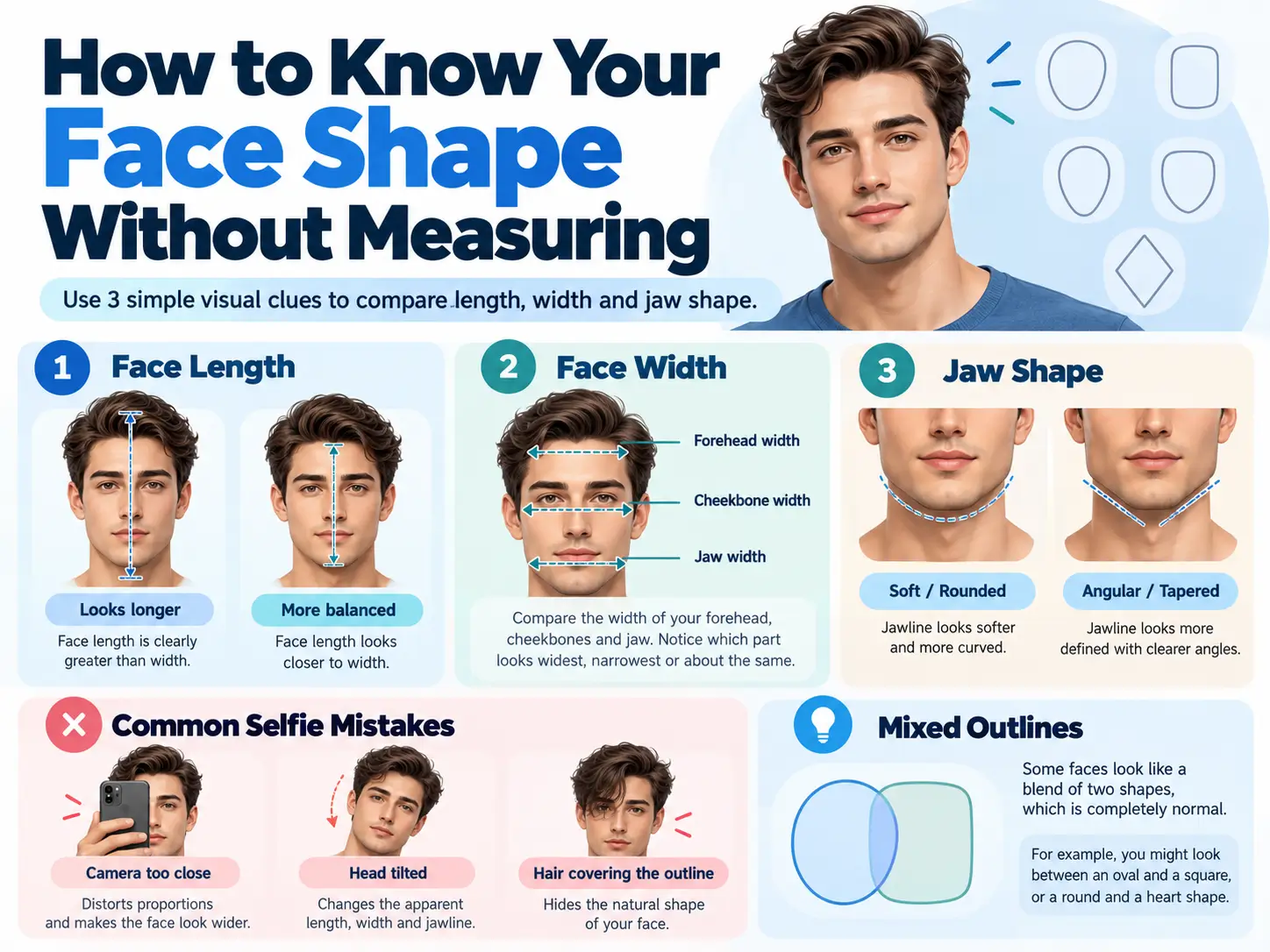
How to Know Your Face Shape Without Measuring
Start with three visible clues: how long your face looks, where it is widest, and whether your jaw curves or has clear corners. A mirror is enough for a first comparison.
The quick answer
To estimate your face shape without a measuring tape, look straight ahead, move hair away from your face and compare its overall outline. Check length versus width, the widest area, and the shape of the jaw. Use those clues together; one feature cannot settle the label.
If two shapes fit, keep both for now. These are styling descriptions, not exact categories.
Original simplified drawings. The lines show what to compare, not universal measurement boundaries.
First, get a clear view
Stand in front of a mirror in even light, with your head level. Relax your mouth and avoid pushing your chin forward. Move fringe and side hair away from your face. You are checking the face outline, not the hairstyle around it.
If using a photo, choose a straight-on view rather than a profile or a tilted selfie. Keep the camera around eye level and avoid holding it very close. Use a timer or ask someone to help if that gives you a clearer, less angled view. Do not apply a beauty filter.
A beard can hide the jaw, and a fringe can hide the forehead. You do not need to shave or change your hair to do this. Simply mark hidden features as uncertain. If you have an appropriate photo with a clearer outline, compare it too.
Check these three things
1. Does your face look compact or long?
Compare the distance from the middle of your visible hairline to the bottom of your chin with the widest part across your cheeks. Ignore the height of your hair. Is the outline roughly as long as it is wide, a little longer, or noticeably long?
Do not turn a small difference into a firm answer. A compact outline suggests starting with round or square; a clearly long one suggests comparing oval, oblong and rectangle. The next clues matter too.
2. Where is it widest?
Look at three areas: the forehead, the cheekbones and the corners of your jaw. Is one clearly wider, or do the widths look similar? Forehead width is the visible face area, not the outside edge of your hair. Jaw width is corner to corner, not the length of a beard.
3. Does the jaw curve or turn a corner?
Follow the side of your face down toward the chin. A rounded turn looks different from a distinct jaw corner. Also notice whether the lower face narrows strongly. A pointed chin alone does not automatically mean heart or diamond; first check the widest area.
Match the clues, not a single feature
| What you notice together | Shapes to compare |
|---|---|
| Compact outline with a curved jaw | Round |
| Compact outline, similar widths and jaw corners | Square |
| A little longer than wide, with a gentle lower-face taper | Oval |
| Clearly long, with relatively steady side widths | Oblong with a softer jaw; rectangle with clearer corners |
| Forehead wider than the lower face, narrowing toward the chin | Heart |
| Cheekbones widest, with a narrower forehead and chin | Diamond |
| Jaw corners widest, with a narrower upper face | Triangle |
This site separates oblong and rectangle to describe jaw outline. Other guides may combine them. We use triangle for a jaw-wider face; some sources use the word for a forehead-wider outline. Always compare the description, not just the label.
Three examples of how to think it through
Round or square?
Both can look compact. If the widths are similar, the jaw turn is a useful next clue. Soft curves lean round; clearer corners lean square. Cheek fullness alone does not decide it.
Oval or oblong?
Both may have a curved jaw. Compare how long the whole outline looks and whether the sides taper. If it is only a subtle difference, keep both descriptions rather than inventing a precise cutoff.
Heart or diamond?
Both can narrow toward the chin. Look higher up: does the forehead look widest, or do the cheekbones stand out beyond it? A fringe can hide this difference, and a widow’s peak does not settle it.
If your mirror and selfie seem different
Start by checking the image, not by assuming one shape label must be wrong. A high camera angle, head turn, close camera distance or different expression changes the view. Hair and beard styling also change the outline you can see.
Short-distance photographs can alter apparent facial proportions. A published perspective model examined this effect for nasal dimensions; it did not validate face-shape labels. For this visual check, our practical advice is to use a consistent, level view and avoid very close selfies.
Do not spend time tracing a moving reflection or comparing ten differently angled pictures. One clear view plus a second similar view is more useful. If an area remains hidden, leave it uncertain.
Choose your next step
- Want guided questions? Use the five-question face shape quiz. It works without a photo and explains tied profiles.
- Want an automatic photo estimate? Try the Face Shape Detector. Review its limitations; landmarks are estimates, not a diagnosis.
- Want to compare dimensions? Follow how to figure out your face shape with consistent measurements.
- Want all outlines in one place? Open the face shape chart.
Once you have a useful description, move on to your actual goal. A haircut, glasses fit or beard decision also depends on your preferences and practical needs. You do not need a perfectly certain shape label to make a good choice.
Common questions
Can I know my face shape without a tape measure?
Yes, you can make a visual estimate by comparing the outline. It may be enough for browsing styling ideas. Use measurements if widths are hard to compare, but do not expect a universal exact label.
Does a round face mean the cheeks are full?
Not necessarily. Round describes the overall proportion and curved outline. Cheek fullness by itself does not identify the shape.
Can I have a mix of two face shapes?
You may share visible features with two descriptions. Keeping both is often more honest and useful than forcing a single answer.
Is a face shape filter always right?
No. A filter or detector depends on the picture, its estimated points and its own rules. Treat the result as a comparison, especially if the visible outline does not match.
Source and editorial method
The three-clue workflow and illustrations are GoldenRatioFace’s practical comparison guide, not a clinically validated test. For the specific claim about short-distance perspective, see Ward and colleagues, Nasal Distortion in Short-Distance Photographs: The Selfie Effect (2018). No universal shape cutoff or accuracy percentage is inferred from that study.
2 thoughts on “How to Know Your Face Shape Without Measuring”