Men’s haircut guide · Triangle
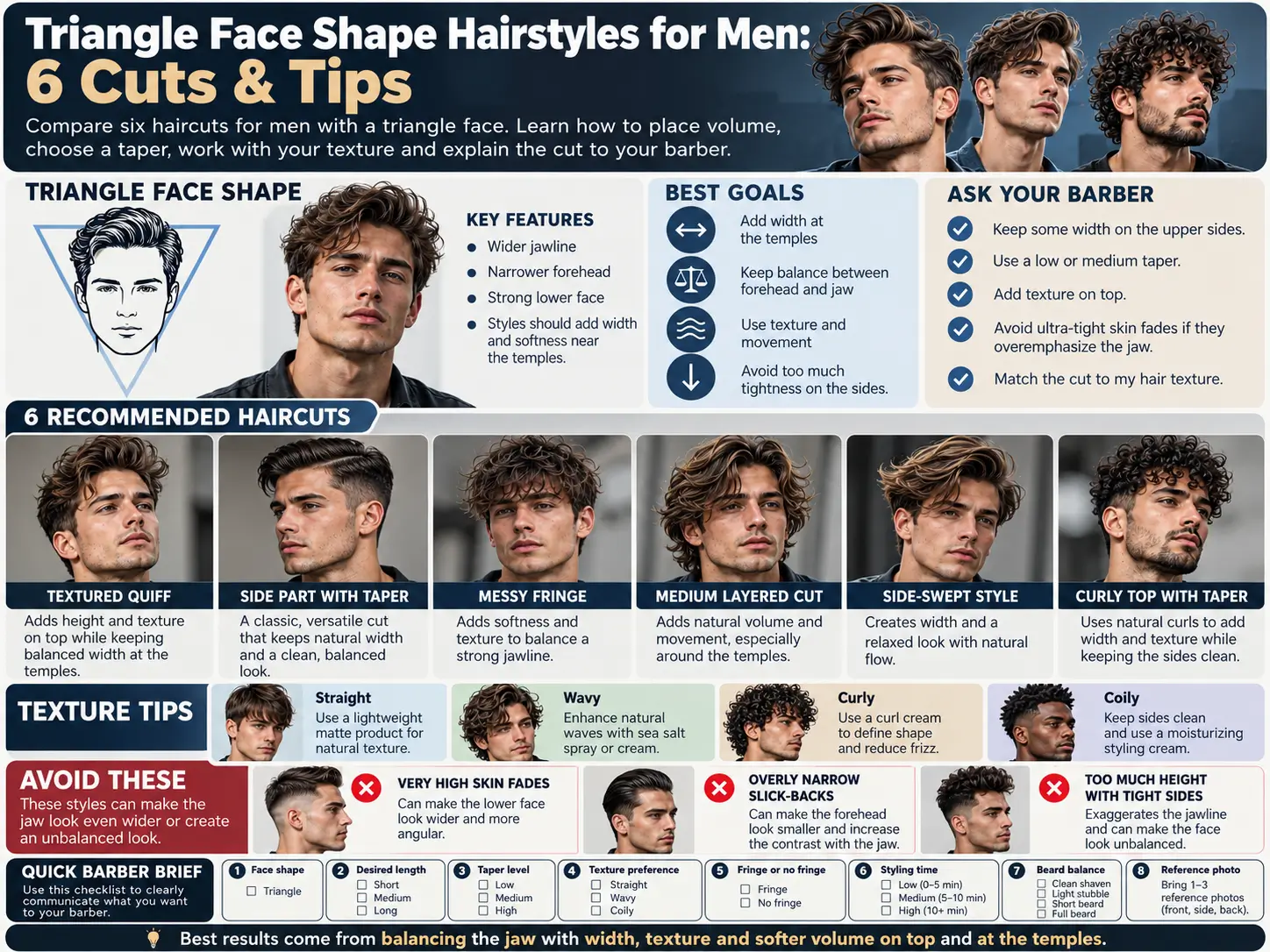
Triangle Face Shape Hairstyles for Men
A broader jaw and narrower forehead? Compare six cuts, see why width and height are different, and choose a clear request for your barber.
What haircut suits a triangle face shape?
A textured side part, relaxed quiff, side-swept crop or rounded curly top can be useful options for a triangle face. If you want more fullness above a broad jaw, discuss hair near the temples and upper sides—not only height at the crown. A low taper can tidy the edges while leaving that coverage.
There is no haircut you must wear. A buzz cut can show your natural outline, while longer layers change it differently. Your texture, preferred look and willingness to style your hair matter as much as the shape label.
Triangle means a wider jaw in this guide
Here, triangle describes an outline that is narrower at the forehead and broader at the jaw. It is sometimes called a pear-shaped face. You do not need an exact ratio or a particular chin tip to explore these haircuts.
Use a front-facing view with your hair pulled away and the camera at eye level. Compare forehead, cheekbones and jaw in the same view. Beard volume and a close, tilted selfie can change the apparent outline. The face shape chart helps compare categories; a photo detector result is an estimate, not proof of an exact shape.
Six haircuts to discuss with your barber
The options below offer different amounts of upper fullness, forehead coverage and daily work. Start with two you like rather than trying to find one perfect match. Illustrations show simplified outlines, not exact haircut instructions or photo predictions.
Temple width and crown height are different
The crown is toward the top/back of your head. The temples sit beside the forehead. Lifting the crown does not automatically make the forehead appear wider. If your goal is more upper width, show your barber which side areas you want to keep full.
A low taper usually concentrates the short transition around the sideburns and neckline. A fade can remove more side hair as it travels around the head. Naming varies, so use a side-view reference and agree on the short area’s height. A high fade or undercut is not forbidden; it simply produces a different contrast.
Adapt the cut to your hair and routine
Work with texture and density
With straight hair, ask whether the front naturally lies forward or springs up. Wavy hair may support a loose sweep; curls and coils need a shape that considers how they sit dry. Fine strands can still be dense, while thicker strands may be sparse. Discuss both strand texture and how much scalp shows.
Do not choose a product or heavy thinning solely from your face shape. Ask the barber to demonstrate a small amount of styling product and explain whether the finish needs a dryer. If you have a receding hairline, choose coverage or exposure according to your preference and what your hair can support.
Beard and grow-out
A beard changes the outline you see at the jaw. If you want less lower-face fullness, discuss keeping its sides closer; a longer chin section also adds visible length. A pointed beard is not a universal solution. A clean shave, stubble, moustache or fuller beard can all be deliberate choices.
There is no fixed week when every haircut loses its shape. Book a trim when the fringe, sides or neckline stop behaving how you want. Keep a phone photo of the fresh cut so you can explain what changed. Our beard and face shape guide explores the separate beard decision.
Your barber brief
“I like this textured side part. I want a little more fullness near the temples, without a very tall top. Keep the taper low and show me what side coverage remains. I want a routine I can manage at home; please adapt the cut to my density and growth pattern.”
Bring front and side reference photos with a texture similar to yours. Before cutting, agree on the fringe’s dry length, top shape, side coverage and neckline. Ask what styling is needed at home and what will change as the cut grows out.
For a reusable request based on your preferences, use the men’s haircut brief builder. It creates a conversation starter, not an AI prediction.
Common questions
Can a triangle face have a buzz cut?
Yes. A buzz cut exposes more of your outline instead of adding upper fullness. You do not need a jaw judged “strong enough” to wear it. Start with a length you are comfortable with; you can shorten it further after checking the result.
Is a low taper better than a high fade?
It depends on the effect you want. A low taper can preserve more upper-side coverage. A high fade creates a closer outline and more contrast. Choose the amount and location of hair to keep, rather than treating one label as automatically correct.
Should I avoid a fringe or middle part?
No. A soft fringe or relaxed part may work well with your growth pattern. Heavy, rigid or very flat styling gives a different silhouette. Try the direction before cutting and decide whether you like the coverage.
Does this advice work for Indian men?
Yes, when adapted to the individual. Indian men have many hair textures and densities. The useful information is how your own hair behaves, the style you prefer and how much upkeep you want—not nationality alone.
What if I have wide cheekbones rather than a wide jaw?
Compare the diamond outline. The diamond face hairstyle guide discusses a cheekbone-led shape. If several categories seem plausible, choose by the visual effect you want instead of forcing a label.
Sources and editorial approach
This guide uses triangle for a jaw-wide outline and keeps styling effects separate from fixed rules. CADMEN explains face shape as one part of a consultation; GQ’s barber discussion also shows why descriptions matter when labels differ. Our haircut examples are editorial suggestions, not validated predictions or a barber consultation. Compare other options in the men’s hairstyle hub.
2 thoughts on “Triangle Face Shape Hairstyles for Men: 6 Cuts & Tips”