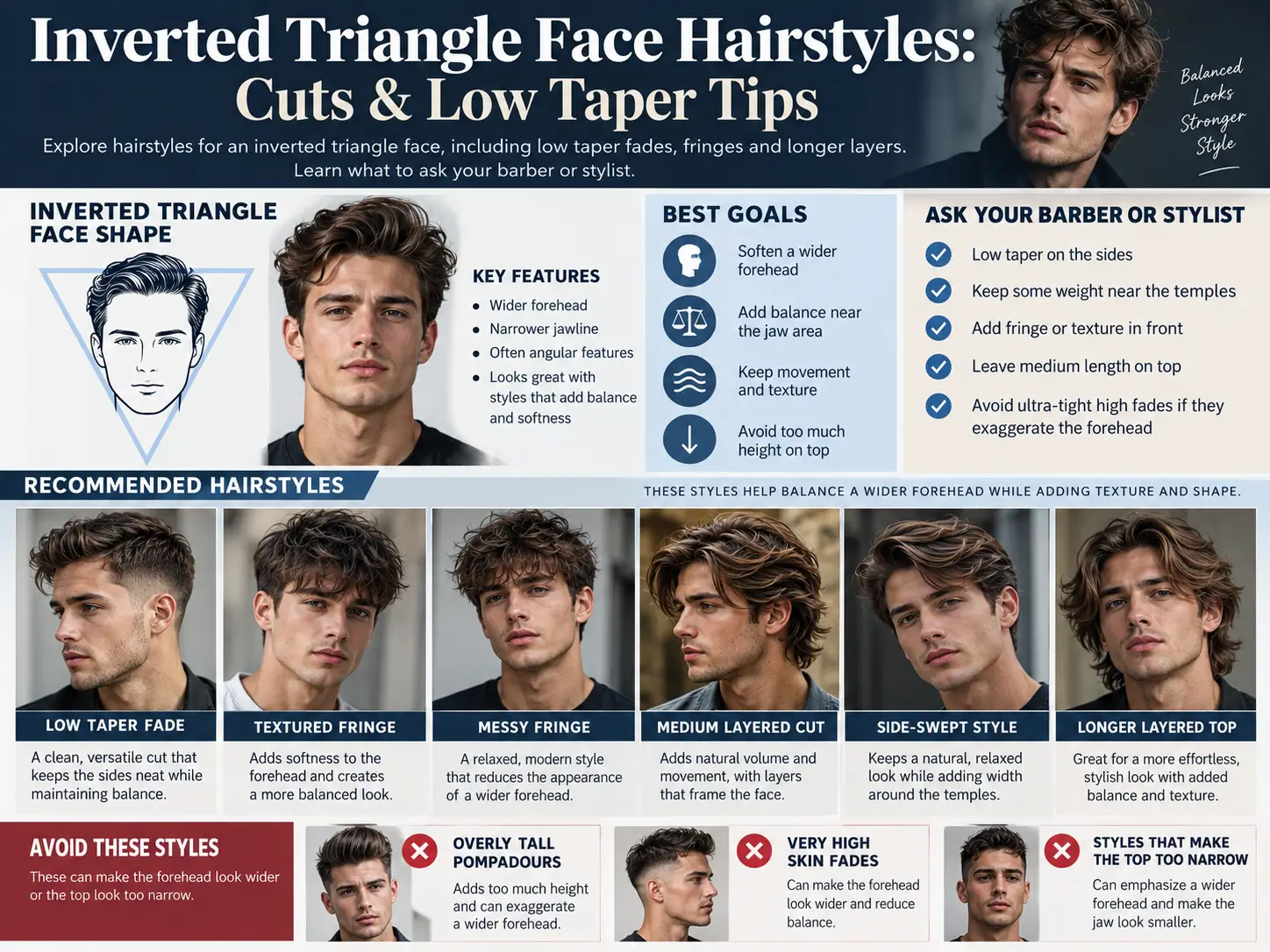
Shape explained. Haircut made simpler.
Inverted Triangle Face Shape Hairstyles
A wider forehead and a narrower jaw? Compare six haircut ideas, understand the low taper option, and choose a look that works with your hair.
What hairstyles suit an inverted triangle face?
A side-swept fringe, textured crop, relaxed side part, curtains or longer face-framing layers are useful starting points. If you want less emphasis on a broad forehead, discuss some front coverage and avoid adding more upper volume than you want. Longer styles can place fullness near the jaw.
These are styling choices, not rules. An inverted triangle face does not need fixing. Choose the outline you enjoy, then adapt the cut to your hair texture, density and routine.
Inverted triangle, triangle or heart?
On this site, inverted triangle means the upper face is wider and the jaw narrows toward the chin. Triangle means the reverse: a narrower forehead and broader jaw. Using the same advice for both can lead to a haircut that creates a different effect from the one you wanted.
Wider above, narrower below
Narrower above, wider below
Heart and inverted triangle are often grouped together for styling. Some guides distinguish them by hairline or contour; there is no universal styling classification. A widow’s peak alone is not enough to choose a haircut. Look at the whole outline and how your hair sits.
A simple visual check
Use a mirror or a front-facing photo at eye level, with hair away from the face. Compare forehead, cheekbone and jaw width using the same view. Avoid judging from a close, tilted selfie or measuring along the curved jaw and comparing that with a straight forehead width. A photo-based face shape estimate can help you explore, but lighting, angle and hair coverage can affect it.
Does a low taper fade suit an inverted triangle face?
It can. A low taper is an option if you like a tidy hairline while keeping more of the side hair above it. Pair it with a top and fringe you actually want: a relaxed side part, textured crop or side-swept front. The taper alone does not decide whether the haircut suits you.
For a less top-heavy appearance, discuss a moderate top height and how much hair to retain near the temples. A very high, close fade with a tall top gives stronger contrast; choose that deliberately if you like it, rather than assuming every fade produces the same result.
| Option | What to clarify | Why it matters |
|---|---|---|
| Low taper | How small the short areas around the sideburns and neckline should be | Lets you discuss edge cleanup separately from the fuller sides |
| Low fade | Where the blend begins and how far it wraps around the head | Can remove more side coverage than you meant by a taper |
| Scissor taper | A softer outline with your preferred ear coverage | An alternative when you do not want a close or skin finish |
Names vary between barbers. Show a side-view photo and point to the height you want. Skin exposure and fade height are separate choices.
Six hairstyles to discuss with your stylist
Choose two possibilities, then compare them against your own texture and styling routine. The examples below are editorial suggestions, not guaranteed matches or a ranked list.
1. Side-swept fringe
A flexible option if you want some forehead coverage without a straight line across it. Try the direction your hair already falls before committing to a deep part.
Ask for: “Leave enough front length to sweep across naturally; show me where it will sit when dry.”
Check first: A strong cowlick may change the direction or length needed.
2. Textured crop
A compact choice for someone who wants a shorter top. A soft or broken fringe can give coverage; the fade is optional.
Ask for: “Keep the fringe soft and the top at a height I can manage without daily blow-drying.”
Check first: Too much thinning or texturizing may remove fullness you want to keep.
3. Side part with a low taper
A useful starting point for a neat outline with an adjustable top. Discuss both the parting and side coverage, not just the fade name.
Ask for: “Keep the taper low around the edges and blend it into a moderate-height top.”
Check first: A sharply exposed part and a very tall top create a different look from a relaxed side part.
4. Relaxed curtains
A middle or slightly off-center part leaves hair framing the forehead. Try both placements; the result depends on how the front sections fall.
Ask for: “Keep the front pieces long enough to fall naturally, with a part I can change.”
Check first: Short curtains that flare outward may add width near the temples.
5. Chin-length bob or rounded layers
For anyone who prefers more length, the ends can create fullness near the lower face. The position of that fullness matters more than the label.
Ask for: “Show me where the ends will land when dry and where the layers will create width.”
Check first: Curls may sit shorter after drying; agree on the dry length first.
6. Medium waves or curls
A rounded or gently layered outline lets you choose where the hair feels fullest. Bring a reference with a similar curl pattern.
Ask for: “Keep a shape that works with my natural texture and explain how to style it at home.”
Check first: Longer hair is not automatically low maintenance; allow time for drying and detangling.
Adapt the cut to your hair and routine
Texture, density and growth
For straight hair, check whether the front lies flat or pushes upward. For waves, see where the natural bend forms. With curls or coils, discuss the shape and length when dry. Fine strands and low density are different; do not ask for heavy thinning just because a reference says “textured.”
Point out a strong cowlick or any hairline area you prefer to show or cover. Ask whether the desired fringe is realistic without a styling routine you will not use. Hair type varies within every country and background, including India; choose from your actual hair rather than a nationality label.
Beard and maintenance
If you wear a beard, discuss its outline together with the haircut. Keeping some fullness toward the jaw corners can change the lower-face silhouette; a long pointed chin section creates a different effect. Neither is compulsory. Clean-shaven faces can wear these cuts too.
A taper may be quick to style but require regular visits to stay crisp. Longer layers can grow out softly while needing more daily care. Ask what the cut will look like between appointments. Explore the beard guide for separate beard considerations.
Make your haircut request clear
A style name is useful; a photo and a few clear preferences make it more useful. Start with the wording under your chosen haircut above. Then add:
- Coverage: say whether you want the forehead partly covered or exposed.
- Sides: point to the fade height and the side hair you want to keep.
- Daily effort: explain whether you air-dry or normally style with a dryer.
- Grow-out: agree how the fringe and sides should look before your next visit.
Bring a photo with similar hair texture and a side view if possible. Ask the barber or stylist to explain any change needed for your hair before cutting. For a reusable preference-based request, use the barber brief builder in our men’s hairstyle guide.
Common questions
Is an inverted triangle face the same as a heart face?
They describe overlapping outlines: a wider upper face and a narrower jaw or chin. Some styling systems separate them, while others group them. This page uses inverted triangle for the wide-top, narrow-bottom outline; use that description rather than the label alone.
What is the best men’s haircut for this shape?
There is no single best cut. A side-swept crop, relaxed side part or curtains can be starting points. Choose the version that fits your texture, preferred coverage and styling effort. See the heart face hairstyles for men guide for related options.
Can I have a buzz cut or a high fade?
Yes. Short or exposed styles show more of your natural outline, which you may prefer. They are not forbidden by your face shape. Compare reference photos and agree on the level of contrast before cutting.
Will a fringe make my forehead look smaller?
A fringe can cover part of the forehead, changing the visible outline; it does not change your forehead itself. Its length, density and direction affect the appearance. Try a temporary sweep before deciding how much coverage you want.
What if my jaw is wider than my forehead?
That is the opposite direction from the shape described here. Our triangle face hairstyle guide is the more relevant starting point. If cheekbones are widest, compare the diamond outline in the chart.
Do I need a beard to balance my face?
No. A beard is optional. It can change the visible jaw outline if you want that effect, but it is not a requirement for looking good or wearing any haircut.
Sources and editorial approach
This guide separates a commonly confused shape label from practical haircut decisions. The examples are editorial options to discuss with a professional; they are not scientifically validated predictions of attractiveness.
- CADMEN Academy: hairstyle consultation and face shape — background on proportions as one input alongside hair and preferences.
- GQ’s fade guide with barber Herson Rodriguez — terminology and the importance of discussing the fade with your barber.
For broader comparisons, visit men’s hairstyles by face shape. For longer styles on the related outline, see heart face shape hairstyles.