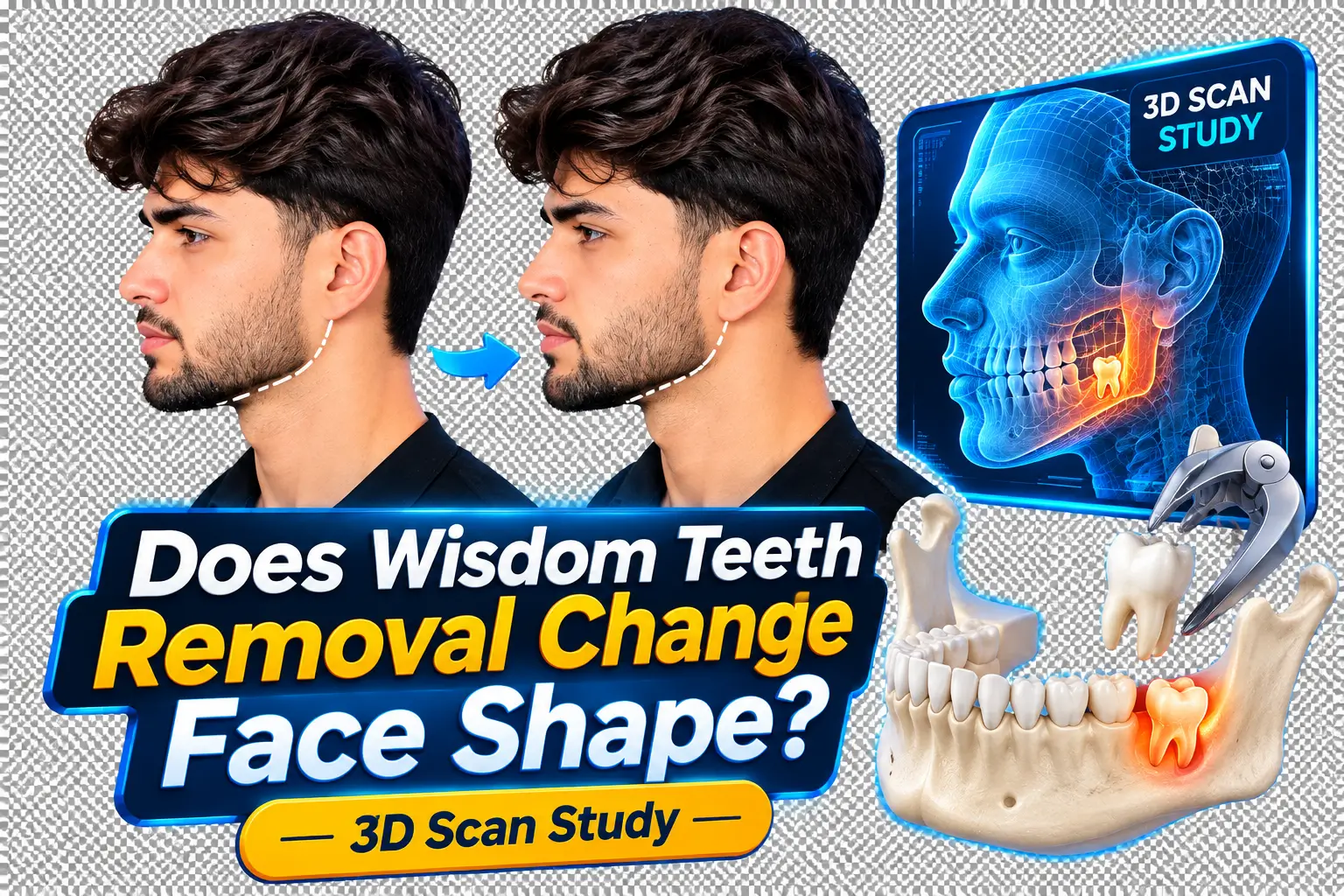
No, removing wisdom teeth does not change your face shape in a lasting way for most people. Your face looks different for a week or two because of swelling. A 2023 study that 3D-scanned faces found the cheeks were slightly slimmer at three months but back to normal by six months. Here is what changes, what does not, and why some people still feel their face looks different.
What happens to your face after wisdom tooth removal
| When | What you see | Why |
|---|---|---|
| Days 1 to 3 | Puffy cheeks, sometimes bruising | Normal swelling after surgery |
| Up to 2 weeks | Swelling and soreness fade | Healing |
| Around 3 months | Face can look slightly slimmer on that side | Small, temporary drop in soft tissue volume |
| 6 months | Back to how it was | Soft tissue returns to its starting volume |
The NHS says pain and swelling should start to improve after one or two days, and symptoms can last up to two weeks. Some people also lose a little weight while they eat soft food, which can make the face look thinner for a while.
What the 3D scan study found
The clearest study comes from Peking University, published in BMC Oral Health in 2023. Researchers scanned the faces of 23 adults aged 18 to 30 before, three months after and six months after removing the wisdom teeth on one side. They also kept each person’s weight within 2 kg, so weight change could not explain the result.
- Jaw bone: the bone volume on the extraction side shrank by about 2.3 ml.
- Face at 3 months: soft tissue on that side was about 1.4 ml lower.
- Face at 6 months: no difference from before surgery.
- Link between the two: the bone change did not predict the face change.
The authors concluded that facial soft tissue volume “does not change evidently.” The study was small, mostly women, and covered only one side of the mouth. Still, it is better evidence than the clinic blogs that most search results rely on.
Does wisdom tooth removal change your jawline or jaw shape?
Not in a way you can see. The jawline you see in the mirror comes from the outer edge of the jaw bone and the chewing muscle on top of it.
Wisdom teeth sit inside the jaw, behind your other molars. The bone that fills the socket can shrink a little as it heals. That change is inside the jaw, not along its outer edge, and in the 3D study it did not show on the face.
If your jaw looks different months later, the usual reasons are weight change, normal ageing, or simply looking much more closely at your face. Faces also keep changing slowly into your twenties and beyond, as covered in does your face shape change.
Does it change your teeth alignment?
Removing wisdom teeth is not known to straighten or shift your other teeth. A systematic review of 12 studies found most did not link wisdom teeth with more crowding of the front teeth. The authors concluded that removing them only to prevent crowding is not justified. Your dentist may still advise removal for other reasons, such as infection or damage to the next tooth.
Why some people say their face changed
- Swelling memory. After two weeks of puffy cheeks, your normal face can look slim by comparison.
- Weight change. A soft-food diet can mean a small, short-term weight loss.
- Before and after photos. Different light, angle or distance can change how wide a face looks.
- Age. Wisdom teeth are usually removed in early adulthood, when faces are still changing slightly anyway.
To check for yourself, take a front photo before surgery and again at six months, with the same camera, distance and light. Then compare both in the face shape detector, which measures the same widths each time.
When to call your dentist
Swelling that slowly improves is normal. The NHS advises getting urgent help if bleeding does not stop, if pain and swelling are severe or getting worse despite painkillers, or if you have pain with a bad taste, a high temperature or feel unwell.
What the evidence cannot tell you yet
The main study had 23 adults and followed them for six months. It did not look at teenagers, people with many teeth removed at once, or long-term changes over years. So “no lasting change” is the best answer we have, not a final one. If you have a specific worry, such as surgery on a deeply impacted tooth, ask your oral surgeon.
FAQs
Does removing wisdom teeth change your face shape?
Not in a lasting way for most people. Swelling changes how your face looks for up to two weeks. In a 2023 3D scan study, the face was slightly slimmer at three months but back to its starting volume at six months.
Will my face look slimmer after wisdom teeth removal?
Only for a short time, if at all. The 3D study found a small drop in soft tissue at three months that was gone by six months. Wisdom tooth removal is not a way to slim the face.
Does wisdom teeth removal change your jawline?
No visible change is expected. The bone around the socket shrinks a little as it heals, but that is inside the jaw. The outer jawline comes from the jaw edge and the chewing muscle, which surgery does not reshape.
How long does face swelling last after wisdom teeth removal?
Swelling usually starts to improve after one or two days, and symptoms can last up to two weeks, according to the NHS. Get help if swelling gets worse or comes with fever, a bad taste or severe pain.
Can wisdom teeth removal cause sunken cheeks?
The best evidence says no lasting hollowing. In the 3D scan study, cheek-side soft tissue was back to normal by six months. Weight loss or ageing are more likely causes of hollow-looking cheeks.
Does removing wisdom teeth change teeth alignment?
It is not known to move your other teeth. A review of 12 studies found most did not link wisdom teeth with crowding of the front teeth, and said removing them only to prevent crowding is not justified.
Why does my face look different after wisdom teeth removal?
Usually because of swelling, a short-term weight change, or photos taken in different light and angles. Faces also change slowly with age. Compare photos taken the same way, six months apart.
Sources
- Wang XW, Yang HF, Wang EB, Cui XY, Zhao YJ, Jiang JH. Slim the face or not: 3D change of facial soft and hard tissues after third molars extraction: a pilot study. BMC Oral Health, 2023.
- NHS. Wisdom tooth removal. Reviewed 12 June 2024.
- Zawawi KH, Melis M. The role of mandibular third molars on lower anterior teeth crowding and relapse after orthodontic treatment: a systematic review. The Scientific World Journal, 2014.