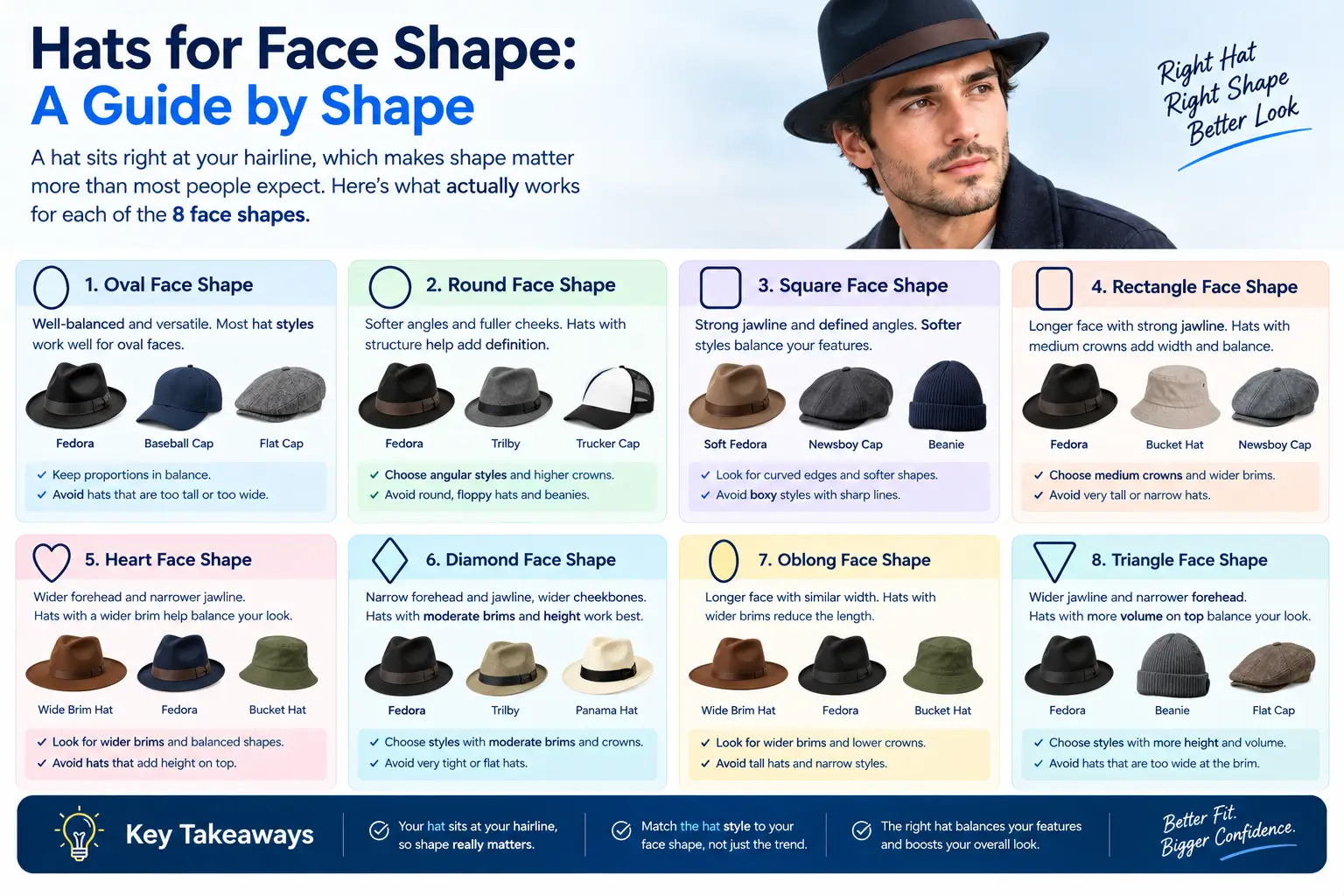
A hat frames your face the same way glasses or bangs do, sitting right at the hairline where width gets judged first. Get the brim and crown wrong for your proportions, and even a well-made hat can look like it’s fighting your face rather than finishing the look.
The general logic mirrors glasses and hairstyles: add what your face doesn’t already have. A compact, round face benefits from height and structure. A long, narrow face benefits from width at the brim rather than more height on top.
Round Faces: Add Height, Skip Wide Brims
A tall crown adds the vertical length a round face doesn’t have on its own. Fedoras and structured caps with height work well here.
Wide, flat brims add width exactly where a round face already has enough, which tends to emphasize roundness rather than balancing it. A narrower brim paired with more crown height is the more flattering direction.
Square Faces: Soften With Curves
A square jaw has strong, defined angles already, so a rounded crown softens rather than competes with them. Bucket hats and soft-brimmed styles work in this direction.
Sharp, angular hat shapes tend to repeat the jaw’s own lines rather than balancing them, which is the opposite of what generally works for this shape.
Oblong and Rectangle Faces: Add Width, Avoid Height
Both shapes are already long, so a hat that adds more vertical height, a tall crown, exaggerates that length further. Wider brims and shorter crowns add width instead, which is the direction this shape generally needs.
Flat caps and wide-brimmed sun hats tend to work well here, since they add horizontal presence without stacking more height on top of an already long face.
Heart and Diamond Faces: Balance the Cheekbones and Forehead
Heart faces carry width at the forehead, so a hat that doesn’t add further width up top, like a soft, slightly asymmetric brim, avoids exaggerating that. Diamond faces are widest at the cheekbones, so hats that add a touch of width near the jaw and forehead, like a structured cap, help balance the narrower points above and below.
Oval and Triangle Faces
Oval faces have the most balanced proportions of any shape, so most hat styles work reasonably well without a specific correction needed. Triangle faces are widest at the jaw, so hats that add height and visual interest up top, similar to the round-face logic, help balance a heavier lower face.
Finding Your Actual Shape First
Guessing your face shape from a mirror is the most common reason a “flattering” hat style doesn’t actually look right in practice. The face shape detector measures your real proportions from a photo, giving you a reliable starting point before you commit to a brim style.
FAQs
What hat shape suits a round face?
Taller crowns with narrower brims, since they add the height a round face doesn’t have naturally. Wide, flat brims tend to emphasize roundness rather than balance it.
What hat works best for a square jaw?
Softer, rounder crown shapes tend to ease a strong jawline, since angular hat shapes can repeat the jaw’s own lines instead of balancing them.
Do long or oblong faces need a specific hat style?
Wider brims and shorter crowns generally work better than tall crowns, since added height exaggerates a face that’s already long.
Does face shape matter as much for hats as it does for glasses?
Yes, for a similar reason. Both sit right at or near the hairline, which is exactly where width and proportion get judged first.