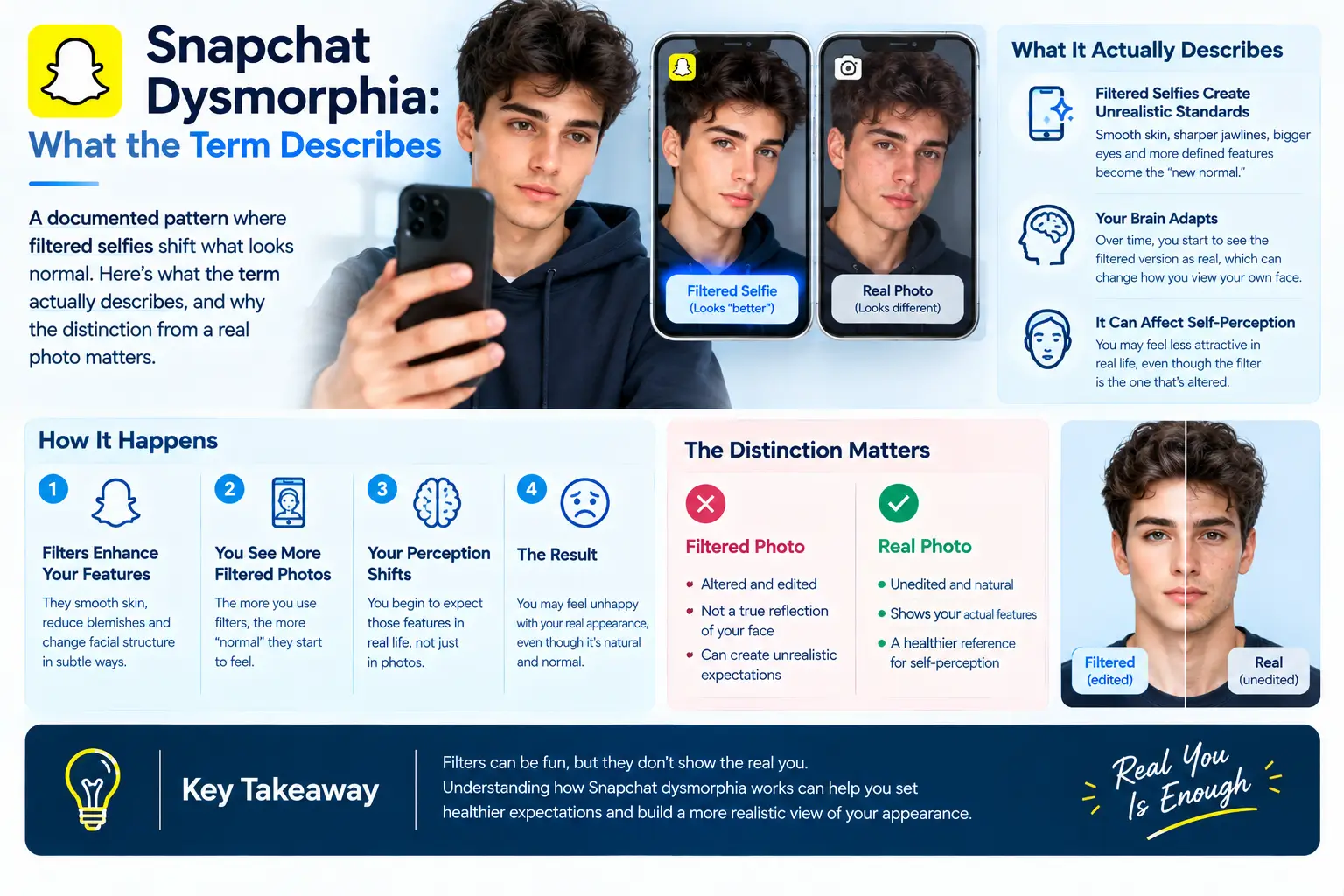
Cosmetic surgeons began noticing something specific around 2018: Patients bringing in filtered selfies instead of celebrity photos, asking to look like the edited version of their own face. The term coined for this, Snapchat dysmorphia, describes wanting cosmetic changes to match a filtered self-image rather than a natural one.
Accounts differ on exactly who first used the term; some credit a commentary from Boston University Medical Center researchers published in JAMA Facial Plastic Surgery, others credit a London-based cosmetic doctor working with patients directly. What’s well documented regardless of origin is the pattern itself, and it’s worth taking seriously rather than treating as a punchline.
What the Research Actually Found
The 2018 JAMA Facial Plastic Surgery commentary described patients requesting procedures specifically to resemble filtered versions of their own selfies, fuller lips, a thinner nose, bigger eyes, rather than referencing a celebrity’s features as patients had done in the past. Survey data from facial plastic surgeons has tracked a rising share of patients citing this motivation over the years.
The researchers connected this pattern to a real, established diagnosis: body dysmorphic disorder, a fixation on a perceived flaw in appearance. Repeated exposure to a filtered version of your own face was flagged as a possible trigger, since it normalizes a version of yourself that took targeted editing to produce.
Why This Happens, Mechanically
Filters make specific, consistent changes: nose narrowing, eye enlarging, jawline slimming, skin smoothing. Seeing your own face with these applied, repeatedly and often daily, can shift your internal sense of what your face “normally” looks like.
The unfiltered version doesn’t change. What can change is how normal or acceptable it starts to feel by comparison, since the filtered version becomes the more frequently seen one.
This Isn’t About Judging Filter Use
Using a filter occasionally, for fun or to soften harsh lighting, isn’t what this term describes. It’s specifically about the fixation that can develop when a filtered self-image is treated as the accurate or expected one, to the point of pursuing real, permanent changes to match it.
If you notice yourself preferring your filtered face strongly enough that your natural one feels wrong rather than just less polished, that distinction is worth paying attention to. It’s a reasonable thing to mention to a doctor or therapist if it’s affecting how you feel day to day, not something to self-diagnose from an article.
An Honest Alternative to Comparing Filtered Images
This site’s own tools exist specifically to measure real, unfiltered proportions rather than an edited version of your face. The face shape detector reads your actual measurements from a photo, without changing anything about what it sees.
Knowing your real proportions, rather than comparing yourself to a filtered image, is at least an honest starting point. It won’t address a psychological pattern on its own, but it removes one layer of distortion from the comparison.
FAQs
What is Snapchat dysmorphia?
A term describing patients seeking cosmetic procedures specifically to resemble filtered versions of their own selfies, rather than referencing a celebrity’s features. It was first documented around 2018 and has been linked to body dysmorphic disorder.
Is Snapchat dysmorphia a real medical diagnosis?
The term itself isn’t a formal diagnosis. It describes a pattern that researchers connected to body dysmorphic disorder, which is a recognized condition. The term is descriptive shorthand for the pattern, not itself a diagnostic label.
Does using filters occasionally mean I have this?
No. The concern described in the research is specifically about fixation, feeling that your unfiltered face is wrong or unacceptable, not casual or occasional filter use for photos.
What should I do if this pattern feels familiar?
Speak with a doctor or therapist if a preference for your filtered appearance is affecting how you feel about yourself day to day. This is a genuine conversation for a professional, not something an article can assess for you.
Reference: Snapchat dysmorphia. If body image concerns are affecting your daily life, a doctor or therapist can help; this is a sensitive topic and this article is informational, not a substitute for professional support.