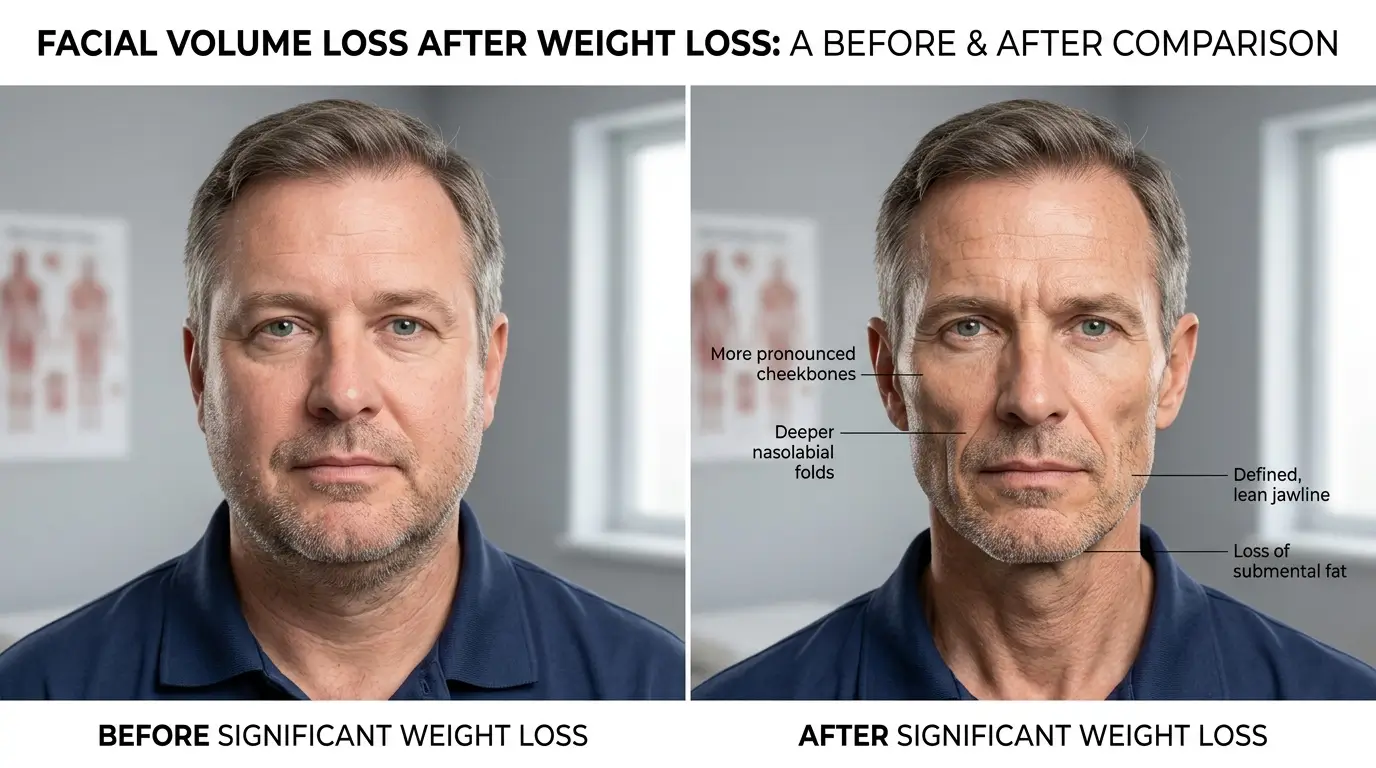
“Ozempic face” is not a diagnosis, and no doctor invented the term. It is a description that caught on because a lot of people noticed the same thing happening to their own faces at roughly the same time, as GLP-1 medications made rapid, significant weight loss common in a way it rarely was before.
Quick answer:
Ozempic face describes the hollowed cheeks, sunken temples, more visible fine lines, and looser skin around the jaw that can follow fast, large weight loss. It happens because facial fat drops quickly, a real share of the weight lost is muscle rather than fat, and skin doesn’t always have time to tighten at the same pace everything underneath it is shrinking.
None of this is unique to Ozempic specifically. The same thing shows up after bariatric surgery or any rapid diet-driven weight loss; the medication just made rapid loss far more common.
What’s actually happening, mechanically
Three separate things are going on at once, and most explanations only mention one of them.
| Factor | What it does |
|---|---|
| Subcutaneous fat loss | The layer of fat just under facial skin thins out. That fat is what gives cheeks their fullness and keeps the face looking supported rather than hollow |
| Muscle loss | Roughly 25 to 40 percent of the weight lost on GLP-1 medications is lean muscle, not fat. The face has around 30 muscles per side, and less muscle means less underlying structure holding everything in place |
| Skin elasticity lag | Collagen and elastin let skin shrink to fit a smaller frame, but that process takes time. When fat and muscle disappear faster than skin can adapt, the result is looseness and sag rather than a smooth, evenly-sized reduction |
Why it reads as aging rather than just weight loss: the same subcutaneous fat loss happens gradually as a normal part of getting older. Rapid weight loss compresses years of that normal process into a few months, which is why the resulting look is so often described as older rather than simply thinner.
The part that connects to face shape specifically
This is the detail most general health coverage of Ozempic face skips, because it isn’t their focus. It’s directly relevant to this site, so it’s worth being specific about it here.
Face shape categories are built entirely from width measurements: forehead, cheekbone, and jaw, compared against face length. Cheekbone fat sits directly on top of the cheekbone width measurement. When that fat thins out, the bone itself becomes the visible edge instead of the fat pad softening it, and the cheekbone measurement can genuinely read narrower even though the underlying bone hasn’t changed shape at all.
In practice, that means a face that measured round or square before rapid weight loss can measure closer to oval, diamond, or oblong afterward. This is not the same as changing your actual bone structure. It’s the same set of bones with less soft tissue sitting on top of the cheekbone and jaw width points, which is exactly what those width measurements are sensitive to.
If your face shape result has changed noticeably since a period of significant weight loss, that’s a plausible, ordinary explanation, not a sign anything was measured wrong the first time. The face shape detector will simply return whatever your current proportions are, the same as it would for anyone.
What may help, and what doesn’t guarantee anything
None of the following prevents facial changes outright. They’re consistently mentioned across clinical sources as factors that can reduce how pronounced the effect is, not as a fix.
- Losing weight more gradually, where that’s an option to discuss with a prescriber. Slower loss gives skin more time to adapt and tends to produce a less dramatic version of the same effect.
- Adequate protein intake. Since a real share of the weight lost is muscle, protein intake is one of the more consistently cited factors in preserving some of it.
- Staying active, particularly resistance or strength training. Works on the same logic: giving the body a reason to hold onto muscle mass rather than lose it as readily.
- Hydration and basic skin care. Cited far more modestly than the above three, but mentioned consistently enough to be worth including.
None of this is medical advice, and none of it is a guarantee. What actually happens depends heavily on age, genetics, how much weight is lost, and how fast, and that list is not something any article can control for.
A note on the term itself
Several medical sources point out that “Ozempic face,” as a phrase, can add to the pile of casually mocking language already aimed at anyone whose weight has changed, medication or no medication. That’s worth taking seriously. The mechanism described above is a genuine, well-documented physiological process. Nothing about it is a punchline, and framing it as one doesn’t make the description more accurate, just less kind.
FAQs
Is Ozempic face a real medical condition?
No. It’s an informal, commonly used description rather than a diagnosis, and it isn’t something a doctor would write on a chart. The underlying changes- facial fat loss, some muscle loss, and skin that hasn’t fully caught up- are real and well documented, but the name for the cluster of changes is informal.
Does Ozempic face only happen with Ozempic?
No. The same changes show up after bariatric surgery, extreme dieting, or any weight loss that happens quickly, regardless of the cause. Ozempic and similar GLP-1 medications made rapid, large weight loss far more common, which is why the name stuck to this specific medication.
Can weight loss actually change your face shape?
It can change how your face shape measures, yes, particularly cheekbone and jaw width, since those measurements include the fat sitting on top of the bone, not just the bone itself. The underlying bone structure doesn’t change. What changes is how much soft tissue sits on top of it.
How much weight loss does it take to notice facial changes?
This varies a great deal by individual, and there’s no single reliable threshold. Some sources describe noticeable change starting somewhere around 10 to 20 percent of body weight lost, but genetics, age, skin quality, and how quickly the weight comes off all affect when and how visibly it shows up.
Can Ozempic face be prevented?
Not reliably, but its severity can often be reduced. Losing weight more gradually, eating enough protein, staying active, and keeping skin hydrated are the factors most consistently mentioned, though none of them guarantees a specific outcome. Speak with a prescriber about the pace of weight loss if this is a concern, since that’s a medical conversation this article isn’t a substitute for.
Curious what your current proportions actually measure? The face shape detector reads your face directly from a photo, and the does your face shape change over time guide covers the other common reasons a result shifts across your life, not just this one.
Reference on the underlying tissue discussed: subcutaneous fat.