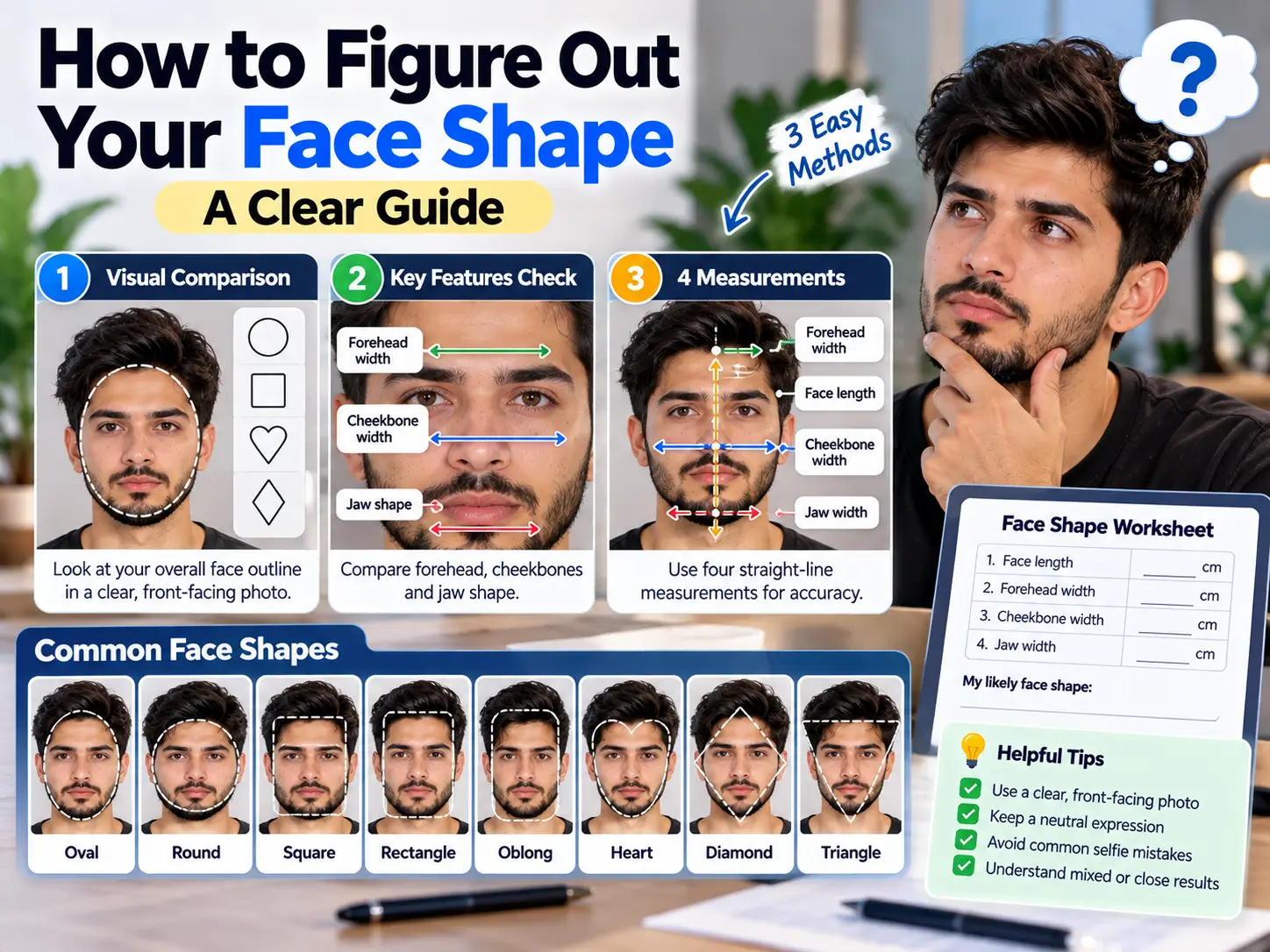
How to Figure Out Your Face Shape: Compare, Measure, Check
Choose a clear view first. Then use a visual comparison, a photo estimate or four consistent measurements to describe your outline without forcing an exact label.
Which method should you use?
To figure out your face shape, compare length, the forehead, cheekbones, jaw and overall outline together. A photo tool can estimate these features automatically. If two widths look close, a consistent measurement worksheet can help you compare them. Neither method proves an exact styling category.
| Method | Useful when | Watch for |
|---|---|---|
| Visual check | You want a quick starting description without measuring. | Hair, beard volume and subjective judgment. |
| Automatic photo estimate | You want the tool to locate facial points. | Photo angle, point placement and the tool’s own rules. |
| Consistent measurements | You want to compare widths or investigate a disagreement. | Mixed measurement methods and uncertain endpoints. |
For the first option, follow our no-measurement visual guide. For photo analysis, use the Face Shape Detector. Continue below if you want to understand and record the measurements.
Prepare one useful photo
Use a straight-on image with a level head, a relaxed expression and even light. Move hair away from the forehead and cheeks. Keep the jaw visible if possible. Avoid a very close selfie, a wide-angle effect or a beauty filter.
For this worksheet, measure straight lines on one flat photo or printed image. You can use a ruler on the print or a line-measurement tool that reports pixels. Keep the picture at the same size for all four measurements.
The units can be pixels, millimeters on a print or another consistent unit. These are picture measurements, not your real-world head size. Do not combine a pixel length, a tape measurement in inches and a screen width in centimeters. If you resize the photo halfway through, start the worksheet again.
Record four straight-line measurements
Illustration only. Real endpoints may be less clear. The jaw line goes straight across; it does not travel around the chin.
- Face length: mark the middle of the visible hairline and the bottom of the chin. Measure the straight distance between them. Do not include hair height.
- Forehead width: compare the widest visible forehead area from side to side, without including hair or ears. Record where you placed the endpoints so you can repeat them.
- Cheekbone width: measure between the outer visible cheekbone areas in the straight-on image. Avoid using the nose or the outside edges of hair as endpoints.
- Jaw width: mark the two visible jaw corners and measure straight across between them. Do not measure one side from ear to chin and double it; that is a different quantity.
If a hairline or jaw corner is hidden, write “uncertain” beside that measurement. Do not quietly replace the hairline with the top of the head. The result is only as useful as the points you can actually identify.
Use this simple worksheet
| Measurement | Your value | Example only |
|---|---|---|
| Face length | Write your value | 190 units |
| Forehead width | Write your value | 140 units |
| Cheekbone width | Write your value | 145 units |
| Straight jaw width | Write your value | 135 units |
| Jaw outline | Soft, angular or uncertain | Soft |
In this invented example, length divided by cheekbone width is 190 ÷ 145 = about 1.31. The cheeks are only slightly wider than the forehead. With a soft jaw, oval could be one profile to compare. The number 1.31 does not prove an oval face.
A small width difference may come from endpoint placement. Re-mark the points once. If forehead and cheekbone widths swap order, record them as close rather than building a firm label around a tiny gap.
Read the pattern, not one ratio
Use length to distinguish a compact outline from a longer one. Then check which area is widest and whether the jaw is curved or angular. A face length-to-width ratio alone cannot reliably separate every styling label.
- Compact plus a soft jaw suggests comparing round; compact plus clearer corners suggests square.
- A gently tapered, moderately long outline suggests comparing oval.
- A clearly long outline with relatively steady widths suggests oblong or rectangle, depending on the jaw outline.
- A forehead-wider outline narrowing toward the chin suggests heart.
- Cheekbones wider than both the forehead and lower face suggest diamond.
- A jaw-wider outline suggests triangle in our naming system.
Use the face shape chart to check the descriptions visually. These are practical patterns, not universal numeric thresholds. You can share features with more than one profile.
Using the calculator without mixing methods
The Face Shape Calculator offers a way to compare proportions. When entering your own values, follow the field definitions shown in the tool, use one unit throughout and use straight jaw width. Do not substitute a curved ear-to-chin tape measurement for corner-to-corner width.
Photo modes estimate landmarks; they do not directly measure a true hairline or a three-dimensional skull. A manually marked visible hairline and an automated forehead proxy may produce different lengths. That difference can change the closest profile even when the math is working.
Check the result’s explanation before accepting its name. A numerical output can still depend on uncertain points and custom classification rules.
If your results disagree
- Check the source image. Are both results based on a similar head angle, expression and camera distance?
- Check the endpoints. Did one method use a visible hairline and the other an estimated forehead point?
- Check the jaw measurement. Was it straight across in both methods, or wrapped around the chin in one?
- Check the naming. Some guides combine rectangle and oblong, or use triangle differently.
- Keep uncertainty visible. If the measurements are close, compare two profiles instead of repeatedly changing inputs until one answer appears.
You do not need all methods to agree before getting a haircut or trying frames. Describe the features that matter to you and combine them with comfort, hair texture, fit and personal taste.
Measurement questions
Do I need a flexible measuring tape?
Not for this worksheet. A straight-on photo with consistent straight-line measurements is easier to compare. A tape following the curve of your face measures a different path.
Can I use inches instead of centimeters?
Yes, if every dimension uses the same unit and method. The ratio is unchanged by converting all values consistently. Measurements on a photo do not give your actual head size.
What if my hairline is receding or covered?
Record that limitation rather than guessing an exact original hairline. Compare the visible outline and other features. An uncertain length should not decide the label on its own.
Is a measured result more accurate than every AI tool?
There is no universal winner. Manual measurements depend on endpoint placement; photo tools depend on the image, model and rules. Both can give useful comparisons, and both can be wrong.
Method and source notes
This worksheet is an original educational comparison method. It does not claim clinical validation. Google’s Face Landmarker documentation describes estimated facial landmarks; it does not validate our styling labels or establish a true-hairline measurement. The 2018 short-distance photography study supports caution about perspective, not a universal face-shape ratio.